

Previous milestones in this evolutionary journey: Krishi.System 0.0 - > Agribusiness Matters 5.0
******************************************
Dear Friends,
I am rebooting Krishi.System 1.0 to rejig my content game in the advent of AI. Wearing a reductionist’s hat, content game can be played in two ways. There is timely content that provides notes for the historians of the future and the changemakers of the present. And there is timeless content that can withstand the vicissitudes of time. My content, so far, has been content to lean tad too much on the former rather than the latter. I am doing the necessary course-correction to bring that balance.
If you’ve been paying attention, I start my subscriber-only posts as “State of Agritech - <Date>”. I think this model is now becoming obsolete.
I am doing two changes.
One, I am officially retiring the word “Agritech”. Today, it means everything and nothing. If you are the kind to pay attention to the devil’s detail, I opened my last post with the header, “Meditations on Food Systems”.
Two, and the most important one is this: I am including more timeless content, alongside timely ones. Of course, the very idea of content is transient. But we can aspire better to create things that can last the tides of time.
I am kickstarting this with my systems change strategy artefact on regenerative transition. It’s a distillation of a question I have circled in this newsletter for four years: What would it take to accelerate a regenerative transition across India's smallholding contexts? Can a farming household eat its own food, stay healthy, grow healthy food for the people it sells to, and live with abundance? It examines these questions through an eight steps framework for systems change.
I hope you enjoy this new version of Krishi.System 1.0. Feedback, suggestions and brickbats most welcome. This work has been a labour of love and you all make it worthwhile:)
I am also introducing few new perks. Annual subscribers get these timeless content artefacts for free; Patron members get access to my Global Agritech 101 course for free, besides all the artefacts that will be published and lots of good karma for supporting my food system ecosystem engineering endeavors.
P.S. Special Thanks to Vivek VS for spurring this shift in my content game.
Cheers
Venky

Meditations on Food Systems - 21st August 2026
In Today’s Edition:
1/ The Next Two Decades
As India celebrates 80th year of independence, two decades of work left to fulfill our collective promise for vibrant agrarian futures when India celebrates her 100th year of Independence.
2/ Systems Change Strategy for Regenerative Transition
What would it take to accelerate regenerative transition across India's smallholding contexts? Can a farming household eat their own food, stay healthy, grow healthy food for the community they serve and live a life of abundance?
If you don’t want Stripe’s notorious CC hassles, you are most welcome to sign up through Nas.io or paypal or UPI (venkat.raman.kr@icici) and pay the annual subscription (8500 INR/95 USD) with your email in the comment. I will enable access immediately across Nas.io (where Community engagements will kickoff) and you will get complimentary access to paid Substack content in one membership.
P.S. Supporting this work doesn’t have to come out of your pocket. If you read this as part of your professional development, you can use this email template to request reimbursement for your subscription.
Upcoming Krishi.System Events
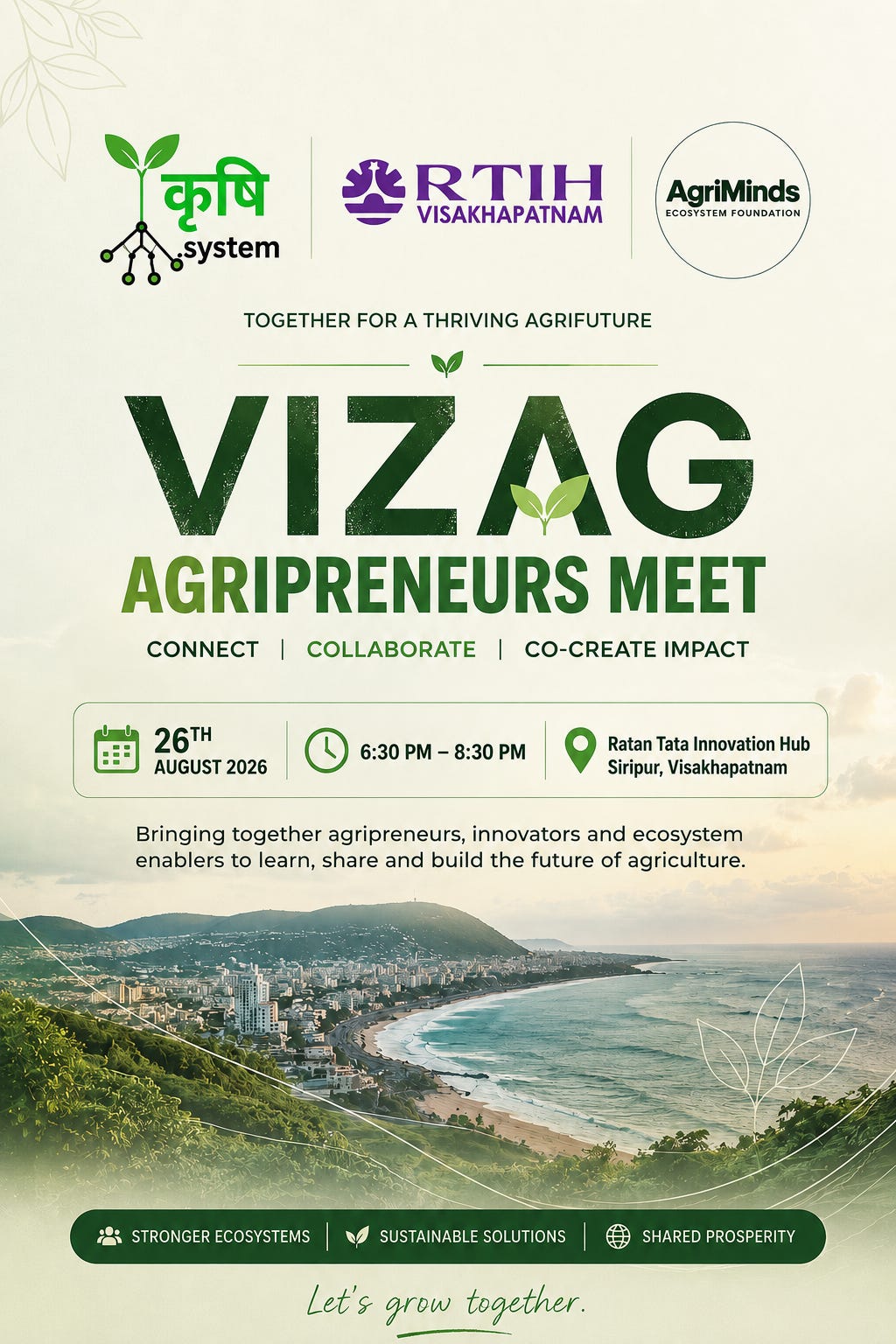
1/ Vizag Agripreneurs Meet - 26th August 2026 | Venue: Ratan Tata Innovation Hub | Time: 630 PM - 830 PM | RSVP here
I’m traveling to Vizag and would love to meet agripreneurs in town. Hosting Vizag Agripreneurs Meet in collaboration with Ratan Tata Innovation Hub (RTIH) AP and AgriMinds Ecosystem Foundation.
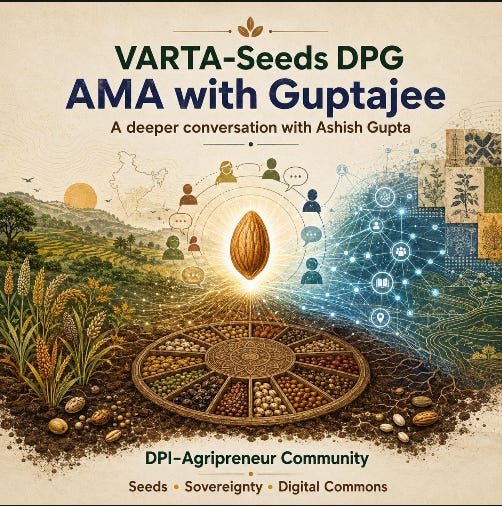
2/ Varta-Seeds DPG AMA with Guptajee - 21st August 2026 | Venue: Zoom | Time: 4 PM - 530 PM | RSVP here
I am hosting an AMA with Ashish Gupta—Guptajee—to take a closer look at VARTA-Seeds, a work-in-progress Digital Public Goods architecture being developed by Gram Disha Trust and Core Stack at IIT Delhi.
VARTA-Seeds seeks to place institutional seed-biodiversity knowledge directly in the hands of farmers. Using localized AI and vector search, it translates dense regulatory gazettes into accessible vernacular information mapped to specific agroclimatic zones. Designed as a participatory commons, its memory can evolve through field-level contributions and farmer logs—strengthening regional seed knowledge and sovereignty over time.
1/ The Next Two Decades
I don’t know about you. When you hit forties, the sense of death starts pervading your subconscious. You see grey hair. You see interesting shifts in your perspective. You learn to enjoy silence as an art of self-expression. You pass through questions that used to bother you with a smile. You see people around you die. You see old enchanted ideas becoming everyday things with a post-script that quietly murmurs, “Yeah. Alright”. You see your favorite singers die. You see your favourite aunts and comedians die. Slowly, you start preparing for that possibility that you too will pass on.
Kabir, in one of his memorable poems, likens death bed to a wedding ceremony where the groom Yamraj (God of death) awaits union with the bride, decked up with garlands and flowers, waiting for that precious moment to unfold and severe ties with the known.
And a few seconds before the take-off, according to Hindu tradition, you get to see the entire movie of your life in an instant. What would you *see* in that moment?
As I took a moment of breath to celebrate India’s eightieth Independence day few days ago, It struck me that I would turn sixty-two on 15th August 2047. That is, if I am still alive:)
It felt like a poignant occasion to ask myself: What would I do over the next two decades before I reach the age ripe for official bureaucratic retirement?
If you pay attention to India’s vibrant political climate, it may seem as if the entire country is gearing up for this one day: 15th August 2047. There are all kinds of plans being made. All kinds of aspiration are floating in the air. Children are asked to write painstakingly innocent essays about how vibrant would India be in 2047.
The plans are grandiose.
India would become $30 trillion economy. India would eradicate absolute poverty and achieve multi-dimensional zero poverty. India would provide high-quality, affordable education and universal healthcare access as basic rights. India would expand workforce capabilities with 100% skilled labor and raise female participation in economic activity to 70%.
To reach the $30 trillion GDP milestone and raise the per-capita income to approximately $18,000, India requires a consistent 8% real GDP growth per annum until 2047. Closer home, in the domain of agriculture, that would also mean, as per official documentation, India would achieve less than 5% post-harvest loss and greater than 75% farm mechanization by 2047.
Beneath these economic plans, there is a deeper spiritual reason behind the fervor: India would finally be able to stand with spine erect and wear the label “Developed Country” with pride.
During an interaction with a correspondent on 6.6.1947, Mahatma Gandhi wrote a powerful statement that still resonates with me.
“You are gravely mistaken in assuming that as soon swaraj [self-rule] comes, prosperity will flood the country. If, before assuming that, you had used your imagination a bit to see that after 150 years of slavery, we would need at least half that much time to cleanse our body politic of the virus that has infiltrated every cell and pore of our being during our subjection, you would not have found it necessary to ask me.”
Would India finally be free, in the truest spiritual sense of the word, on 15th August 2047?
I am not interested in doing intellectual masturbation examining whether these plans are feasible in the climate emergency futures we inevitably see today.
There is a grand aspiration in the air. And my question, as a concerned citizen of India who cares about her future, scratch that, our futures, would be: What would I contribute to this grand orchestra of hope?
Few days ago, in a conversation with V.S.Vivek , we discussed two goals that are worthwhile to achieve vibrant agrarian futures and got into a friendly debate
Goal 1: Four Unlocks to Achieve India’s Vibrant Agrarian Futures
Unlocking Land as a resource - What would it take to unlock land as a resource and give the agency to the farmers to decide what to grow and exit agriculture if god forbid they want to?
Unlock Soil as an Asset - What would it take to treat soil as an asset instead of treating it callously as an income?
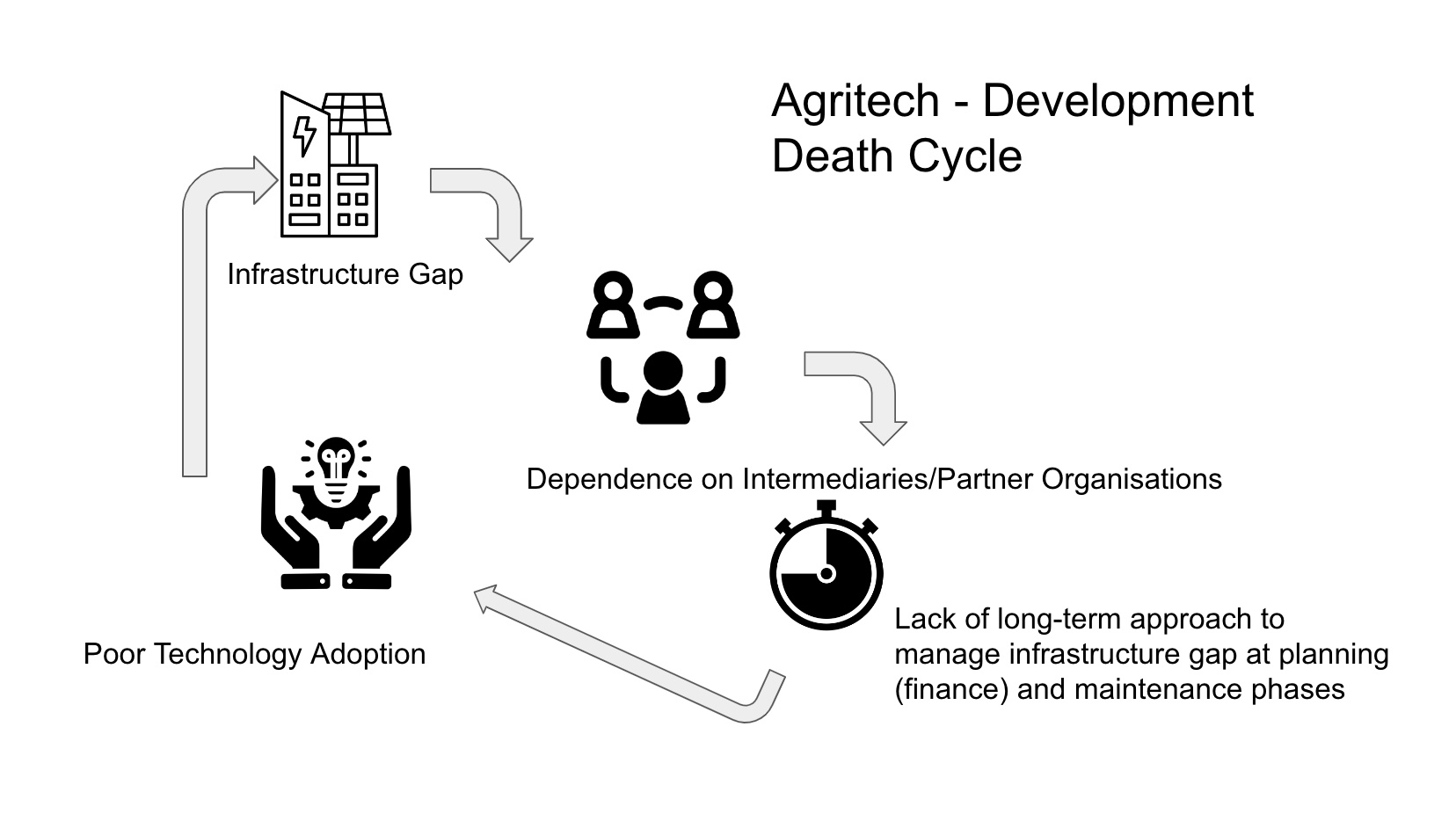
Unlock Infrastructure as an Asset - What would it take to build better infrastructure that can deal with the adverse effects of agritech - development death cycle?
Unlock Technology as an Asset - Can we unlock technology’s licensing potential which has been hugely under-indexed in Indian Agriculture?
Goal 2: What would it take to accelerate regenerative transition in Indian Agriculture from 5-6% to 25%
In India, out of 93 Million farmers (based on 2019-20 census), we have around 5-6% of Indian farmers who practice regenerative farming. Of course, I take every public number in India with a heavy dose of salt, at the risk of straining my cardiovascular system.
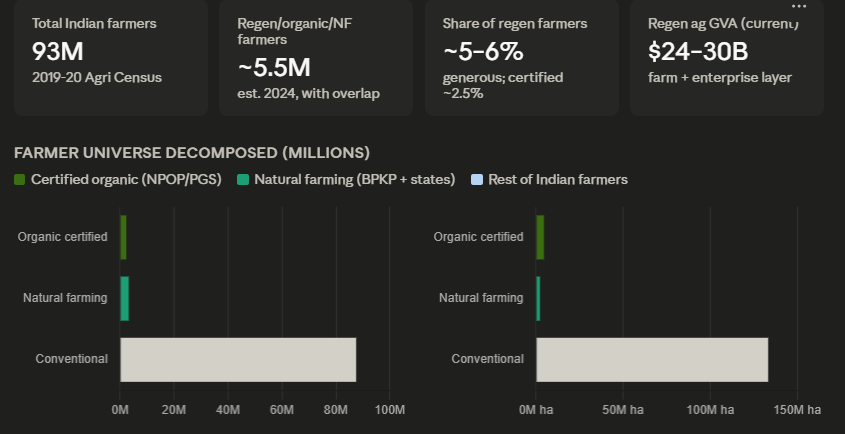
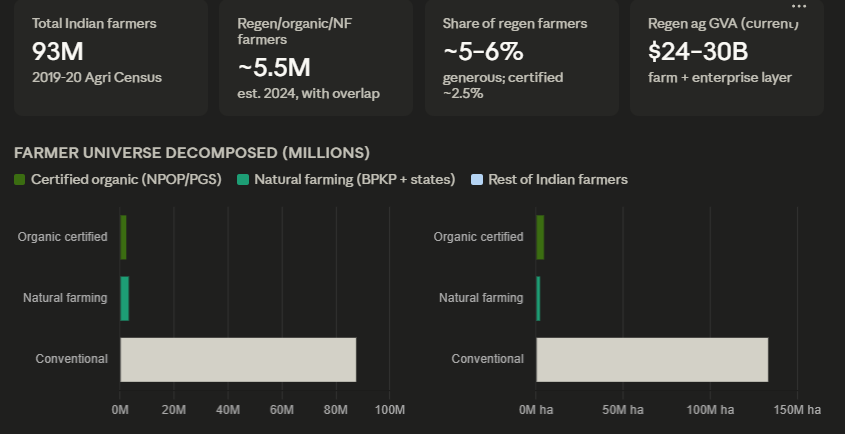
How did I arrive at 5-6% estimate?
India has 2.3 million certified organic farmers — the largest such count globally — with around 4.5 million hectares under organic certification as of 2023–24, representing 2.5% of total agricultural land.
As of 2024, approximately 3.4 million farmers are engaged in natural farming across India — covering 2.2 million hectares — through the Bharatiya Prakritik Krishi Paddhati (BPKP), Namami Gange, and state-level programs.
APCNF alone has grown 25 times since 2016, reaching over a million smallholder farmers across 500,000 hectares in Andhra Pradesh, and is recognised as the world’s largest agroecology program.
There is significant overlap between the organic-certified and natural farming populations. Netting out duplicates, the conservative unique estimate of farmers practicing some form of regenerative, organic, or natural farming is 4.5–5.5 million, or roughly 5–6% of all Indian farmers. The certified-only share — those who can command a market premium — is closer to 2.5–3%.
As you can see, my definition of regenerative farming covers the entire spectrum with usage of bio-inputs to minimize pesticide usage on one end to minimizing external inputs on the other end with a healthy soil microbiome. And so this number could very well be conservative or grossly overestimated, depending on your political stance
With my work transitioning from a strict agritech/agribusiness lens to Food and Agriculture System lens, I am watching life lovingly providing me with wings to go beyond my comfort zone and help me address Goal 2 - regenerative transition challenge - head on.
I seem to have a bias towards Goal 2 although I am increasingly seeing Goal 1 to be equally important, especially around the question of unlocking Land as a resource.
Perhaps, the answer lies in holding both Goals loosely enough so that I am able to address the inherent tension that lies underneath them.
One thing is clear. The harder the systems change problem I chase, the lighter I must feel from inside while tackling them. If that’s not happening in my inner climate, surely, I must be doing something wrong.
Let’s see:)
2/ Systems Change Strategy for Regenerative Transition
I prepared this strategy artefact as a part of my Mastery in Systems Leadership fellowship. This began as a question I have circled in this newsletter for four years. What would it take to accelerate regenerative transition across India’s smallholding contexts? Can a farming household eat their own food, stay healthy, grow healthy food for the community they serve and live a life of abundance?
Answering this wicked, tangled question urged me to build a way of seeing before I could find my way through any answer.
Where does the system begin and end? Who are its actors, and where has trust broken between them? Where is the energy, and where is the resistance? Which feedback loops keep the old pattern in place, and which small opening could compound into a new one? The eight steps of system change are the scaffolding I used to hold all of this in one frame.
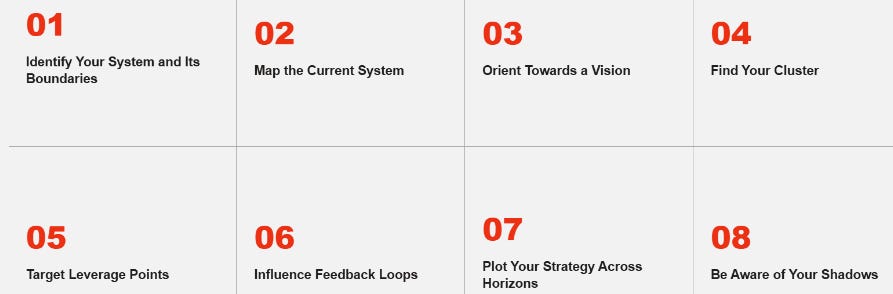
This deck would be only available for annual and founding members. It has already been shared with few friends whom I know are serious about regenerative transition.
If you are also seriously working on these goals, I am happy to speak with you.
Treating agriculture as a business and treating it as sacred have both ended with farmers capturing less of the value they create.
What would it take to move past this and accelerate a regenerative transition across India's smallholding contexts without romanticizing the small or worshipping scale?
So, what do you think?
How happy are you with today’s edition? I would love to get your candid feedback. Your feedback will be anonymous. Two questions. 1 Minute. Thanks.🙏
💗 If you like “Krishi.System”, please click on Like at the bottom and share it with your friend