

Meditations on Food Systems - 14th August 2026
1/ How to deal with India’s Ethanol predicament?
There are problems to be solved and predicaments to respond to. There was a time when Ethanol was a problem to be solved in India. Today, it is a predicament to respond to.
2/ When Algorithms Take Over Village Planning
Ram wrote a fascinating essay about algorithms taking over village planning in India’s new draft rural employment law. If you open the hood and pay attention to the devil’s detail, you discover that the problem is much more than what it seems.
3/ Reflections from Kashmir Agripreneurs Meet
If you don’t want Stripe’s notorious CC hassles, you are most welcome to sign up through Nas.io or paypal or UPI (venkat.raman.kr@icici) and pay the annual subscription (8500 INR/95 USD) with your email in the comment. I will enable access immediately across Nas.io (where Community engagements will kickoff) and you will get complimentary access to paid Substack content in one membership.
P.S. Supporting this work doesn’t have to come out of your pocket. If you read this as part of your professional development, you can use this email template to request reimbursement for your subscription.

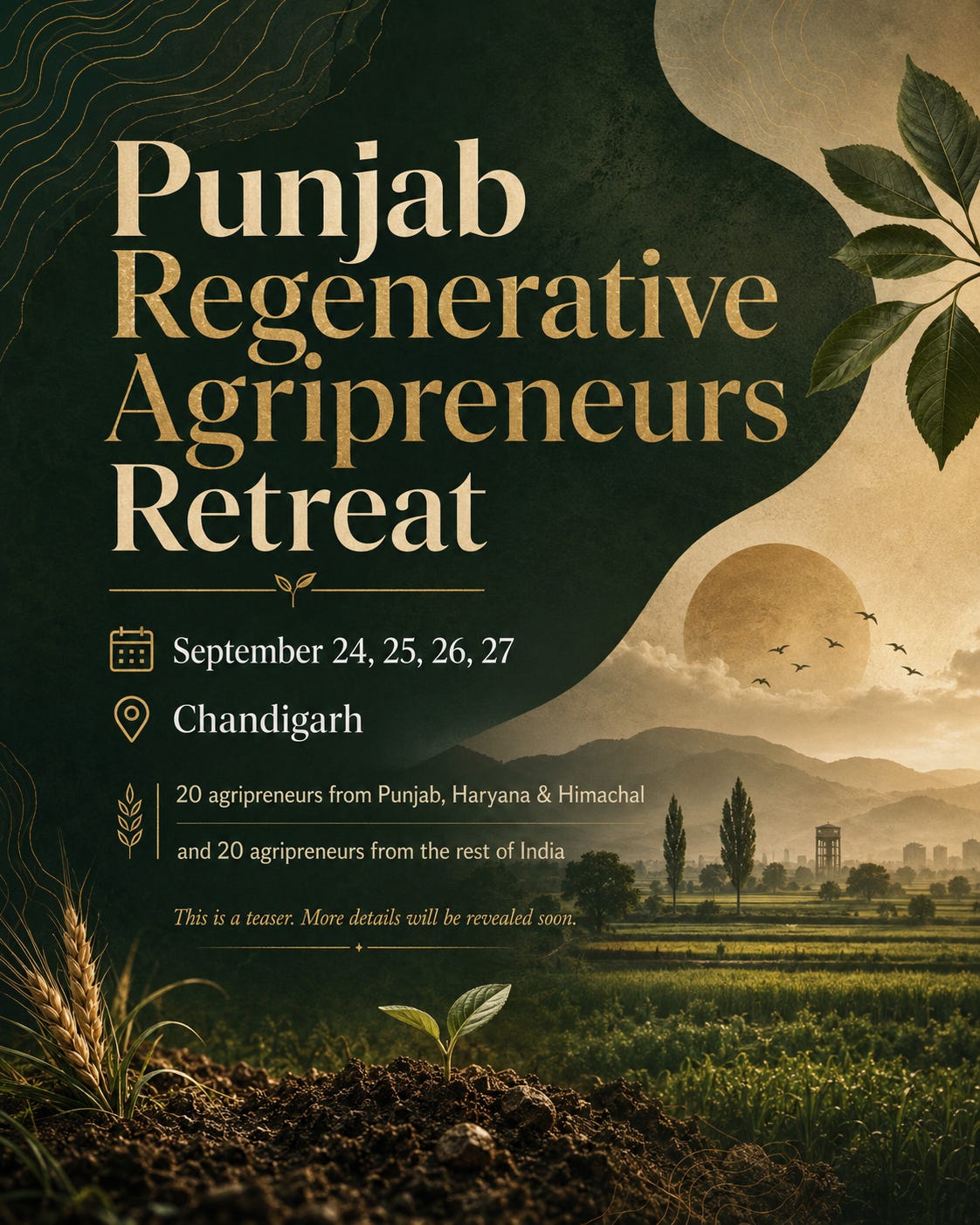
Upcoming Krishi.System Events
1/ How to deal with India’s Ethanol predicament?
Many moons ago, a wise man taught me the difference between a problem and a predicament. As John Michael Greer wrote,
“The difference is that a problem calls for a solution; the only question is whether one can be found and made to work, and once this is done, the problem is solved. A predicament, by contrast, has no solution. Faced with a predicament, people come up with responses. Those responses may succeed, they may fail, or they may fall somewhere in between, but none of them “solves” the predicament, in the sense that none of them makes it go away.”
There are problems to be solved and predicaments to respond to. There was a time when Ethanol was a problem to be solved in India. Today, it is a predicament to respond to.
Why does this distinction matter?
When you look at Ethanol as a problem, you start to zoom in excessively on Ethanol and its attendant problems while forgetting solar.
When you look at Ethanol as a predicament, you ask an important question: Is India using its farmland for the right kind of energy in the first place?
Hannah Ritchie’s thought experiment is deeply helpful.
Take the land the world currently uses -about 32 million hectares net- to grow biofuel crops. Cover the same land with solar panels instead. You would produce around 22 times more energy. Crops convert less than 1% of incoming sunlight into usable biomass. Solar panels convert around 20%.
This efficiency further multiplies when you add electric motors to the mix as they are twice or thrice efficient as compared to combustion engines.
India crossed 162 gigawatts of installed solar by June 2026, up 57-fold in a decade, the third-largest solar fleet in the world. A megawatt of solar needs about four to five acres. On the other side, India blends 20% ethanol, produces 661 crore litres of it, and still makes almost all of it from first-generation food crops.
Holding E20 to 2030 on today's crops would need 7 to 9 million hectares, the entire cropped area of Andhra Pradesh, by Arcus Policy Research's reckoning.
The predicament we face on the ground is this: The same government racing to 20% ethanol on food crops is also running the world's third-largest solar build-out. The government's own 2025-26 Economic Survey admits the bind, warning of "an emerging tension between Aatmanirbharta [self-sufficiency] in energy and Aatmanirbharta [self-sufficiency] in food."
The government has no incentive to get itself out of this bind.
41 of India's 75 ethanol companies, a full 57.7%, are owned by politicians across every party. 1
The farmer has a new income line. The politician has a new product line. The state has saved ₹1.9 lakh crore in foreign exchange and displaced 30 million tonnes of crude imports. Who would want to rock this boat?
India hit 20% blending five years early precisely because nobody with power wanted it stopped.
Of course, facing record sugar prices and a drought-hit cane crop in Maharashtra and Karnataka, the government has begun weighing a cut to the sugarcane going into ethanol. Mills would be told to stop making ethanol from cane juice and B-heavy molasses, and to lean on C-heavy molasses instead, the residue left after most of the sugar is pulled out.
What moved the government was the sugar price, not water data or the vanishing pulses or the food-security warning in its own Economic Survey.
Producing one litre of ethanol takes about 3,837 litres of water from sugarcane, 3,764 from maize, and a staggering 9,854 from rice. [Data Source: Down To Earth investigation drawing on Arcus Policy Research]
The state acts on ethanol only when ethanol threatens sugar. The sugar lobby is already pushing for E27, and 100% ethanol is now a legally recognised transport fuel.
If we are serious about resolving this bind, there is only way to work with the powers that be.
Treat ethanol as a bridge fuel to an electrified future and price it like one. Cap its claim on food crops, push it patiently toward crop residues and degraded-land feedstocks, and stop pretending a higher blend number is the goal.2
I’m not being cynical here.
Second-generation ethanol, made from crop residue and biomass rather than food crops, is the technically clean answer. India has chased it since 2019 through the PM JI-VAN scheme. The results are sobering. The flagship Panipat plant runs at only 62% of capacity, defeated by the shifting moisture and silica in the straw it feeds on. Two years into commercial production, it still has not passed its contracted performance-guarantee test. IOCL has withheld half the licence fee owed to its technology provider. The build cost has crept to ₹984 crore against an approved ₹909 crore.
Second-generation ethanol costs about ₹120 a litre to make, against ₹72 for the maize-based kind, and there is still no standardised process for it. The International Energy Agency reports the same fragility worldwide.
The bottom line is an uncomfortable truth: India is attempting to imitate Brazil prematurely. India must first build the feedstock supply chain first, the aggregation, the storage and the farmer-aggregator contracts. And then build the plant.
When the same acre that yields a litre of ethanol can yield twenty times the energy as electricity, and can do it without the farmer giving up her food crop, why should the farmer choose biofuel over solar?
Why should the farmer have to choose between growing food, growing fuel, and harvesting sunlight, when on the same land, she can do all three?
Why not organise farmers into a community-owned solar utility, on the model of a milk cooperative, let them hold equity in a special-purpose vehicle, and the farmer stops being a tenant on her own land and becomes a co-owner of the power plant?
What is the moral of the story? There are plenty of possibilities for systems change even if the macro picture looks bleak:)
2/ When Algorithms Take Over Village Planning
I began to pay deeper attention to India’s new rural employment law after reading Ram’s fascinating essay about algorithms taking over village planning in India’s new draft rural employment law.
“The real constitutional test of India’s digital governance revolution is therefore not whether artificial intelligence can plan villages more efficiently than villagers themselves. It is whether the Indian State still believes that democracy begins with citizens—or whether it now begins with datasets.”
The plan cannot be faulted for its ambition:
“The planning framework marks a paradigm shift from traditional demand-based or “wish-list” approaches towards a scientific, geospatially enabled, and resource-optimised model of rural development”
But how does this framework work in the first place?
The document that will decide what two and a half lakh Indian villages build over the next two decades was published in June 2026 by the Ministry of Rural Development and the German development agency GIZ, under a project called “Support to India's Water Vision 2047”. It carries seven named authors and one reviewing IAS officer. It is called the Draft Framework for the Viksit Gram Panchayat Plan.
Somewhere inside the document is a fascinating table. It counts the works a Gram Panchayat is permitted to propose.
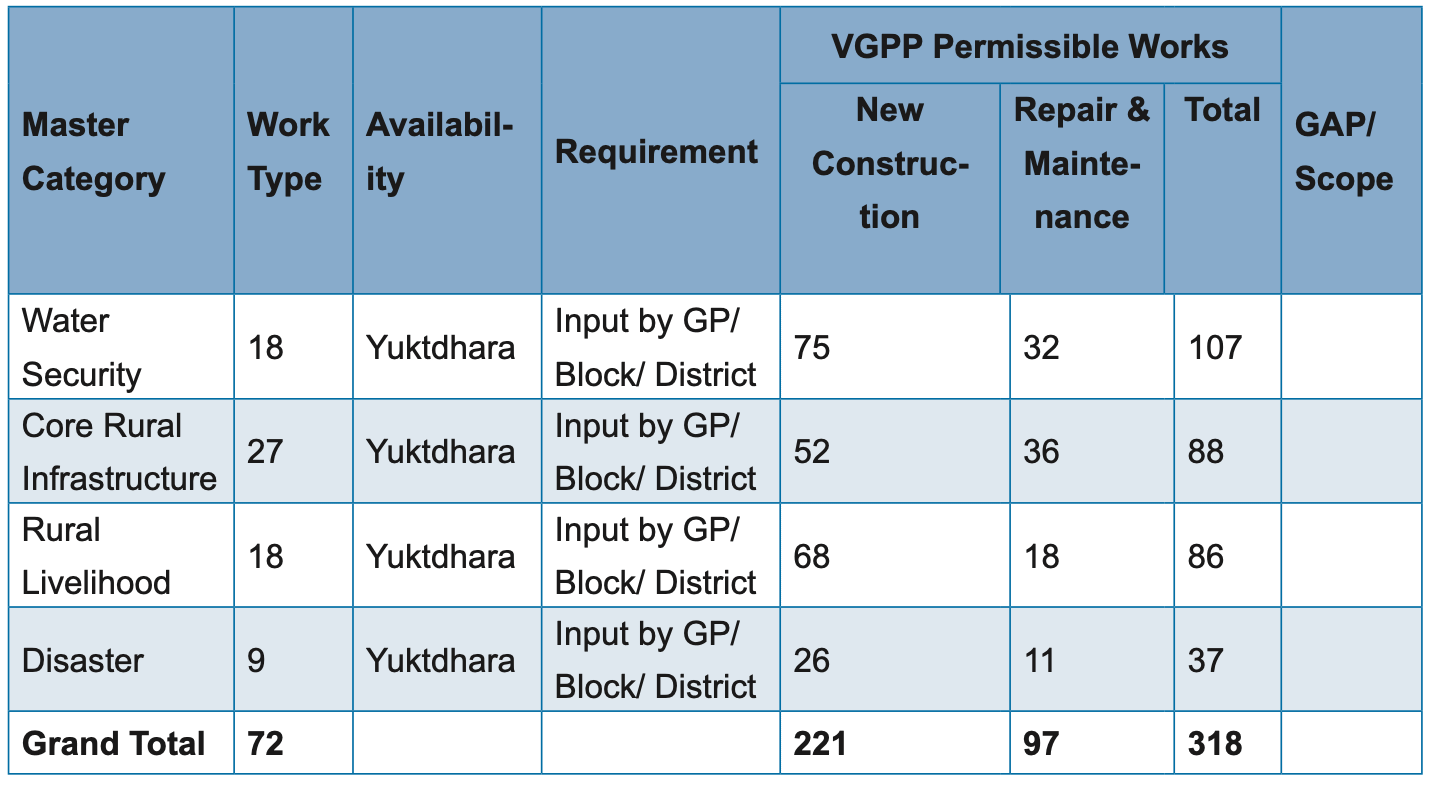
Seventy-two work types. Three hundred and eighteen permissible works. Two hundred and twenty-one of them new construction, ninety-seven of them repair and maintenance. Water security gets 107 options. Core rural infrastructure gets 88. Rural livelihood gets 86. Disaster mitigation gets 37.
The most fascinating statement in the document comes in the section 2.3
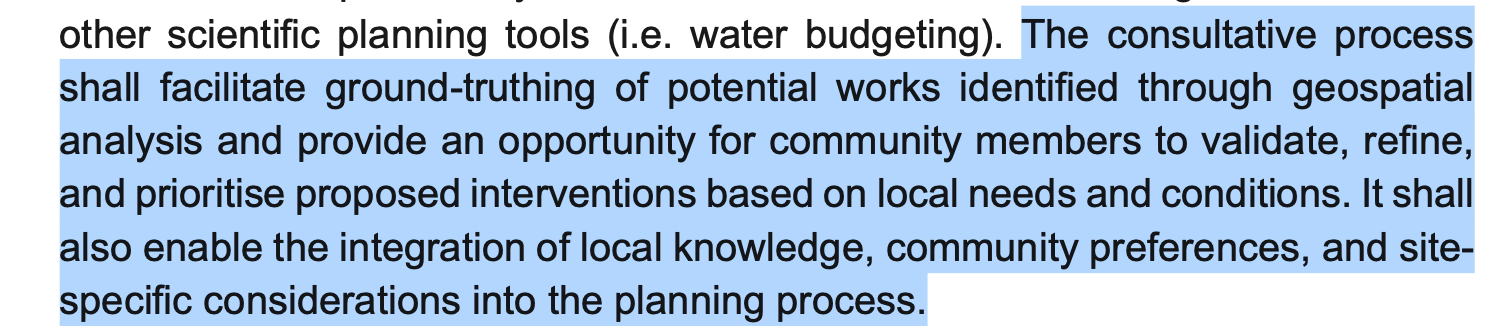
Did you pay attention to the fine print? The algorithm has become the first planner and the Gram Sabha has become the reviewer.
Here is how it works.
The Yuktidhara portal ingests layers from PM Gati Shakti, India-WRIS and Bhuvan. It runs a gap assessment. It produces a shortlist of works with proposed coordinates, site boundaries and dimensions. The planning team walks into the hamlet consultation carrying findings and the Gram Sabha assembles to “ground truth” and “validate, refine and prioritise interventions based on local needs and conditions”.
Are you kidding me?
Anyone who has visited India’s villages knows what a joke this could turn out into the ground.
Now, let’s rewind and examine MGNREGA’s planning in the first place.
The most recent all-India performance audit the CAG ever conducted on MGNREGA covered April 2007 to April 2013. It sampled 3,848 Gram Panchayats across 182 districts, 458 blocks, 28 states and 4 Union Territories. There has not been another one since.
Yes, you read it right. We have only decade-old data.
In 1201 sampled Gram Panchayats across eleven states, roughly thirty-one percent, the annual plan was either never prepared or prepared incompletely. In three states, including Andhra Pradesh, not one sampled Gram Panchayat had made a plan at all.
District labour budgets were missing in 49 districts, a quarter of those sampled. And where plans did exist, they were often hollow. In 58 districts the projected employment generation was simply left out. Many carried no shelf of works and no list of assets to be built at all. The gap between when a Gram Panchayat plan was due at the block and when it actually arrived ran from one month to twenty-one months.
What about plans that were made?
Across fourteen states and one Union Territory, 129.22 lakh works worth Rs 1,26,961 crore were approved in annual plans. Only 38.65 lakh of them, thirty percent, were actually completed in the audit period. Meanwhile, in 25 districts across nine states, nearly five thousand works were executed outside the annual plan altogether. The plan predicted one set of works, seventy percent of it never got built, and a parallel set of works appeared that no plan had authorised.
Who is in charge and where does the buck stop?
The Gram Rozgar Sevak (GRS) is the village-level functionary meant to run registration, job cards, work allocation, wage payment and social audit. The audit found vacancy rates in these posts running from twenty percent in Uttar Pradesh to ninety-three percent in Punjab. In four states, including Tamil Nadu and Kerala, no dedicated GRS had been appointed at all. In Uttar Pradesh, seventy-four percent of the money set aside to train these staff went unspent.
The deliberation that was supposed to legitimise the plan was often not happening either.Attendance studies of Gram Sabhas routinely report participation in the low double digits.
And so the honest question we need to ask is: If Gram Sabha is largely a signature on the page, can it be disrupted by an algorithm3?
A 2024 ethnographic study of MGNREGA planning captured a functionary in Jharkhand explaining, with some relief, that GIS would put an end to the whole business of gram sabhas passing schemes.
Where is GIS better suited than Gram Sabhas in passing schemes? How about groundwater?
The framework mandates minimum water expenditure floors keyed to groundwater status: sixty-five percent of spend in over-exploited and critical blocks, forty percent in semi-critical, thirty percent in safe blocks.
A farmer knows his or her borewell is failing. Can he know that the aquifer he is drawing from crosses three panchayats? Hydrology is genuinely supra-local, and local knowledge is often blind to it.
How about maintenance?
Ninety-seven of the 318 permissible works are repair and maintenance. Under MGNREGA, a silting check dam belonged to nobody. New works generated persondays, photographs and political credit. Repair generated none of those things. Making maintenance a first-class category with its own line items in the catalogue is a genuine correction to a real perverse incentive.
How about duplication?
GeoMGNREGA has geotagged more than three crore assets since the exercise began in 2016. Yuktdhara has existed as a planning portal since August 2021. If the portal can tell a panchayat that a percolation tank already exists four hundred metres from where it is about to build another one, wouldn’t that help planning of public goods better?
Can GIS act as a guard rail against elite capture? Perhaps, if it can provide its recommendation backed by data.
But how far is the data reliable?
Annexure 1 of the draft framework lists every layer the Yuktdhara portal will use for its scientific gap assessment. The satellite imagery is recent. High resolution one-metre data from 2022 to 2024. LISS-IV from 2025.
The interpretation layers are unfortunately dated. The coarse 1:50,000 Land Use Land Cover layer is dated 2015-16. Land Degradation is dated 2015-16. Geomorphology is dated 2005-06. Wetlands, pre and post monsoon, are dated 2005. And Waste Land is dated 2008-09.
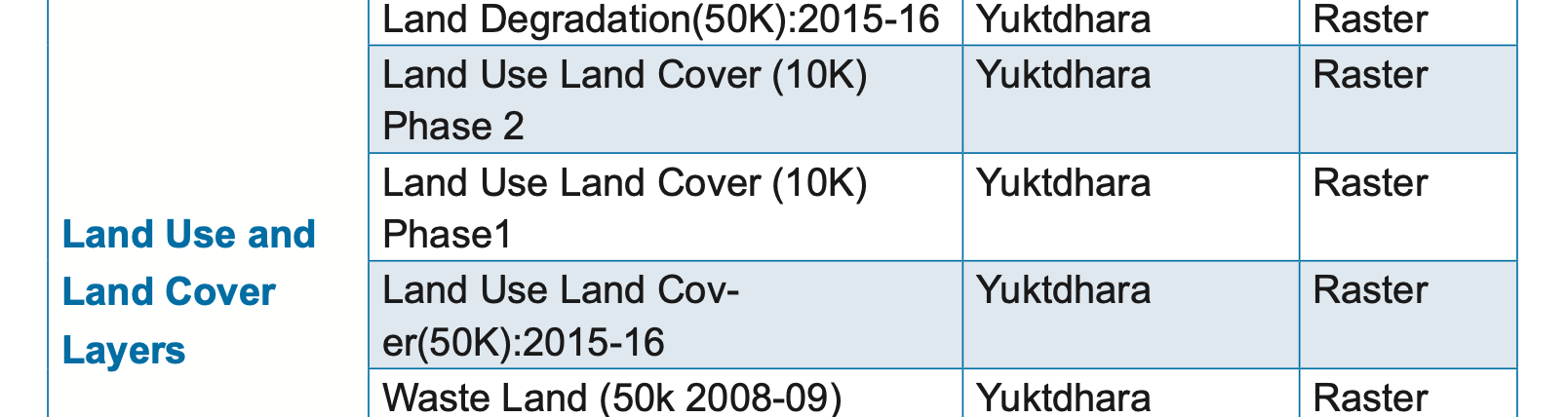

What happens when the portal will tell a Gram Panchayat in 2026 that it has degraded wasteland available for plantation, on the authority of a raster generated in 2008-09?
Wasteland is the most politically loaded category in Indian land classification. It is the colonial inheritance that turned commons into surplus. Grazing land is wasteland. Fallow is wasteland.Every historical enclosure of the Indian commons has begun with a map that could not see who was using the land.
A 2024 ICTD field study of digital planning tools for rural water security found Bhuvan's thematic layers to be spatially coarse and not temporally updated, and found that government staff were not trained to use them. Only civil society field staff attempted to use the layers and they routinely had to source higher resolution data elsewhere.
So who is exactly going to run the gap assessment, compose the maps, analyse pour points and micro-basins, and then present findings to the hamlet? We have no clue.
Here is the irony. In the older MGNREGA world, bad plans were inert while the village works were done by the sensible judgement in the ground.
In the newer VB-G-RAMG world, bad plans have no escape valve. All works must be drawn exclusively from approved Village Gram Panchayat Plans. Top-down authoritarian plans’ failure patterns have been documented adequately
Look at a complex and confusing reality with intricate social dynamics.
Fail to understand all the subtleties of how this complex reality works.
Attribute that failure to the irrationality of what you are looking at, rather than your own limitations.
Come up with an idealized blank-slate vision of what that reality ought to look like.
Argue that the relative simplicity and platonic orderliness of the vision represent rationality.
Use authoritarian power to impose that vision, by demolishing the old reality if necessary.
Watch your rational Utopia fail horribly
Given that this framework still calls itself “draft”, I’m hoping it would be revised more sensibly so that technology complements democratic judgement rather than substitute it.
3/ Reflections from Kashmir Agripreneurs Meet
When I first entered Srinagar airport to pick up my luggage, I heard the birds chirping inside. My head wandered. I could only see the airport's scaffolding.
Kashmir Agripreneurs Meet manifested out of a simple conviction: Its time to build bridges and connect Kashmir's wonderful agripreneurs with the rest of India's agripreneur community.
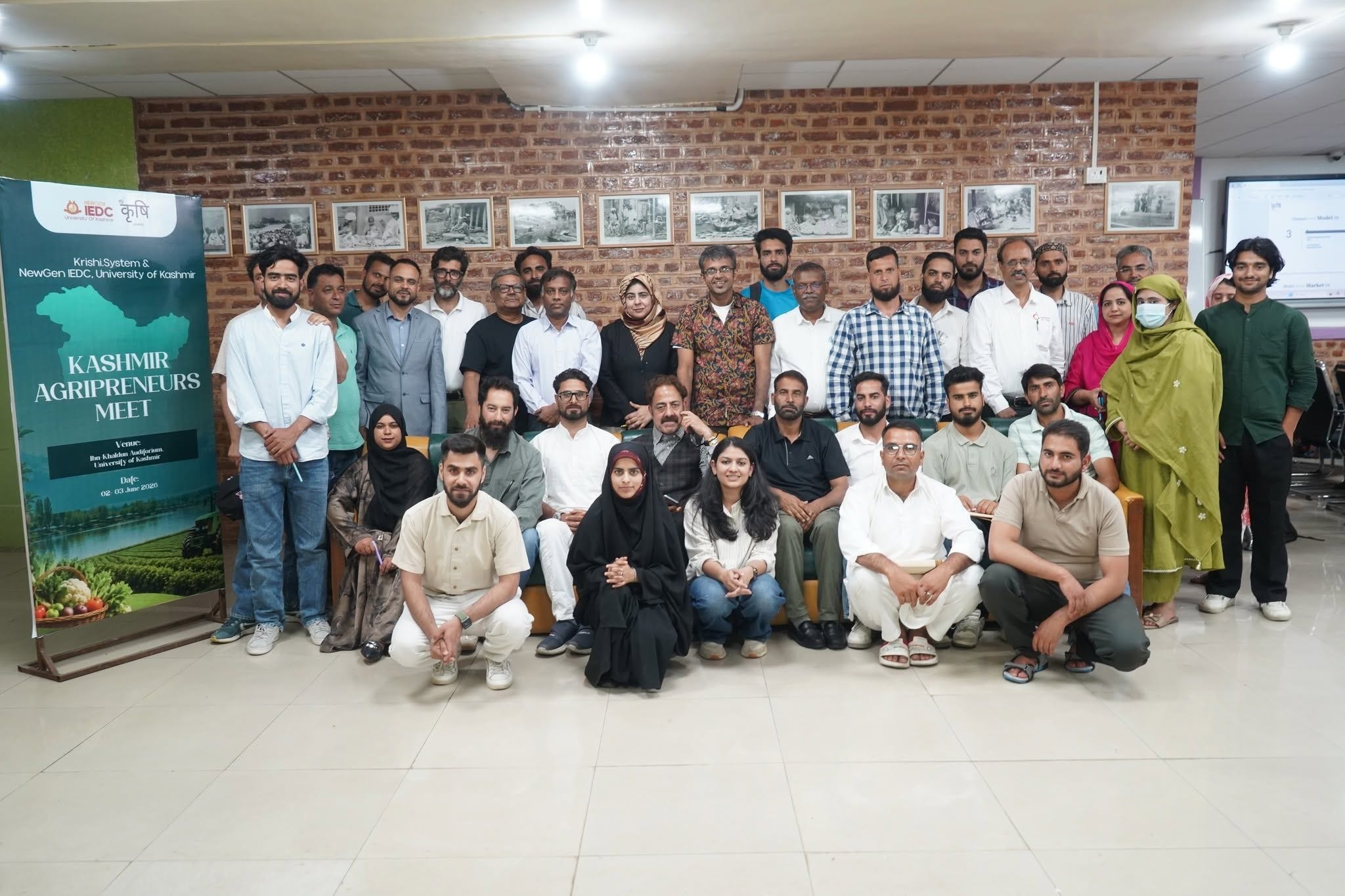
It started off with a random LinkedIn message to Dr. Irfana Rashid. We started talking and we had around 30 agripreneurs, including farmers and my old friend KHAN MUKHTAR joining us. Agripreneur friends Manohar Sambandam Partha Chakraborty Jagadeesh Sunkad Ashok Banerjee from various parts of the country, Saumya Sen and friends from CEEW joined us.
Word started to spread about the event and Shamsuddin Saab from Kashmir Agriculture department joined us to share fascinating insights, including how Himachal Pradesh learned its market-linkage lessons from J&K and took a great leap forward.
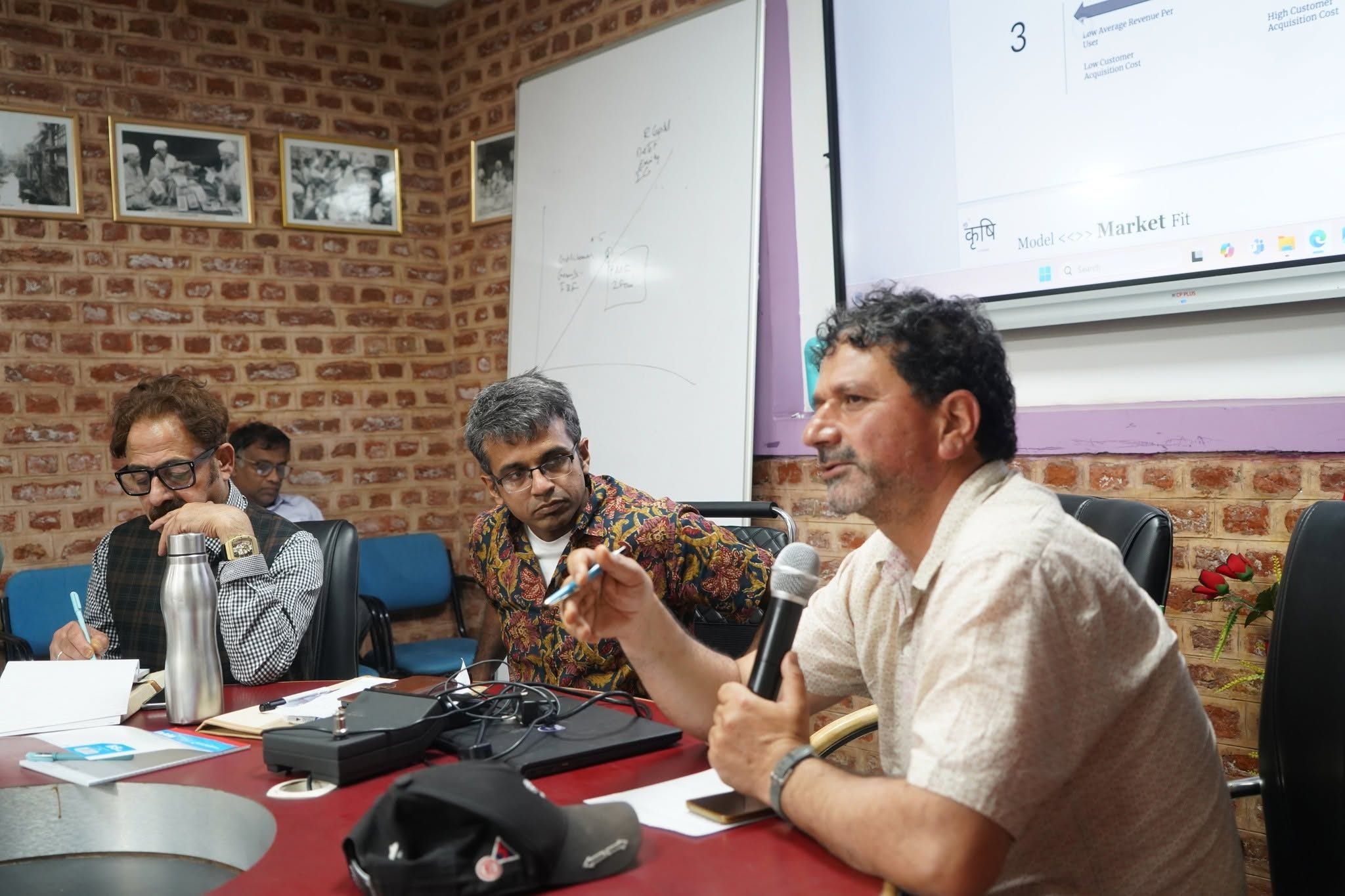
Kashmir has incredible potential. It produces incredible agricultural products.
The ecosystem needs to be strengthened. We need allied ecosystem support that can make agripreneurs successful. There is a huge gap.
Kashmir grows the best walnut in India. It sells for half the price of a chilean one. Kashmir's apple economy runs on a single highway, NH44, often called the valley's Achilles heel. In 2025, landslides on the Ramban-Banihal stretch stranded around 22,000 tonnes of apples, about 2,200 truckloads, for nearly two weeks, right at peak harvest.
Kashmiri saffron carries a crocin content around 8.72 percent, higher than the Iranian standard, which is what gives it deeper colour and aroma. It earned a GI tag in 2020. And it still cannot command its price, because on a shelf a buyer cannot tell genuine Kashmiri saffron from threads blended with cheaper Iranian stock.
As a followup to the Kashmir Agripreneurs Meetup, we are working on an agripreneur incubator cohort specifically for regenerative value chains for Kashmir. I’m planning the next Regenerative Agripreneurs Retreat in Kashmir in April 2027.
It has been seven years since Article 370 was abrogated. The important work remains: How do we build better bridges that can unlock more opportunities and prosperity for the farmers of the state? How do we unlock regenerative transition in Kashmir?
And when this model is clearer, I want to go to Arunachal Pradesh and other places where we need to build more bridges. Let's see:)
Programming Note: I’ve kept footnotes under the paywall, as they have juicy tidbits that are better served by those who enjoy this kind of nerding out and are willing to pay for it:)
So, what do you think?
How happy are you with today’s edition? I would love to get your candid feedback. Your feedback will be anonymous. Two questions. 1 Minute. Thanks.🙏
💗 If you like “Krishi.System”, please click on Like at the bottom and share it with your friend
