
Can APCNF be scaled across India?


State of Agritech - 6th March 2026
In Today’s Edition:
1/ Can Andhra Pradesh Community Managed Natural Farming (APCNF) be scaled across India?
Indian agriculture plays a strange Jekyll and Hyde act.
During the day, the government foots the ventilator bill of the conventional chemical farming system. Every year, ₹1,75,099 crore — roughly $21 billion flows in as synthetic fertilizer subsidies, keeping the dying system alive. Urea reaches farmers at a fraction of its production cost. The drip has been running for decades despite depleting the soil, guzzling water and trapping farmers in feudal chokepoints. It is a political hot potato no politican worth her spine will dare to touch.
At night, the same government funds a programme to replace chemical farming entirely. One million farmers in Andhra Pradesh are now practising chemical-free natural farming.
Can this model scale across India? What would a strong investment case that could back this scaling effort after considering every possible objection look like? Settle down with green tea, if you will. We will address all of this and attempt to look at the elephant that eludes us all.
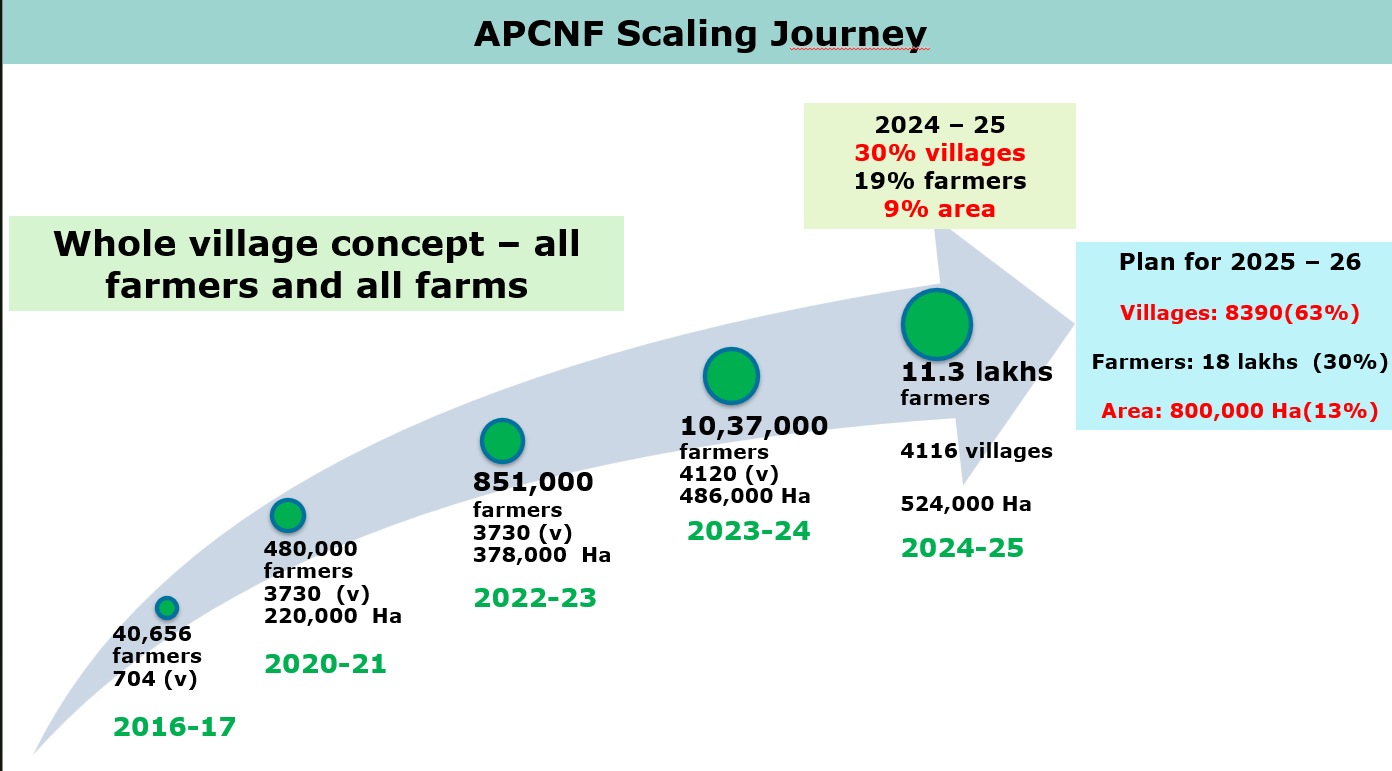
Before we navigate the choppy waters of complexity involved in scaling this effort, let me breathe and meditate on this important chart.
The village count was identical in 2020-21 and 2022-23 — 3,730 villages both years — but farmers grew from 480,000 to 851,000 in that period. It suggests that the program perhaps deepened within existing villages before expanding to new ones. Village saturation before expansion is a healthy signal of genuine community diffusion.
The farmer-to-area ratio is also striking. 1.13 million farmers on 524,000 Ha = 0.46 Ha per farmer on average. AP's average farm size is about 1.06 Ha. APCNF is overwhelmingly concentrated in the smallest landholding category — marginal farmers below 0.5 Ha. The 2025-26 plan is a near-doubling of village coverage — from 4,116 to 8,390.
The national programme to replicate this — the National Mission on Natural Farming, launched in November 2024 — targets 40 lakh farmers across 28 Indian districts by 2030.
The 2025-26 budget gave it ₹616 crore. The fertilizer subsidy got ₹1,75,099 crore.
Can you see this fascinating contradiction?

That’s the crux of the problem we are dealing with. This ratio -0.35% - is, perhaps, the most expensive act of policy incoherence in Indian agricultural history. If we are serious about correcting this, it is important to delve deep into the contradiction and find a way out.
Where Scaling Might Fail
The standard argument against natural farming — repeated by agricultural economists, policymakers, and input industry lobbyists — goes like this. The transition to organic or natural farming causes a yield penalty in the first several years, during which farmers lose income. Smallholders with no savings buffer cannot absorb that loss. Therefore, natural farming is a luxury for rich-country hobbyists and cannot feed a country of 1.4 billion.
This argument has driven agricultural policy for forty years. It is the justification for ₹1,75,099 crore in annual fertilizer subsidies. It is the reason every natural farming program in India has been treated as a niche welfare intervention rather than a mainstream agricultural strategy.
Let’s now walk further with the devil’s advocate in context with the data showcased by APCNF.
The Andhra Pradesh programme’s income improvement data — farmers earning 57% more than their chemical-farming neighbours by year four — comes primarily from assessments commissioned by the implementing agency, RySS. The most rigorous independent study, from the University of Reading, partially validated these findings but found yield improvements in only three of five AP districts studied. Context-specific variation, the researchers noted. Not a blanket success.
There is also a labour cost problem that the headline numbers hide. Natural farming increases labour hours — bio-stimulant preparation, intensive crop management, diversified planting systems. The income improvement figures measure the return on cash expenditure, not total economic cost. For households with competing off-farm income options, the net gain is smaller than the 57% figure suggests.
Then there is the equity gap. A 2024 peer-reviewed paper from Coventry University and the Food Sovereignty Alliance India documented that APCNF’s use of women’s self-help group credit infrastructure primarily benefits land-owning farmers.
Agricultural labourers — more than half of India’s agricultural workforce — are structurally excluded from a programme that is being celebrated as transformational for India’s rural poor.
Let’s be clear. NMNF is not APCNF.
The national programme uses a lighter delivery model — routed through Krishi Vigyan Kendras and Bio-Input Resource Centres rather than the intensive SHG-embedded Community Resource Person network that APCNF spent a decade building in Andhra Pradesh. AP’s results required a pre-existing dense women’s federation infrastructure that most Indian states do not have. Whether the lighter model can replicate APCNF-level behaviour change on a five-year timeline is, as of today, an open question.
There is also the Sikkim precedent.
In 2016, Sikkim became India's first fully organic state , winning the FAO Future Policy Award in 2018. Within a few years, cardamom yields — the state's primary cash crop — had fallen sharply, with over 60% of plantations becoming barren. A CSE survey of 16 farms across Sikkim's four districts found that only two of 14 private farmers reported any yield increase after the transition; ginger production on some farms fell to a third of earlier levels.
The state now imports significant food from outside its borders. Critics noted that organic certification benefited tourism and premium export markets far more than it helped the average farming household.
Sikkim's organic transition was state-mandated, fast, and uniform — synthetic inputs were banned outright. APCNF's model is the opposite of Sikkim: the transition is voluntary, gradual, and community-managed, with crop diversification built in from the start.
Sikkim's yield decline did not appear immediately. It emerged several years after transition — precisely the horizon at which APCNF is now operating in its earliest villages. The question is not whether APCNF farmers are doing well in years one to three. It is whether the model holds at year seven, eight, nine. AP now has villages that have been fully NF long enough to answer that.
Mind you, these are not random objections. They are the central empirical uncertainties in dealing with the scaling question. Now that we have examined every possible way this system could fail, let’s now look at what the data is actually telling us.
What the Data Actually Tells Us
Critics point out that AP’s total fertiliser consumption has actually risen — from 3.5 million tonnes in 2016-17 to 4 million tonnes in 2024-25. If the programme is working, shouldn’t the state be using less?