

Dear Friends,
Greetings from Hyderabad, India. Welcome to Sunday Reflections where I reflect on what I’ve written and ask myself, In doing what I am doing, what am I really doing?
If you don’t want CC hassles, you are most welcome to use paypal or UPI (venkat.raman.kr@icici) and pay the annual subscription (8500 INR/95 USD) with your email in the comment. I will enable access immediately.
P.S. Supporting this work doesn’t have to come out of your pocket. If you read this as part of your professional development, you can use this email template to request reimbursement for your subscription.

Subscriber-only Post Trailers
Decoding PerPlant’s Digital Ag Moat
Perplant is attempting to make the existing tractor-sprayer stack intelligent in an European context. When camera is getting commoditized, can crop-protection workflows become a stronger moat?
The Copenhagen-based startup has built a tractor-mounted AI camera system that scans fields in real time, enables precision spraying, and claims reductions of up to 90% in herbicide use and 30% in fertilizer use.
PerPlant is not building a new vehicle; it is trying to make the existing tractor-sprayer stack intelligent.
John Deere’s See & Spray is the incumbent benchmark. Deere says its “See and Spray” system uses camera vision and machine learning to differentiate weeds from crops and spray only the weeds, and its technology was reportedly used across more than five million acres in 2025, reducing non-residual herbicide use by nearly 50%.
If Deere already owns the tractor, the sprayer, the dealer, the data pipe, the service network, and increasingly the camera model, what room is left for PerPlant?
More in a recent subscriber-only edition of Krishi.System
Post-Facto:
PerPlant’s Co-Founder, Sumod, in response to my teaser post wrote,
“More than 90% growers don’t have the possibility to purchase new equipments which costs a couple of 100k$, while their margins are shrinking day by day. All that they want is doing better with their existing equipment and that’s our primary target. Our proposition is simple most of the machines in agriculture are currently running blind, we just want to give them eyes while creating tangible value for growers.”
ONO Ag takes A Fintech Turn
ONO Ag takes A Fintech Turn - Can ONO.Ag convert mandi players workflows into credit intelligence in an Indian context?
I’ve covered ONO Ag before, especially with its attempt to place the commission agent at the centre of its agritech constellation.
ONO’s latest $1.2 million Pre-Series A round, led by Aeravti Ventures with participation from Tremis Capital and angels signals its fintech ambitions. As part of this growth phase, ONO has reportedly acquired a significant stake in an NBFC to deepen lending capabilities and improve credit access for underserved Agri-SMEs.
A SaaS tool can digitize behaviour. A mandi platform can reveal transaction flows. But a fintech layer can change the velocity of the system.
More in a recent subscriber-only edition of Krishi.System
Making Sense of Manam Chocolate’s Fundraise
There are two ways to build a chocolate brand on Indian cacao.
First, Make origin irrelevant. Second, Make Origin Everything.
When you do the first, you build a brand so strong that the ingredient disappears behind it. Cadbury Dairy Milk sold chocolate in India for decades. No Indian consumer knows or cares where its cocoa comes from. Honestly speaking, calling it a chocolate is debatable. Chocolate-looking Sugar perhaps?
When you do the second, you attempt to build West Godavari into a name that carries flavour meaning the way Darjeeling carries it for tea.
Perhaps you know this. Belgian chocolate carries its brand value despite Belgium not growing cacao. Belgium's reputation for chocolate is a reputation for processing and technique.
Manam is playing this second game and have raised capital recently from Omnivore.
Manam Chocolate, founded by Chaitanya Muppala, operates across cacao sourcing and fermentation, chocolate making and retail. It exports fine-flavour cocoa beans and produces chocolates for the HoReCa sector, walking the long mile from farmer to fermentery to finished bar to export.
Chaitanya Muppala, a Level 3 certified chocolate taster, did not arrive at craft chocolate through a food-tech startup trajectory. He came through Almond House, the Hyderabad mithai (there is a difference between mithai (Indian sweet) and sweet) institution his family built across decades.
Its parent company Distinct Origins works with over 250 farmers cultivating more than 3,000 acres of cacao across West Godavari. The $9 million raise would, if all goes well, take them from three experiential retail stores to eighteen.
The important question we need to ask is this: Can Manam scale from 3 to 18 while keeping their supply chain intact? Or to put the question in more flavourful terms, can craft chocolate thrive with the rocket fuel of VC funding without losing its soul?
More in a recent subscriber-only edition of Krishi.System
How Lactalis Group Learned to Love Low Margins
When most global dairy players (Danone, Nestlé) failed to crack the largest dairy economy on earth, what makes family-owned French dairy player Lactalis Group tick? And how did Lactalis become the only global dairy giant to build a mass dairy business in India? What is their end-game for India?
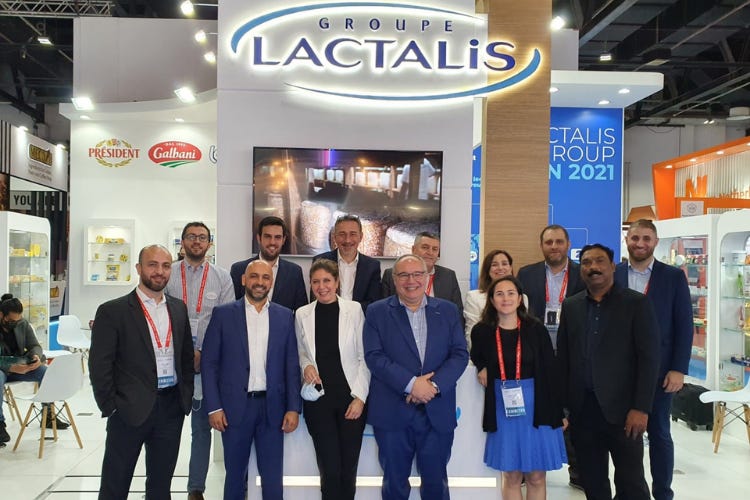
India is the largest milk economy on earth, and almost all of it is drunk, set, and cooked at home. Every global food company wanted a share of it. Danone entered and retreated to nutrition. Nestlé built quietly and never chased the mass milk market. Lactalis, the family firm behind Président cheese, is the only global dairy giant to have built a mass dairy business in India. It stays mid-sized inside India, far behind Amul and the big cooperatives.
It is private, owned by one family for generations, and has stayed inside dairy while rivals diversified into water, nutrition, and snacks. It is also the most acquisitive dairy company in history, with more than a hundred buyouts and reportedly none ever sold. Its latest is Fonterra's consumer brands abroad, bought for around US$2.4 billion.
How did Lactalis reach here?
In 2014 it acquired Tirumala in the south for about ₹1,750 crore. Tirumala was owned by the private equity firm Carlyle, which exited at three times its money. Lactalis was buying not from a founder but from a financial owner who wanted out.
It repeated the move, taking Anik in the centre (covering UP, MP and Chhatisgarh) and Prabhat in the west for roughly ₹1,700 crore. The three buys cost around ₹4,000 crore in all and assembled in a few years a procurement footprint that greenfield building would have taken fifteen years to grow.
More in a recent subscriber-only edition of Krishi.system
Making Sense of FirstClub Fundraise
Quick commerce imposes a distribution tax and F&V players die when they confuse freshness with a defensible channel. Otipy tried and failed. Sorted came and pivoted to Handpickd. Wheelocity came and pivoted. Deeprooted came and shut down. Can FirstClub, with its horizontal quick commerce gameplay, crack the F&V code? How does it compare with Freshly’s vertical-but-not-so-quick commerce gameplay?
Think School recently hosted Quick Commerce accelerator and few friends from Agripreneurs community joined them as well.
There has been tremendous interest in F&V quick commerce as it has been the albatross neck of quick commerce beast. You could crack almost every other SKU in the quick commerce pipeline.
Except F&V.
Otipy tried and failed.
Sorted came and pivoted to Handpickd.
Wheelocity came and pivoted.
Deeprooted came and shut down.
Can FirstClub do something different?
Ayyappan R is not entering grocery as a farm-to-fork romantic. His background runs through Flipkart, Myntra, Cleartrip and the larger consumer internet machinery.
Flipkart brings fulfilment density. Myntra brings curation and premium consumer behaviour. Cleartrip brings experience and trust in a category where friction kills conversion.
FirstClub’s thesis is a jhalmudi (a melange, to put it loosely) of all three.
More in a recent subscriber-only edition of KrishidotSystem.
How to Blow Mangoes in Indian Agriculture
Prasanna, founder of Mangopoint, in response to my piece, wrote,
“…As someone closely working with the mango ecosystem, it is an irony and still mystery how this mayhem continuous to run year after year. Production hit in Konkan with high Hapus prices passed to consumers while we are harvesting Totapuri for a processing unit for mere 7000/Ton in the South and UP just starting their season with Dasheri. Localized, region specific intervention is what we might need. Yes we grow half of worlds mangoes and we also consume them in whatever form. So there is a problem, there is an opportunity, are we ready to think beyond Varieties, Pulps and Juices?…We could start looking at maximizing the most value out of the fruit itself and options might differ based on the clusters and varieties. Decentralized micro value additions with high value generation instead of chasing me too products”
Ankur wrote,
“You make a lot of relevant points. But the irony is that markets and farmers have interests too divergent to act as one unit for any “mango change.”
Take Konkan Alphonso. It is an old cultivar that got romanticized over the last few decades. The variety is very delicate. It bears fruit in alternate years, has spongy tissue, and is highly sensitive to weather like rain and temperature. In today’s climate change era, this is a recipe for farmer distress. People in Konkan know how the temperature and rain cycles have shifted. This distress has grown over the last five years. Bigger farm holdings can still survive, since one good fruiting year can carry their overall income. For smaller farmers, it is a crash. So what does it take to shift to more resilient varieties?
It is an open secret that non-Konkan hapus gets mixed in and sold as Konkan hapus. There are also ripening malpractices at market yards. Who is going to stop these? The farmer? Farm-to-home sounds like a helpful idea, but it absorbs very little cost at market scale, and only at a higher rate. We all love mangoes. But how many of us actually buy genuine, GI-tracked, tree-ripened hapus at home for, say, 1200 rupees a dozen?
I met a few shopkeepers who are genuine sellers with a good reputation. They are finding it hard to get consumers to buy hapus this year at such high prices, because the Konkan produce was low. So even mango lovers have a limit on what they will pay.
The same problem hits the pulp. Genuine hapus pulp gets mixed just like the fruit, all in the name of hapus, because of the huge price gap. Totapuri pulp is the B2B market favourite since it is so cheap. Hapus pulp costs about 4.5 times more. It does not stand a chance, except with a few loyal hapus fans.”
APCNF won the Food Planet Prize. Can it now scale across India?
It was a delight to receive a beautiful comment from Vijay Kumar Garu who spearheaded APCNF
“…You have summarized my 26 years journey very well. A big thanks. We owe so much to so many people. I want to acknowledge the role of Dr. Sanghi, Founder of CSA and WASSAN and Dr. Rupela of ICRISAT. I can never forget their contribution to my thought processes. Sh.Subhash Palekar is another person who had a remarkable influence on us.
It is an excellent article. One correction - the cost per farmer in our model is not Rs. 15,000 per year. It is much, much less. The cost is Rs.25,000 over 8 years which works out to Rs.3000 per year. There are many Scientific breakthroughs in our work, which makes it such an important transformation. CSA, WASSAN, DDS all provided pillars with their expertise, ability to work together etc, the years of SERP, NPM provided an excellent launchpad for what APCNF could achieve.”
Ananth Krishna who is deep in the Vidarbha BRC rabbit hole wrote,
”In maharashtra, our version of the lite model with the promotion of bio input resource centers has largely failed because it targeted the wrong audience (farmer group, all males) , pushed brc's based on two philosophies (farmlab, ten drum theory) and nothing else. It was hurried, it got no official backing from the four state universities (a powerful stakeholder in the advisory space) on that, no concerted push on the ground without a dedicated workforce, honestly it ended up giving a bad name to natural farming. we were already very polarized with subhash palekar ji with the way he went around the state with 'my way or highway' approach, lambasting the scientific establishment. so it was no surprise that APCNF dumped him, went on their own broadbasing, adapting to the ground realities there. Yeah they cant. blended as you say has possibilities. the carbon market can chip in with a tiny lil bit. I don’t think APCNF still has touched that yet or maybe you haven’t heard it if they have. And we should evolve to ecosystem services credits as well ahead but that is still some ways away which might potentially give more than what the carbon market do”
Rajiv Prakash wrote,
“When we one day understand that most solutions are intrinsic, what will it do the extrinsic economy? Hence a need to imagine and propogate nature's intrinsic abilities and our role as individuals and through entities we create is to help restore and support the balance. The regenerative "economy and society" can provide millions of viable livelihoods and meaningful lives.”
Prasad YG, Former Director, ICAR Cotton Research wrote,
“RA and NF systems have similar goal but differ in the means to achieve it as far as I understand. Certified programs for standards like RA or Organic have a more documentation focus… is there a standard for NF supported by MRVs essential for scaling up? I understand that farmer markets may have the limitation of confinement to production areas. Rythu Bazars in AP & Telangana are now occupied by Vendors. Expanding markets beyond local requires building trust in NF produce. Just my 2 cents.”
Agristack Samvaad
Agristack Samvaad unfolded beautifully beyond our expectations.
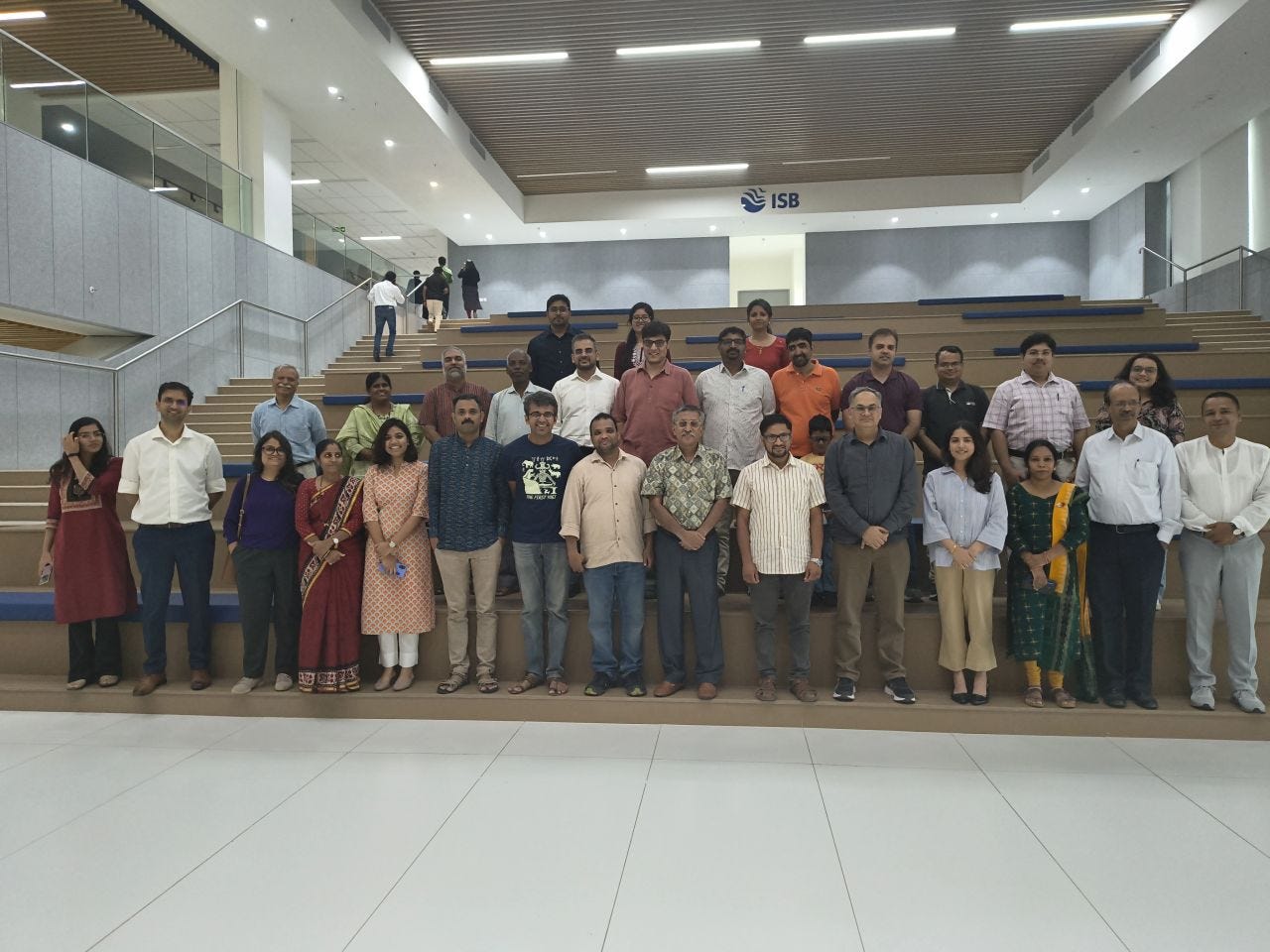
We had thirty five friends join us from the DPI ecosystem, ministry of agriculture, civil society organisations, privacy advocacy groups, ex ACS, data enablers, CTOs, digital payment specialists, tech leaders, lawyers, journalists and activists working on farmer rights.
The Samvaad began yesterday with Shri Rajeev Chawla IAS (Chief Knowledge Officer and Strategic Advisor, Agristack) sharing the vision of Agristack and ended with Rajeev ji listening to our discoveries and findings from the two day brainstorming of every aspect of Agristack design and implementation today.
We also had a special session on Mahavistaar, with a detailed open Q&A session with the relevant stakeholders.
We did four case study clinics on 1) Land governance 2) Farmer services 3) Data privacy issues 4) Market enablement and business models in a post Agristack universe and brainstormed on guard rails (with an interactive game using lego blocks) that can be brought into the Agristack across its layers.
Based on the clinics, we arrived at design principles that could be measured and evaluated across four domains viz.,
1) Chinese firewall
2) Farmer Consent
3) Decentralization
4) Inclusion, contestability and grievances at the edge.
We hope to contribute our discoveries, learnings to the relevant avenues and make Agristack far more inclusive for vulnerable farming communities, including pastoralists, women farmers thereby making it a true enabler for Indian agriculture.
Deep gratitude to Ashwini Chhatre, Dinesh Balam, Sameet Panda Rohin Kumar, Neha Niharika, Kasturi Thorat Devahuti Sarkar and friends from Purpose (Gurpriya S. Komal Chaudhry ) who made this event possible.
Deep love and gratitude to all the Samvaad participants for the open, frank conversations and the debates that sharpened our perspective about Agristack.
We hope to take this momentum forward and make this engagement a continuous one and a valuable feedback mechanism for Agristack.
Auroville/Pondicherry Agripreneurs Meet
Auroville/Pondicherry Agripreneurs Meet became Agripreneur Family Men and Women get together.
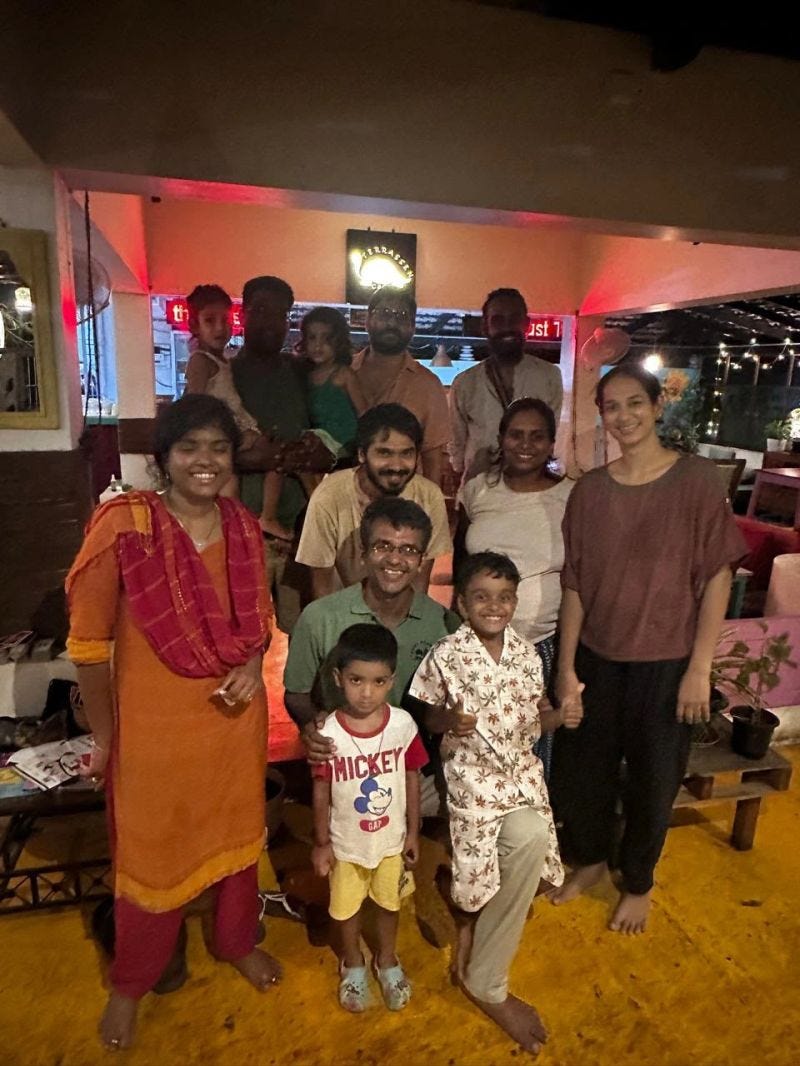
Met Aurovilian family entrepreneurs who've left the city grind and make ginger ale and ice tea with steady b2b demand. Last week I wrote about FirstClub and it was interesting to hear entrepreneurs talk about it as a channel to distribute their quality conscious ginger ale.
Met back to the landers who are growing vegetables in ancestral land while wondering who in the right mind takes up farming.
Met bellyful dreamers who care deeply about serving healthy food to the people of Pondicherry and struggle with the working culture of Gen Z who are entering the workplace with different expectations about work.
Met meditating sadhu entrepreneurs who care deeply stewarding the land and facilitating conditions of abundance.
We ended up attracting a car traveling family to our gathering who are asking deeper questions about the food that comes with labels.
Children kept entertaining themselves while stepping in at times to ensure adults remain in order and stay grounded.