
APCNF won the Food Planet Prize. Can it now scale across India?

Editor’s Note: An earlier version of this article was published inside the paywall. Given my current project as a Catalyst in Residence to accelerate regenerative agripreneurship in India, I thought it would be good to revisit this and publish this outside the paywall.
This hand-crafted piece takes sixteen minutes to read. It examines the origin story, evolution, impact of Andhra Pradesh Community Managed Natural Farming (APCNF) and its scaling possibilities. It examines the nitty grittiness of its impact - what its critics say, where scaling might fail; what the data actually says about APCNF - and what is needed on the ground to scale this model across India.

If you don’t want CC hassles, you are most welcome to use paypal or UPI (venkat.raman.kr@icici) and pay the annual subscription (8500 INR/95 USD) with your email in the comment. I will enable access immediately.
P.S. Supporting this work doesn’t have to come out of your pocket. If you read this as part of your professional development, you can use this email template to request reimbursement for your subscription.

APCNF won the Food Planet Prize. Can it now scale across India?
Indian agriculture plays a strange Jekyll and Hyde act.
During the day, the government foots the ventilator bill of the conventional farming system that depends on synthetic external inputs. Every year, ₹2.3 lakh crore, roughly $24 billion flows in as synthetic fertilizer subsidies, keeping the dying system alive. Urea reaches farmers at a fraction of its production cost. The drip has been running for decades despite depleting the soil, guzzling water and trapping farmers in feudal chokepoints. It is a political hot potato no politican worth her spine will dare to touch.
At night, the same government funds a programme to replace chemical farming entirely. One million farmers in Andhra Pradesh are now practicing natural farming, thanks to Andhra Pradesh Community Managed Natural Farming. How it came this far and where it is poised today with over 50 countries adapting the model to their own agro-ecological contexts is fascinating.
Let’s start from the origin story.
The Evolution of APCNF
The year was 1992. At a SAARC summit in Colombo, South Asian heads of state commissioned a study on rural poverty. The resulting document, Meeting the Challenges, landed on one core insight: the poor cannot be helped through technocracy alone. They have to be organised.
UNDP took this seriously and ran pilots across South Asia. The model that worked best came from Pakistan. Shoaib Sultan Khan’s National Rural Support Program. In India, UNDP chose the three most “backward” districts in Andhra Pradesh viz, Anantapur, Kurnool, Mahbubnagar. The logic was obvious.
If it works there, it works anywhere.
In 2000, Andhra Pradesh scaled the pilot through a new body, the Society for Elimination of Rural Poverty (SERP). The Chief Minister chaired it. The Vice Chairman was B.N. Yugandhar, civil servant and father of Satya Nadella.
A young IAS officer named Vijay Kumar Thallam joined as Co-Leader. Over the next decade, SERP organised 11.5 million rural women in Andhra Pradesh into Self-Help Groups. The groups federated at village, mandal and district levels. They became parallel institutions of the rural poor, capable of holding the panchayat, the bank, and the welfare departments to account.
In 2004, SERP introduced Non-Pesticide Management into this SHG infrastructure. The model had started in Punukula village and was scaled by G.V. Ramanjaneyulu's Centre for Sustainable Agriculture. By 2010, it spread across 18 districts and 35 lakh hectares, cutting pesticide use by half.
NPM is the direct precursor of APCNF. The vehicle was the same — women's federations. The principle was the same — community professionals embedded in villages doing the teaching. WASSAN and the Centre for Science and Environment built early proof-of-concept. Deccan Development Society contributed millet recipes and traditional food knowledge. The ASHA-Kisan Swaraj network kept the policy conversation alive across governments.
In 2011, Vijay Kumar moved to Delhi to lead the National Rural Livelihoods Mission. He extended SHG support from three to ten years, arguing that people poor for centuries cannot be lifted out by a single subsidy. By 2023, the architecture he championed had organised 100 million rural women across India. He returned to AP in 2015 and the next year took over a new mission — APCNF — as Vice Chairman of Rythu Sadhikara Samstha, a parastatal originally set up for farm loan waivers but given a deliberately broader mandate.
The early years drew on Subash Palekar's Zero Budget Natural Farming, but, as Vijay Kumar points, the conversion rates from Palekar's trainings were at only 2-5%. The programme needed its own scientific foundation.
It found one in 2018. Vijay Kumar had been watching a four-hour YouTube lecture by Walter Jehne, an Australian soil microbiologist, on the carbon cycle. He listened seven times.
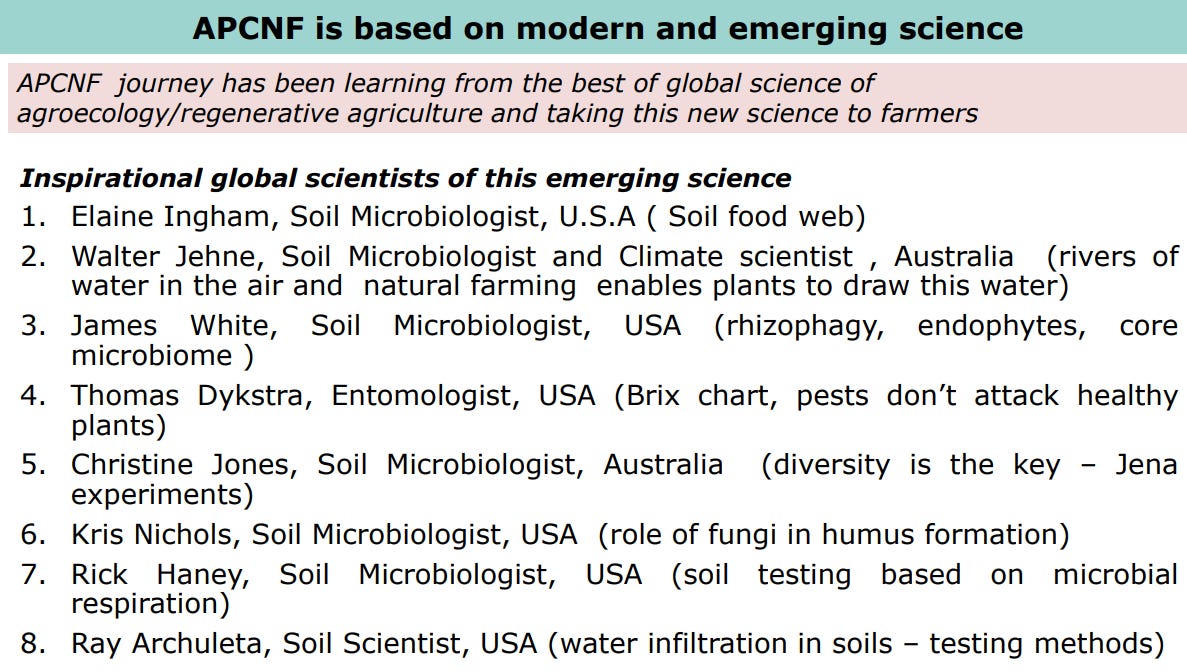
He invited Walter to AP. Together they experimented with pre-monsoon dry sowing — pelleted seeds planted before the rains, soil covered with mulch. Eleven farmers tried it in 2018 in arid Anantapur. The rainfall was poor. Their fields stayed green. By 2023, 850,000 farmers were using the technique.
Food Planet Prize
Few weeks ago, APCNF won the 2026 Food Planet Prize from the Curt Bergfors Foundation in Sweden — the world's largest environmental award for changing global food systems.
“Out of over 1,000 nominations worldwide, APCNF was chosen for showing that farming can support both people and the planet. The prize gives USD 1.5 million and honors scalable solutions to major food system problems.”

Is it a scalable solution?
What would a strong investment case that could back this scaling effort after considering every possible objection look like? Before we navigate the choppy waters of complexity involved in scaling this effort, let me breathe and meditate on this important chart that outlines their scale.
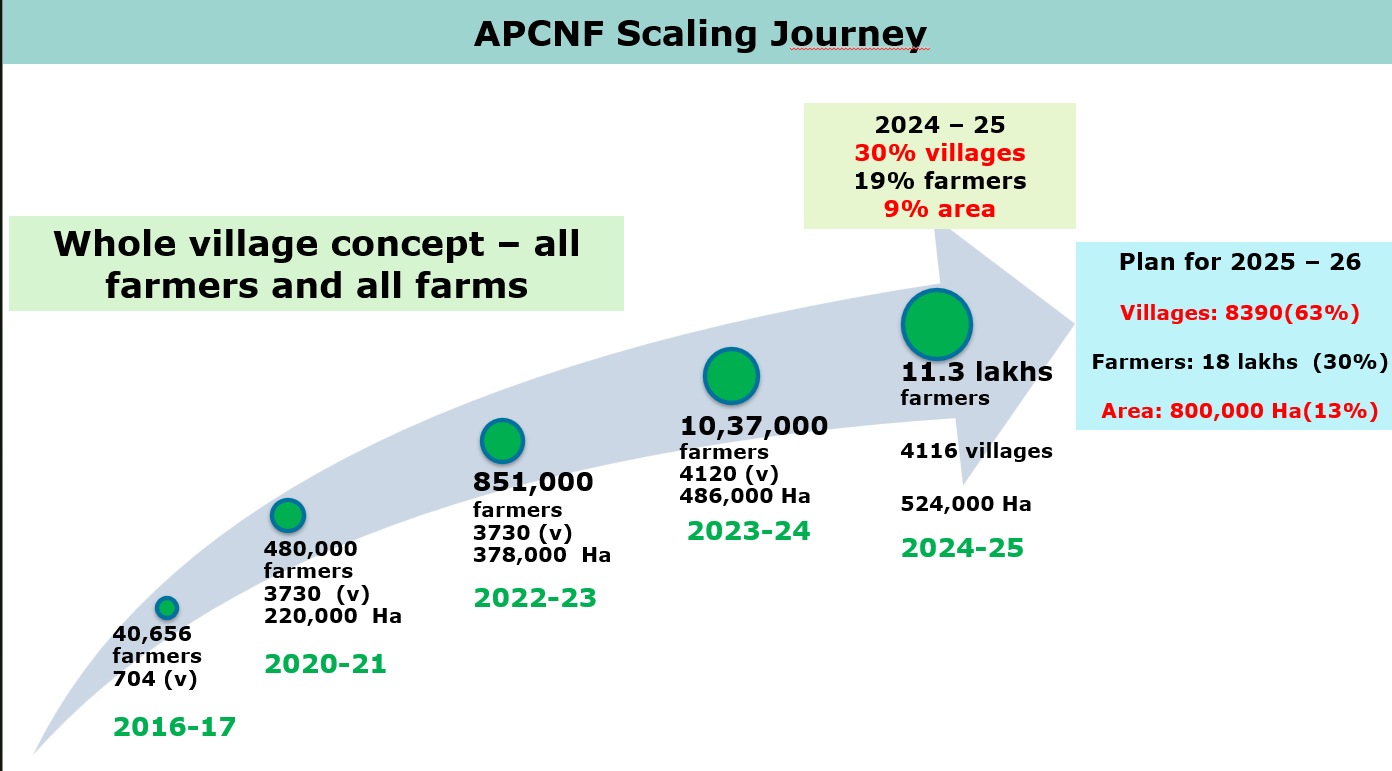
The village count was identical in 2020-21 and 2022-23 — 3,730 villages both years — but farmers grew from 480,000 to 851,000 in that period. It suggests that the program perhaps deepened within existing villages before expanding to new ones. Village saturation before expansion is a healthy signal of genuine community diffusion.
The farmer-to-area ratio is also striking.
1.13 million farmers on 524,000 Ha = 0.46 Ha per farmer on average. AP’s average farm size is about 1.06 Ha. APCNF is overwhelmingly concentrated in the smallest landholding category — marginal farmers below 0.5 Ha. The 2025-26 plan is a near-doubling of village coverage — from 4,116 to 8,390.
The national programme to replicate this — the National Mission on Natural Farming, launched in November 2024 — targets 40 lakh farmers across 28 Indian districts by 2030.
The 2025-26 budget gave it ₹616 crore. The fertilizer subsidy got ₹1,75,099 crore.
Can you see this fascinating contradiction?

That’s the crux of the problem we are dealing with. This ratio -0.35% - is, perhaps, the most expensive act of policy incoherence in Indian agricultural history. If we are serious about correcting this, it is important to delve deep into the contradiction and find a way out.
Where Scaling Might Fail
The standard argument against natural farming — repeated by agricultural economists, policymakers, and input industry lobbyists — goes like this. The transition to organic or natural farming causes a yield penalty in the first several years, during which farmers lose income. Smallholders with no savings buffer cannot absorb that loss. Therefore, natural farming is a luxury for rich-country hobbyists and cannot feed a country of 1.4 billion.
This argument has driven agricultural policy for forty years. It is the justification for ₹1,75,099 crore in annual fertilizer subsidies. It is the reason every natural farming program in India has been treated as a niche welfare intervention rather than a mainstream agricultural strategy.
Let’s now walk further with the devil’s advocate in context with the data showcased by APCNF. There are five specific objections worth taking seriously — on data quality, labour costs, equity, replication, and long-run yield trajectory.
Let’s examine each of them.
The Andhra Pradesh programme’s income improvement data — farmers earning 57% more than their chemical-farming neighbours by year four — comes primarily from assessments commissioned by the implementing agency.
GIST Impact study commissioned by the Global Alliance for the Future of Food, conducted across 12 villages in three agro-ecological zones between 2020 and 2022: prime crops — paddy rice, maize, millet, finger millet, red gram — showed an average 11% yield increase and a 44% reduction in input costs.
The most rigorous independent study from the University of Reading partially validated these findings but found yield improvements in only three of five AP districts studied. Context-specific variation, the researchers noted.
“The southern (drier) districts of Andhra Pradesh (Anantapur, Kadapa, Nellore, Prakasam) had the highest yield in the ZBNF > conventional > organic treatment. There was no significant difference between the treatments in Krishna, and the effects of treatments were reversed in the northernmost district of Visakhapatnam (highest yield in conventional > organic > ZBNF).” (Source)
There is also a labour cost problem that the headline numbers hide.
Natural farming increases labour hours — bio-stimulant preparation, intensive crop management, diversified planting systems. The income improvement figures measure the return on cash expenditure, not total economic cost. Scarcity of hired labour is a growing constraint for APCNF farmers, reported by 35% of farmers in 2018-19, rising to 60% in 2021-22.
Who actually benefits from APCNF?
A 2024 peer-reviewed paper from Coventry University and the Food Sovereignty Alliance India documented that APCNF's SHG credit infrastructure primarily benefits land-owning farmers. The programme uses women’s self-help group networks as its delivery vehicle. That architecture works well for small landholding households. Agricultural labourers — more than half of India's agricultural workforce — are structurally excluded.
Although to be fair to APCNF, as Vijay notes, natural farming has changed tenancy rates and provides a pathway for landless to move towards leased lands.
“There are 522,935 landless families in the project, who have enrolled themselves in Natural Farming. Out of this, 352,262 have raised seasonal nutri-gardens (67%) and 73,922 have raised 365-day nutri-gardens. More than 50% of these families are Dalits. The data on further graduation to leasing lands for food production is not being captured in our MIS.” - Vijay Kumar Thallam
Would the national programme attempting to scale it inherit these blind spots?
Let’s be clear. NMNF and APCNF are apples and oranges.
The national programme uses a lighter delivery model — routed through Krishi Vigyan Kendras and Bio-Input Resource Centres rather than the intensive SHG-embedded Community Resource Person network that APCNF spent a decade building in Andhra Pradesh.
AP’s results required a pre-existing dense women’s federation infrastructure that most Indian states do not have. Whether the lighter model can replicate APCNF-level behaviour change on a five-year timeline is, let’s face it, a tall order.
There is also the Sikkim precedent.
In 2016, Sikkim became India's first fully organic state, winning the FAO Future Policy Gold Award in 2018. Within a few years, cardamom yields — the state’s primary cash crop — had fallen sharply, with over 60% of plantations becoming barren. A CSE survey of 16 farms across Sikkim’s four districts found that only two of 14 private farmers reported any yield increase after the transition; ginger production on some farms fell to a third of earlier levels.
The state now imports significant food from outside its borders. Critics noted that organic certification benefited tourism and premium export markets far more than it helped the average farming household.
Sikkim's organic transition was state-mandated, fast, and uniform. Synthetic inputs were banned outright. APCNF's model is the opposite of Sikkim: the transition is voluntary, gradual, and community-managed, with crop diversification built in from the start.
Sikkim’s yield decline did not appear immediately. It emerged several years after transition, precisely the horizon at which APCNF is now operating in its earliest villages.
Mind you, these are not random objections. They are the central empirical uncertainties in dealing with the scaling question. Now that we have examined every possible way this system could fail, let’s now look at what the data is actually telling us.
What the Data Actually Tells Us
Critics point out that AP’s total fertilizer consumption has actually risen — from 3.5 million tonnes in 2016-17 to 4 million tonnes in 2024-25. If the programme is working, shouldn’t the state be using less?
This is a base rate error. APCNF covers 524,000 hectares out of AP’s 8.9 million hectares of gross cropped area — 6% of the state’s farmland. Six percent coverage cannot move a state-level aggregate that fluctuates more than 6% annually from rainfall variability alone.
AP’s per-hectare nitrogen consumption was 116.8 kg/ha in 2021, up from 105.4 kg/ha in 2020, against an all-time high of 146.8 kg/ha in 2015. The trend is declining from a 2015 peak but the direction is not obviously APCNF-linked. It correlates more with the shift in AP’s cropping pattern post-bifurcation with Telangana (which took most of the irrigated paddy area).
You need to look where the intervention actually happened.
Between 2015-16 and 2019-20, Andhra Pradesh’s pesticide consumption fell by approximately 40%. In the same period, Telangana and Uttar Pradesh recorded steady increases. The decline tracks precisely with APCNF’s initial scaling — from 40,000 farmers to nearly half a million.
Pesticide is a demand-side signal tracked through commercial dealer networks. It is the closest thing to a population-level, independently observable validation that APCNF is genuinely changing farmer behaviour.
Why pesticide before fertilizer?
Because farmers replace chemical pest management first with botanical preparations they make themselves. Fertilizer reduction follows more slowly. But this claim carries a caveat.
A 2024 peer-reviewed MDPI study using Directorate of Plant Protection, Quarantine & Storage data found that AP's total pesticide consumption actually increased significantly over the last decade.
The two sources may be measuring different metrics — technical grade pesticides versus all formulations, or different sub-periods — but the discrepancy has not been publicly reconciled and the 40% decline figure cannot be treated as settled.
The only study that looked at the retail channel directly - A 2022 Lancet survey of 894 farmers and 38 pesticide retailers in Kurnool - found APCNF farmers were 35% less likely to use pesticides. But no impact on retailer sales was observed. After a median two years in the programme, individual behaviour had shifted but the market had not. Training alone, the study concluded, may be insufficient.
The definitive evidence is pending.
The BLOOM study — a cluster-randomised controlled trial across 80 clusters in four AP districts, measuring urinary pesticide metabolites, crop yields and household income — will provide the first controlled evidence on whether APCNF reduces actual pesticide exposure at population scale.
To sum up, the pesticide signal is a plausible hypothesis. The evidence has not confirmed yet.
The CEEW independently estimated in 2020 that APCNF covering 25% of AP’s crop area would yield $70 million in annual fertilizer subsidy savings in AP alone — at pre-Ukraine prices. A government spending ₹15,000 per farmer per year on transition for three to five years, then displacing ₹12,000 per farmer per year in subsidies permanently, makes a bet that pays back within a decade and saves money indefinitely thereafter.
The longer arc is sharper still. A 2024 FAO-CIRAD-RySS foresight study led by CIRAD economist Bruno Dorin modelled two scenarios for AP through 2050: agro-industrial intensification versus full agroecological transition via APCNF. The agroecology scenario performed better on employment, food production, income inequality and natural resource depletion.
Now that the case has stronger legs, can we examine the scaling question?
What Scaling Really Wants
The full APCNF delivery model costs roughly ₹15,000 per farmer per year, with 75% going to capacity-building and the CRP cadre. At 40 lakh farmers, that is ₹18,000 to 30,000 crore over the transition period.
The government’s total NMNF commitment is ₹2,481 crore. It covers roughly one month of what the proven model actually costs. The programme will run regardless. To achieve a pan-India behavioural change, we need to work on two critical levers.
The first is the knowledge institution.
IGGAARL launched India’s first Farmer Scientist Course in July 2023 — a four-year degree for practicing natural farmers, graduation conditional on demonstrated farm income performance, not examinations.
The first cohort of ~520 graduates in 2027. At current intake, four cohorts by 2030 produce roughly 2,000 trained farmer-scientists, almost entirely from AP.
The farmer-as-teacher model is the right approach, although it is something which ICAR wouldn’t be able to stomach. Agricultural ministry budgets flow through ICAR. ICAR funding comes with its conditions viz., curriculum approved by PhD-qualified faculty, degrees awarded through UGC-affiliated examination systems, institutional positions requiring conventional academic credentials.
The second is the market.
APCNF has been clear about what kind of market it wants. When asked about selling to private aggregators in his Journal of Peasant Studies conversation, Vijay’s response was straightforward: "Instead of selling to Amul and others, why can't we sell to ourselves?".
The model is producer-owned and circular.
265 NF stores already operate in 56 Rythu bazaars run by NF farmers. Mahila Marts (women-owned retail) stock NF foods in 24 locations. Anganwadi tie-ups in 129 villages supply 157 centres and 132 schools with fresh vegetables. The five-year goal: 10,000 farmer-entrepreneurs across 500+ villages doing their own value addition and urban marketing.
There is plenty of potential for blended capital that underwrites farmer-owned enterprises and producer infrastructure.
This is where APCNF can accelerate regenerative agripreneurship in India at scale. 10,000 farmer-entrepreneurs in five years is not a small number. Each one — the NF farmer running a village vegetable shop, the SHG processing unit, the urban retail entrepreneur, the farm-to-Anganwadi supplier — needs capital, mentorship, market access and value chain integration.
Investments need to flow towards the producer-owned market infrastructure at scale and the agripreneurial ecosystem around it. SHG-owned processing units, cold chain, urban retail presence, procurement contracts with state midday meal and Anganwadi systems beyond pilot scale, and patient capital with technical assistance for 10,000 farmer-entrepreneurs.
The combined investment — knowledge institution and market architecture — is ₹800 to 1,300 crore over five years. It is 0.7% of a single year’s fertilizer subsidy, invested once.
And so we come to the million dollar question.
Can It Be Scaled?
Yes. But not the way the government is currently trying to do it.
The agronomy is proven. The community diffusion model is proven. What is not yet proven is whether the pesticide signal holds at scale, whether NMNF's lighter delivery model achieves APCNF-level adoption depth, and whether yields hold steady in AP villages now entering their seventh, eighth and ninth years of full natural farming — the horizon at which Sikkim's cardamom collapsed. The next 36 months — tracked through the BLOOM RCT, district-level pesticide data and NMNF enrollment — will answer at least two of those questions.
The investment case does not require certainty. Either way, you need the CRP cadre. Either way, you need the market channel. The two investments are robust to both outcomes.
India is spending ₹1,75,099 crore a year to keep the ventilator of a broken system running and ₹616 crore to build the alternative. Whether the Jekyll and Hyde act ends or continues indefinitely at public expense is a bet we would collective make for our food system’s regenerative futures.
Bibliography
APCNF — Origin, Operations, and Leadership
Thallam, V.K., & Patel, R. (2025). Andhra Pradesh community managed natural farming – a conversation. The Journal of Peasant Studies. Link
Rythu Sadhikara Samstha (RySS) / APCNF official site. Link
Ramanjaneyulu, G.V., Chari, M.S., Raghunath, T.A.V.S. Non Pesticidal Management: Learning from Experiences. Springer. Link
Centre for Sustainable Agriculture — Ramanjaneyulu profile. Link
EcoTippingPoints — Punukula Non-Pesticide Management origin story. Link
Walter Jehne — Land & Leadership Initiative profile. Link
Subhash Palekar — Wikipedia. Link
MANAGE — APCNF: A leading example for scaling (training PDF with ₹15,000/farmer cost structure). Link
National Rural Livelihoods Mission (NRLM). Link
ASHA-Kisan Swaraj Network. Link
WASSAN. Link
Independent Evaluations
Gupta, N., Tripathi, S., & Dholakia, H.H. (2020). Can Zero Budget Natural Farming Save Input Costs and Fertiliser Subsidies? Evidence from Andhra Pradesh. CEEW. Link
GIST Impact & Global Alliance for the Future of Food (2023). Natural Farming Through A Wide Angle Lens: True Cost Accounting Study of Community-Managed Natural Farming in Andhra Pradesh. Link
Duddigan, S., et al. (2022). Impact of Zero Budget Natural Farming on Crop Yields in Andhra Pradesh, SE India. University of Reading / Sustainability. Link
Jaacks, L.M., et al. (2022). Impact of Large-Scale, Government Legislated and Funded Organic Farming Training on Pesticide Use in Andhra Pradesh. The Lancet Planetary Health. Link
Jaacks, L.M., et al. (2023). Co-Benefits of Largescale Organic Farming on Human Health (BLOOM): Protocol for a Cluster-Randomised Controlled Evaluation. PLoS One. Link
Critical Studies
Ramdas, S.R., & Pimbert, M.P. (2024). A Cog in the Capitalist Wheel: Co-Opting Agroecology in South India. The Journal of Peasant Studies. Link
2024 MDPI study on AP pesticide consumption trends. Sustainability. Link
Government and Policy Sources
Press Information Bureau — National Mission on Natural Farming launch (November 2024). Link
Down to Earth — Budget 2025-26 NMNF allocation. Link
BigHaat — Fertiliser subsidy budget overview. Link
NITI Aayog — APCNF documentation. Link
CEIC / Directorate of Economics and Statistics — AP per-hectare nitrogen consumption series. Link
Agriculture Census 2015-16 — average landholding size. Link
KfW — €90 million Agroecology programme grant to AP. Link
IGGAARL launch — Agro Spectrum India. Link
Sikkim Comparison
IndiaSpend — Why the move to organic is faltering in Sikkim. Link
FAO India — Sikkim Future Policy Gold Award. Link
Sikkim Express — Sikkim’s Black Gold Fades: Cardamom Farmers Face Uncertain Future. Link
Down to Earth / CSE — organic trial survey from 16 Sikkim farms. Link
Recognition
Food Planet Prize — APCNF 2026 award profile. Link
This was a really terrific article