
How to Blow Up Mangoes In Indian Agriculture?
When Indian mangoes sell for absurd prices in American grocery stores and Konkan farmers stare in penury at empty trees, we might as well blow them up right?
Editor’s Note 1: I have no editor.
Editor’s Note 2: This hand-crafted criminal activity began with tomatoes. Mango follows next.

If you don’t want CC hassles, you are most welcome to use paypal or UPI (venkat.raman.kr@icici) and pay the annual subscription (8500 INR/95 USD) with your email in the comment. I will enable access immediately.
P.S. Supporting this work doesn’t have to come out of your pocket. If you read this as part of your professional development, you can use this email template to request reimbursement for your subscription.
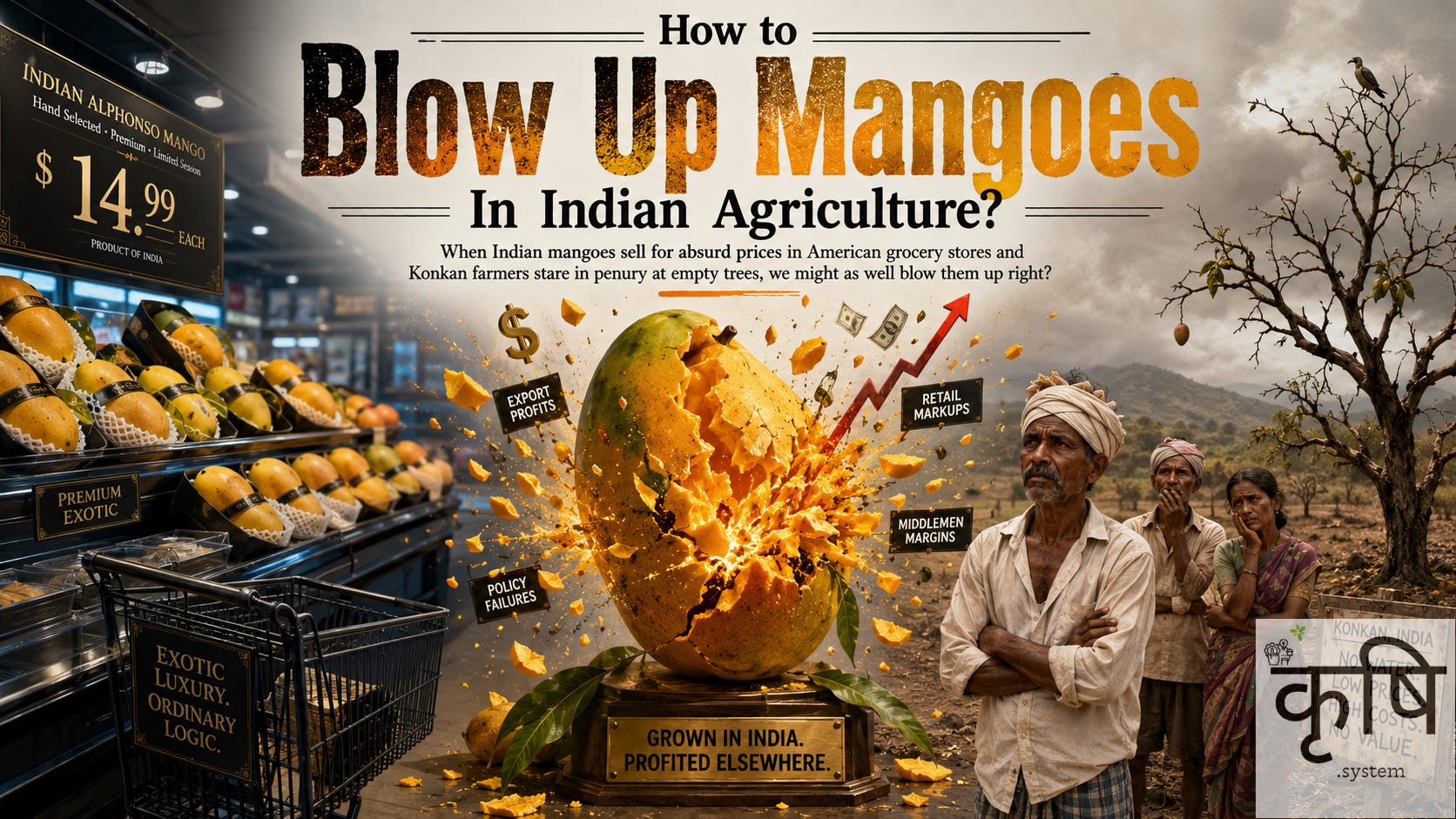
By every measure of public attention, the Indian mango had its best season in years. The Prime Minister flew a box of Alphonso (We lovingly call it Hapus as our Marathi brethren do) to the White House for the Modi-Trump trade talks in February. American supermarkets sold boxes of fresh Indian fruit for up to a thousand dollars each. Fifteen shipments worth half a million dollars ended up in a Los Angeles landfill over a paperwork error at a Mumbai irradiation facility. Influencers ran blind tastings of Alphonso against Kesar.
Meanwhile, in the Konkan, the crop fell by seventy to ninety percent. A farmer named Santosh in Devgad village watched fog kill his flowers at dawn, thick enough to drip like rain. His crop insurance returned nothing. In Junagadh, traders pressed Kesar growers to give up ten percent of every sale as commission and those who refused dumped their fruit at one hundred rupees a box in the private market. Dayabhai Sojitra saw his season's earnings collapse from three lakh to forty thousand.
Indian Agriculture has a fine tradition of treating every commodity crisis as a one-off event even when the same crisis turns up every other year like clockwork. This has been the bane of tomato. Mango is now joining the club.
Honestly. It feels deeply frustrating, especially, if you love India and Indian Agriculture.
<Trigger Warning. I am venting>
We produce abundance, celebrate abundance, culturally worship abundance, hold mango festivals for abundance, and then somehow ensure that the people who grow the abundance remain the weakest actors in the chain.
</Venting>
Why do we do this?
If you've been reading me in the inter webs, you know I care deeply about Indian Agriculture and its future in the nick of Climate emergency. So here is what I want to do. I want to hand you a three-step playbook to blow up mangoes.
Step 1: Blame the Weather
The heat broke the flowering window this year. Winter ran long. April jumped to forty-two degrees. Fog rolled into the Konkan in April thick enough to drip like rain. Ninety percent of the Alphonso crop fell. Every English-language paper ran a climate shock story. Including the Marathi press. The climate-change brigade got a beautiful villain. The weather is cruel, changing. The weather did this.
All of that is true. But the deeper problem sits somewhere else.
India grows almost two of every five mangoes on Earth and earns almost nothing. It ranks fourth among exporters, behind Mexico and Brazil, both of which grow a fraction of what India does. Most farmers who grew the fruit are still poor. This was true in a normal year. The weather just made the fragility of the system visible.
Weather takes the mango cake to be the most convenient villain in Indian agriculture for a good reason. It absolves everyone else. The trader becomes innocent. The exporter becomes innocent. The state government becomes innocent. The insurance company becomes innocent. The policy machinery becomes innocent.
The climate did it. Case closed. Can we move on to the next horticulture mission?
If we are serious about examining the fragility of the system, we need to unpack its deeper layers.
Let us start with the fruit.
A mango tree is fussy. It is bruise-prone and unforgiving. It flowers only when the nights turn cold for a few weeks, usually in February. If the cold comes late or the heat arrives early, the flowers fail. A ripe mango lasts about five days before it rots. The weather broke the flowering window this year. Winter ran long. April jumped to 42 degrees Celsius.
The mango is also alternate-bearing by nature.
A heavy crop year is usually followed by a thin one, even without climate stress. This makes cold chains and packhouses hard to justify, because the fruit they handle disappears every other year. You can run a juice factory year-round on Totapuri pulp. You cannot run a fresh-export packhouse on Alphonso that flowers fully only once every two summers.
The next layer is the farm.
Most Indian mango orchards are small and scattered. A typical grower has a few acres, often split across plots. Yields are low, sometimes just six to eight tonnes an acre in the older belts. A farm this size cannot pay for a cold store, a grading line, or a packhouse on its own.
If you peel the skin deeper, you will arrive at infrastructure
The infrastructure a mango needs barely exists in India. NCCD's last full assessment found a ninety-nine percent shortfall in pack-houses and eighty-five percent shortfall in refrigerated trucks.
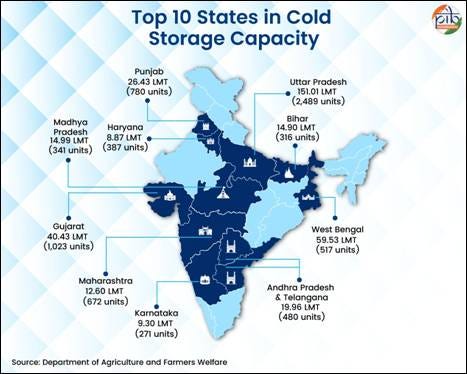
The northern mango states have cold storage capacity built almost entirely for potatoes. The biggest producing states - Uttar Pradesh, Bihar, Bengal and Madhya Pradesh - are landlocked and short on the right refrigeration. Their fruit rarely reaches a port.
The indifference towards mango cultivation has historical roots.
When India brought in Land Ceiling Acts in the 1960s to break up large landholdings, almost every state wrote in an exemption for orchards. Uttar Pradesh let an owner keep twelve and a half acres of agricultural land plus another 6.17 acres of grove. Assam's first ceiling act allowed nine additional acres for orchard above the main ceiling. Madhya Pradesh's 1960 Act classified orchards as dry land for ceiling purposes.
Many of the owners never farmed them. They handed them out on annual contracts to traders who paid for the crop in advance and managed the trees. The trader's interest was the season's box count. Barring few romantic outliers, he or she had no incentive to prune, nurse old trees, fight spongy tissue or improve the soil.
Trust leaks as well.
Cheaper Karnataka mangoes are ripened with chemicals and sold as Hapus. A good name takes three generations to build and one season to steal. If misdiagnosing the root cause is the first step to perpetuating a problem, what guarantees that the problem repeats itself ?
Step 2: Mistake Glamour for the Industry
A box of Alphonso selling for a thousand dollars in an American supermarket does not mean India has built a mango economy. It means one box reached one shelf at one absurd price. A mango festival does not mean the farmer has bargaining power. A GI tag does not mean origin is protected. A viral tasting does not mean the grower captured value. A Prime Ministerial gift does not mean the mango economy is healthy.
Let’s be clear about the market dynamics. There is no single mango market in India.
Thanks to its alternate bearing structure, there are tiers stacked delicately on top of each other.
Premium GI-tagged varieties like Alphonso sit at the top, fragile and fake-vulnerable, with volatile prices. Mid-tier varieties like Kesar, Banganapalli, Dasheri and Langra cover the broader domestic plate. The mass tier is Totapuri and a few processing varieties that feed the pulp factories.
Each tier behaves differently.
When Alphonso collapsed this year, Banganapalli prices in Mumbai rose because shoppers switched. Gujarat Kesar growers had their best season in years. Climate damage to one variety lifted prices for another. The total mango export figure is an average that hides which variety, which district and which farmer is actually winning.
The glamour layer is useful because it distracts us from the boring layer where the money is lost. Who graded the fruit? Who owned the packhouse? Who financed the farmer? Who captured the premium? Who took the rejection risk? Who paid for the cold chain? Who certified the origin? Who benefited when a consumer abroad paid a ridiculous price for memory wrapped in cardboard? None of these questions are interesting as long as we play out mango hype in Instagram reels.
The fake Hapus problem exposes this perfectly.
Premium mango markets are built on names: Devgad, Ratnagiri, Gir Kesar, Banganapalli, Dasheri, Langra, Himsagar. These names carry geography, memory and price. So the market naturally invites fraud. Cheaper mangoes are ripened, polished, renamed and sold as Hapus. The consumer is cheated, but the deeper damage is to the real grower whose premium margins are stolen.
A premium depends on trust. If the market cannot distinguish Devgad Alphonso from a chemically ripened lookalike, the premium weakens. If the premium weakens, the incentive to invest in quality weakens. If investment weakens, the origin brand becomes a joke. A geographical indication without enforcement and traceability is not a moat. It is a fit for nothing certificate.
Even the biodiversity story gets distorted by glamour.
India grows six or seven hundred named mango varieties and only two of them carry almost the entire fresh export trade. Alphonso has the highest spongy tissue rate and the lowest export viability.
Kesar and Banganapalli dominate much of India’s fresh export trade because they fit the export machine better. They have thicker skins, longer shelf lives, more forgiving shipment characteristics and better aggregation geographies.
More importantly, they sit closer to serious processing ecosystems.
Kesar exports work because Gujarat has flat land, large concentrated holdings, a serious pulp industry in Junagadh, and a Gujarati diaspora in the Gulf. Banganapalli exports work because Andhra has the Nuzvidu pulp factories absorbing the lower grades and a Telugu diaspora in the United States.
The Konkan Alphonso belt has nothing like this. There is no Maaza-grade processor at scale absorbing the cheap fruit. So Konkan growers swing violently from glut to scarcity with no buffer, and the celebrity variety the country loves most is structurally the most exposed.
This is our worst habit: We celebrate diversity in speeches, destroy it through incentives.
Of course, the answer is not to romanticize every variety.
Some mangoes should become premium fresh fruit. Some should dominate regional domestic markets. Some should feed pulp, pickles, beverages, dairy, desserts, dried products, cosmetics, seed-kernel products and waste valorisation. Some may work best as local tourism or heritage products. The task is to assign economic roles to diversity. Every mango does not need to fly to Dubai. Every mango needs a convincing reason to remain in the orchard.
Which brings us to the most uncomfortable step.
"Mirror, mirror on the wall, who in this land is fairest of all?"
Step 3: Love Mangoes So Dearly That Reform Never Reaches Them
India exports so little because we love our mangoes so much. Indians buy almost everything. The home market eats about eighty-five percent of the crop with ease and clears the surplus as well. That sounds like a strength, and in one way it is.
A large domestic market can absorb varieties, price points, regional preferences and seasonal surges that no export market can. But it is also the reason none of the challenges we have been talking about ever get fixed.
A farmer who can always sell into the mandi has no reason to grade, chill, or prove his fruit. The deep home market is a cushion. It absorbs every shock and sadly, every incentive to improve.
Because the crop can usually be sold somewhere, the system is not forced to improve. Fruit moves even when it is ungraded. Consumers buy even when origin is uncertain. Traders clear volumes even when cold-chain discipline is weak. Farmers survive even when they do not prosper. The system functions just enough to avoid collapse.
This is the tragedy of Indian agricultural underperformance: It rarely dies. It adjusts downward and calls the new level normal. I am done with snarky cynicism.
Export obsession will not change the status quo. It will not change the fragility of the system. It will only make it worse. We have already seen in in the case of tea, spices and marine products.
If we are serious, what changes do we need?
Mango regions need farmer-aligned aggregation with commercial discipline. Packhouses must be tied to assured volumes, grade standards and market contracts. Cold-chain investments must be variety-specific and region-specific. Alphonso does not need the same architecture as Totapuri. Kesar does not need the same system as Dasheri. Banganapalli does not face the same constraints as Himsagar.
Processing must be treated as price insurance. A pulp plant, frozen puree line, drying facility, beverage ingredient chain or mango butter unit can stabilize the fresh market by giving lower-grade fruit a destination. The fresh market becomes less desperate when rejected fruit finds new lease of economic life.
Climate risk must be redesigned into the mango system. Orchard insurance cannot behave as if flowering failure is a paperwork inconvenience. Heat stress, fog, unseasonal rain, alternate bearing and fruit-set failure need better assessment models.
Traceability must become the foundation of premium. If a consumer pays for Devgad, the system must prove Devgad. If a buyer pays for Gir Kesar, the system must prove Gir Kesar. Origin, grade, ripening method and farmer identity cannot remain matters of faith in a dynamic market built for substitution. A premium that cannot defend itself becomes an invitation to fraud.
Let us stop treating the domestic mango market as the consolation prize after exports. It is the main event. It is where most mangoes will be eaten, gifted, pulped, blended, frozen, cooked, worshipped and fought over. Upgrading this market is the real prize.
We are blessed to remain the largest mango producer in the world. Can we work towards becoming the world’s greatest mango economy?
So, what do you think?
How happy are you with today’s edition? I would love to get your candid feedback. Your feedback will be anonymous. Two questions. 1 Minute. Thanks.🙏
💗 If you like “Krishi.System”, please click on Like at the bottom and share it with your friend
I always thought the reason I get teary eyed when I devour mangoes the traditional way, was because it brought back some childhood memories.
But now I know the real reason.
This was an education, thank you.