
Few Personal Updates
1) Catalyzing Regenerative Agripreneurship in India 2) Upcoming Melbourne Agripreneurs Meet 3) Kashmir Agripreneurs Meet

Dear Friends,
I send personal updates when I embark on new projects. Not out of vanity to play status games. But out of the humbling realization that in systems change work, especially while dealing with those that lovingly pushes me out of my comfort zone, tapping the collective wisdom is the often the hardest part.
Trust Margaret J. Wheatly to beautifully explicate this:
“For me, the moments when collective wisdom appears are always breathtaking. Even though I know such wisdom is bound to appear, I’m always stunned with delight when it enters the room. And the appearance of such wisdom is a huge relief. We actually do know how to solve our problems! We can discover solutions that work! We’ve just been looking in the wrong places—we’ve been looking to experts, or external solutions, or to detailed, empty analyses. And all this time, the wisdom has been waiting for us, waiting for us to enter into meaningful conversations and deeper connections, waiting for us to realize that we can be wise only together.”
Since the three dimensions of my work - Content, Community Building (Retreats and Meetups) and Consulting- are dedicated to build the underlying mycorrhizal networks that can potentially tap into this collective wisdom for food systems transformation, it is fascinating to watch my informal work become formal over a span of six years.
Catalyst in Residence
I have signed up as “Catalyst In Residence” for accelerating regenerative agripreneurship in India with CEEW, supported by Rainmatter Foundation, through their Green Economy Accelerator.
Since a large part of my ecosystem engineering work has largely been open source-driven, I thought why not take this approach for this project as well.
Regenerative Agripreneurship in India is currently a niche affair, operating in counter currents with the current economic, policy, social ecosystems that favors conventional agriculture, locking us in a zero-sum game that neither benefits agribusinesses, farmers, consumers or the planet.
In India, out of 93 Million farmers (based on 2019-20 census), we have around 5-6% of Indian farmers who practice regenerative farming. Of course, I take every public number in India with a heavy dose of salt, at the risk of straining my cardiovascular system.
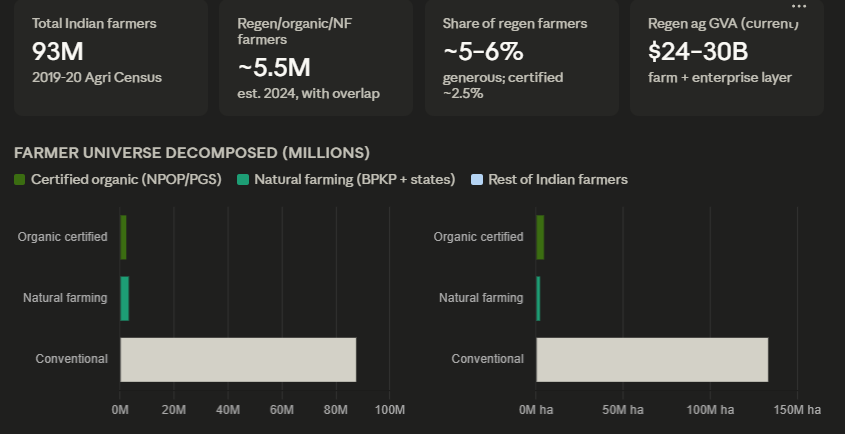
How did I arrive at 5-6% estimate?
India has 2.3 million certified organic farmers — the largest such count globally — with around 4.5 million hectares under organic certification as of 2023–24, representing 2.5% of total agricultural land.
As of 2024, approximately 3.4 million farmers are engaged in natural farming across India — covering 2.2 million hectares — through the Bharatiya Prakritik Krishi Paddhati (BPKP), Namami Gange, and state-level programs.
APCNF alone has grown 25 times since 2016, reaching over a million smallholder farmers across 500,000 hectares in Andhra Pradesh, and is recognised as the world’s largest agroecology program.
There is significant overlap between the organic-certified and natural farming populations. Netting out duplicates, the conservative unique estimate of farmers practicing some form of regenerative, organic, or natural farming is 4.5–5.5 million, or roughly 5–6% of all Indian farmers. The certified-only share — those who can command a market premium — is closer to 2.5–3%.
As you can see, my definition of regenerative farming covers the entire spectrum with usage of bio-inputs to minimize pesticide usage on one end to minimizing external inputs on the other end with a healthy soil microbiome. And so this number could very well be conservative or grossly overestimated, depending on your political stance
The question is: How do we accelerate regenerative agripreneurship in India?
Given my strengths and what the ecosystem sorely lacks, I am breaking down my intervention into three levers viz.,
Entrepreneurship:
Build entrepreneurial collectives that bring together Civil Society Organisations driving regenerative Agripreneurship on grassroots and Entrepreneurs with strong unit-economics acumen to build deeper market linkages and create further cascading effects with entrepreneurs incubating regen-market clusters that require hand-holding support to build market-ready regen commodity ecosystems.
Finance:
Build hybridized financial models that can be sequenced according to the payoff and risk-return and built into financial products that can help farmers transition towards regenerative agriculture.
Culture
Focus on farmer dignity, shame of pursuing “ancient” (as opposed to “progressive”)agriculture and build collectives of religious/spiritual organisations that use their narrative juggernaut to help farmers with transitioning towards regenerative farming.
I have consciously kept Policy (Policy is still a black box for me and I feel its wasteful investment to work on something where you have less control over outcomes) and Production Systems (Who am I to tell farmers/growers how to transition towards regen? I am happy being enabler catalyst) out of this framework.
The most recent Bhopal Regenerative Agripreneurs Retreat was a first step in building this mycorrhizal layer.
With the help of friends, I plan to run regen-specific incubation programs, design workshops that unlock the challenges in cracking transition financing and bring together diverse religious/spiritual organisations that are involved in regenerative transition.
What would be the collective outcome of these activities?
I plan to come up with few specific investment proposals that can be taken to funders who would be willing to address Agritech - Development Death Cycle
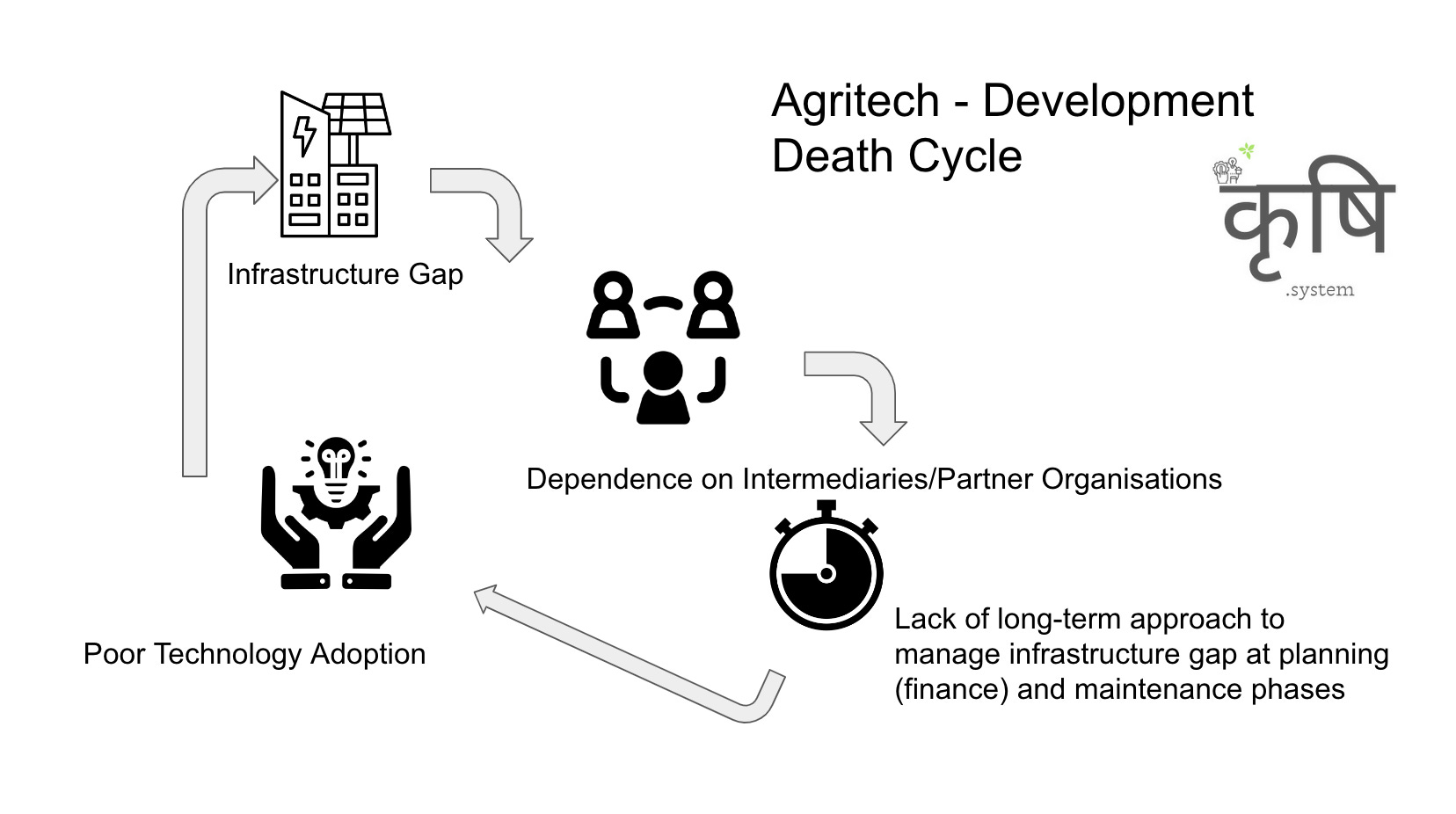
I sketched this image several moons ago to talk about Development-Death cycle and strangely enough, it refuses to become irrelevant. Can we attract capital towards systemic investments that does the hard job of market creation and address infrastructure gap that inhibits regenerative agriculture’s highest potential?
I will find out. :)
Melbourne Agripreneurs Meetup
I'm coming to Melbourne for the in-person retreat module of the Small Giants Academy's amazing Mastery in Systems Leadership Retreat. I would love to meet agripreneurs/agritech entrepreneurs/investors/regen farmers in town. I am especially excited to meet Beanstalk Agtech folks and Tenacious ventures folks and folks working on food systems in Regen Melbourne ecosystem.
Why do I host Agripreneur Meetups?
My life time goal is to build a mycorrhizal network of changemakers working on transforming food and agriculture systems. There is no agenda other than learning and understanding what different change makers are working on, wearing a variety of hats, whether through finance, entrepreneurship or culture.
If you are from Melbourne or know someone doing interesting work in food systems there, you can share this RSVP link with them. I will be grateful
Dates: 28th April 2026
Time: 530 - 730 PM AEDT
3. Kashmir Agripreneurs Meetup
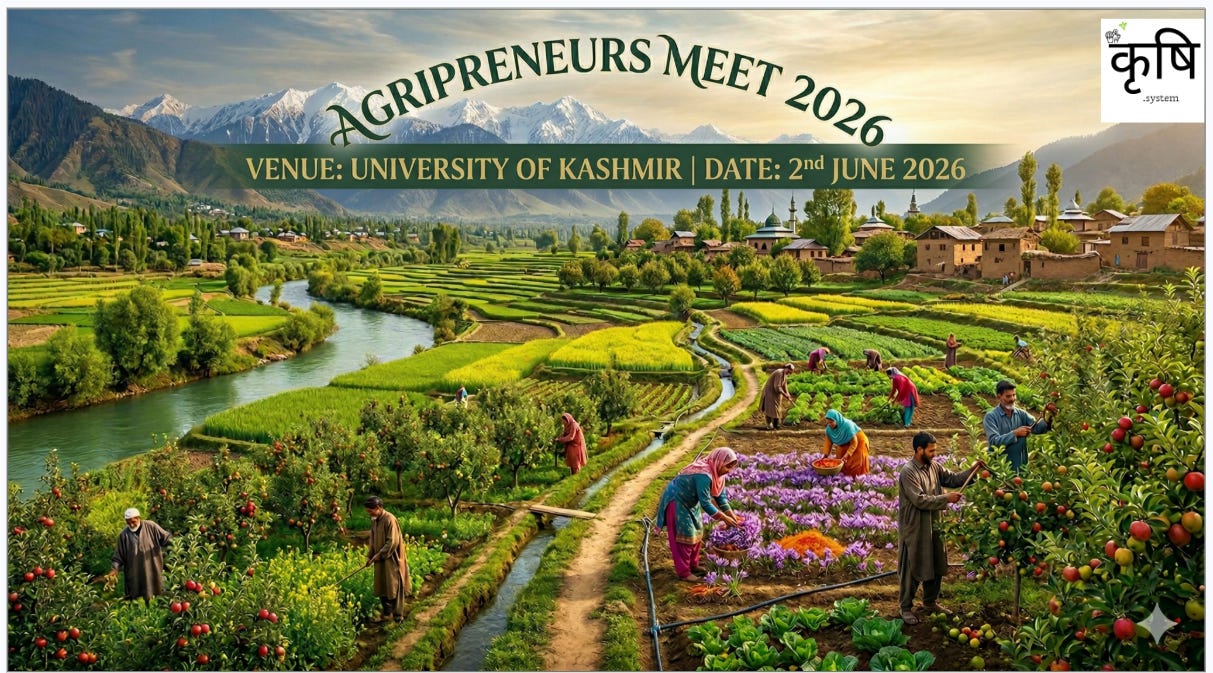
I am planning my first Agripreneurs Meet in Srinagar on the first week of June. Despite the conflict this region has witnessed over decades, Agriculture has been the most resilient sector in this region for three reasons.
1) Altitude
Kashmiri saffron grows at 1,600 to 1,800 meters above sea level in the Karewa highlands between the Pir Panjal and Great Himalayan ranges. This altitude produces the specific combination of temperature differential, soil drainage, and UV exposure that gives the stigma its biochemical profile: higher crocin (coloring strength), higher safranal (flavor), higher picrocrocin (bitterness). These are the three parameters by which saffron is graded internationally. Kashmir maximizes all three.
2) Terroir
Kashmiri apples taste the way they do because the Karewa soil, the valley's night-day temperature differential, and the high-altitude sunlight angle are an unreproducible combination.
3) Tradition
J&K holds nine GI-tagged products: saffron, Pashmina, Kani shawl, walnut wood carving, sozani craft, papier-mache, hand-knotted carpet, Khatamband, and Basmati.
How can we accelerate agripreneurship in Kashmir? How do we integrate Kashmiri agripreneur ecosystem with India's agripreneurial ecosystem? Few agripreneurs are traveling with me to Srinagar. If you are interested in joining hands, and can help me reach out to many more founders from Kashmir, let me know. You can RSVP here
Date: 2nd June 2026
Time: 10 AM - 6 PM
Wish me good luck:) If you have suggestions that will help me reframe my “Catalyzing Regenerative Agripreneurship” thesis, I am all ears.
Cheers,
Venky
So, what do you think?
How happy are you with today’s edition? I would love to get your candid feedback. Your feedback will be anonymous. Two questions. 1 Minute. Thanks.🙏
💗 If you like “Krishi.System”, please click on Like at the bottom and share it with your friend
Someday soon I hope to join your bandwagon of Regenerative Agripreuners.