Reflections from the Sixth Agripreneurs Retreat
Reflections from the Regenerative Agripreneurs Retreat that happened on April 2-3-4-5 in the forests of central India
You can follow the series here: The Seed- > The Second Retreat - > The Third Retreat - > The Fourth Retreat → Fifth Retreat
If you don’t want CC hassles, you are most welcome to use paypal or UPI (venkat.raman.kr@icici) and pay the annual subscription (8500 INR/95 USD) with your email in the comment. I will enable access immediately.
P.S. Supporting this work doesn’t have to come out of your pocket. If you read this as part of your professional development, you can use this email template to request reimbursement for your subscription.
Reflections from Bhopal Regenerative Agripreneurs Retreat
The scent of contentment is intoxicating. It implores you to start afresh with a regenerative sense of vigour. I am starting the new financial year FY 26-27 with a deep sense of contentment as I plan what comes next after completing the Bhopal Regenerative Agripreneurs Retreat.
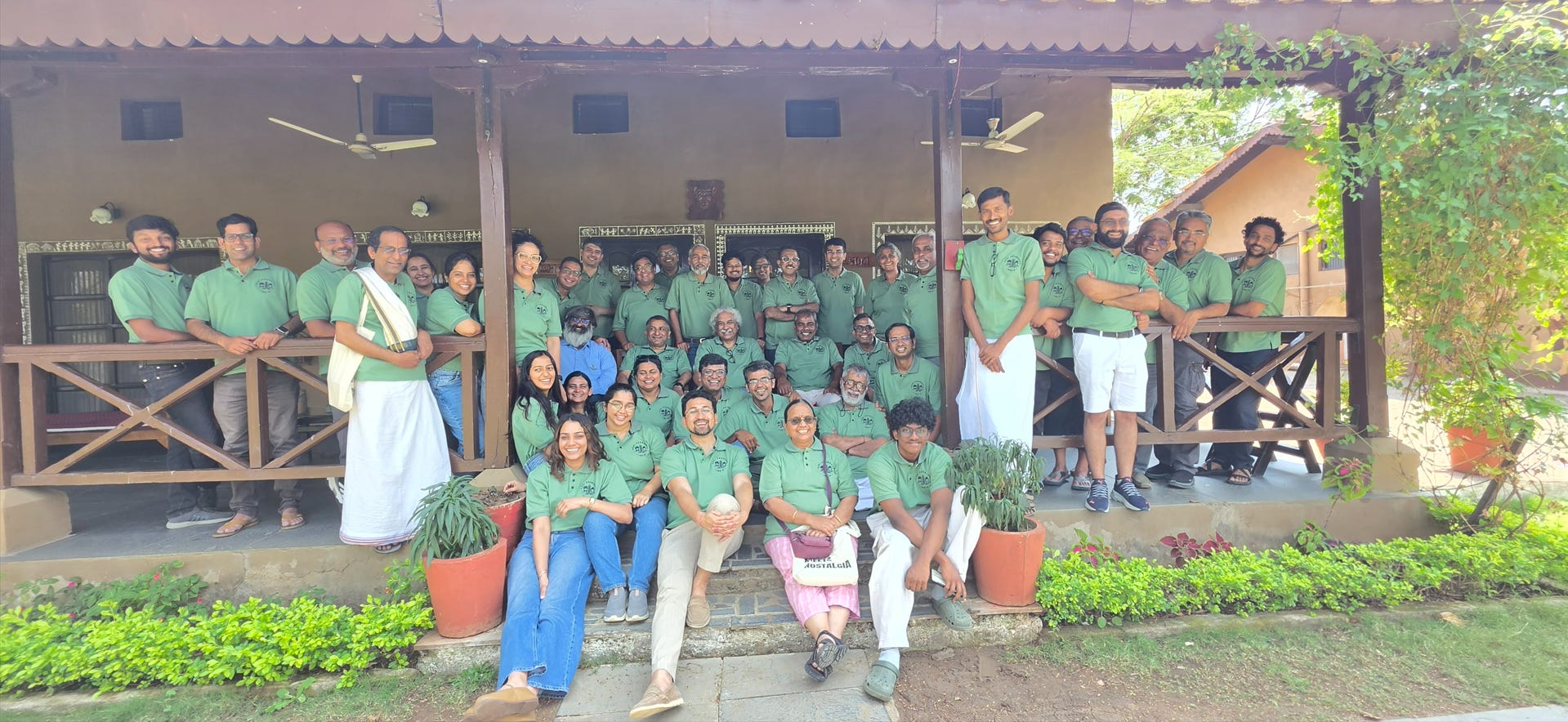
Thanks to incredible local hospitality of Prateek Sharma, Vijay Dhole and Varun Chouhan and other friends, we had an incredible experience as the retreat unfolded with lots of love, joy, care and fun. It was filled with abundance and fragrance of the mahua (Indian Butter Tree Madhuca longifolia).that besotted us throughout the Satpura forests.
With friends joining us from various parts of India, Singapore and Dubai, we had forty four entre/intrapreneurs/ change-makers working across eight clusters viz., 1) Finance & Catalysts 2) Narrative Building 3) Policy and Research 4) Direct Farmer Commerce 5) Labour and Mechanisation 6) Agritech and Digital Ag 7) Bio-Inputs and Soil Science 8) Narrative Building
Unlike the previous editions, thanks to loving nudges of friends like Gurpriya and many others, we had better gender parity among the participants with 9 women changemakers joining us among 44 participants.
As you can see from the clusters, unlike the previous retreats, we made the definition of “Agripreneurs” fluid enough to bring together diverse, mutually dependent players working in regenerative transition.
Having done five retreats, we were confident during the planning phase to go beyond the Collective and Cooperative designs that have been attempted so far and try out collaborative structures with a vibrant group that had enough fuel of passion to appreciate the mutuality and interdependence instinctively from the abundant diversity in the room.

And so it warmed the cockles of my heart to watch this retreat become the Regenerative Social Hadron Collider that accelerated individual change makers to incredible energy levels, thanks to the passion and conviction each one was bringing from their lived experience to the room about regenerative pathways.
At one point, during the second day, the energy shift was palpable as spontaneous breakout sessions went on till 9 PM despite having a long day that started at 9 AM.
This energy owed a lot to the deep authenticity and vulnerability that emerged from sharing deeply personal stories of ethical dilemmas each of the participants have been holding in their breasts.
Among the various sessions we had organized, including a beautiful deepdive on Vrikshayurveda from CIKS Balu that forced agripreneurs to revisit their assumptions towards Indian Knowledge Systems, the one on “Ethical Dilemmas” is the closest to my heart. We ask an extremely personal question to every agripreneur in the room: What are your ethics? What are the most difficult ethical dilemmas you are sitting with ?
Thirty-odd dilemmas surfaced, each a live wire. Be a marketer or a farmer's friend. Follow the funder's agenda or the community's need. Hire people who execute or people who question. Stay small and stay true, or compromise a little and scale. Is data really objective ? Is it possible to institutionalize good work?
Should I be an apolitical entrepreneur or stay true to my political roots? Should I price my product based on the market realities or the real value I perceive in my bones? Should I take CSR funding or wait for the elusive patient capital? Should I stay true to my family and family business or break it down and become an entrepreneur in my own right? Should I focus on mechanisation or focus on livelihoods even when the work has copious amounts of drudgery? Should I give into pressures of the State or stay true to my ethics?
In conferences, especially with entrepreneurs in the room, people typically find ways to quickly resolve them. In a retreat like ours, we didn’t do that mistake here. We listened and sat. For listening intensely is sometimes more than enough.
There was one beautifully dilemma that I didn’t see coming though: What if the solutions we are envisioning for today become tomorrow's problem? And there was one that is definitely worth meditating deeper on.
Should I stay 100% committed to the perfect vision that is possible only at small scale right now ? Or should I compromise a bit and scale bigger? Most ecosystem conversations treat this as a sequencing question, as though deep conviction and scale are bed fellows. Anyone who has watched a regenerative enterprise navigate its fifth year knows that such hard questions have no other way other than to live through them.
Sometimes the willingness to sit with hard questions long enough is sufficient to change the people asking.
You see, at the end of the day, there is not much difference between agripreneurs and plants.
Both need sufficient nutrition to transform themselves. The trouble begins when we settle down with only one form of nutrition (VC capital, Incubator/Accelerator) and see everyone else as competitors.
Mitali and Saumya from Urbanfarms gave us a master class on Crop Nutrition 2.0 based on the emerging paradigm in soil science.
The first generation of crop nutrition thinking asked a very simple question. What is the plant missing and how do we deliver it directly?
Nitrogen, phosphorus, potassium — ionic, water-soluble, immediately available. It worked spectacularly for a generation until physics and biology started protesting. A soil running on electrolytes alone eventually loses its ability to manage itself.
Mycorrhizal networks do something ionic delivery cannot: they route surplus from where it exists to where it is needed, across species lines, in response to signals the plant cannot even articulate.
Strangely enough, this session on Crop nutrition opened up a rabbit hole that transformed how I look at the entirety of my retreating business.
What if there could be another form of nutrition for agripreneurs beyond the conventional sources of nutrition? What could happen when we build mycorrhizal networks of agripreneurs who are willing to provide nutrition to fellow agripreneurs?
When we can let the plants choose the relationships it wants to build for nutrition and disease protection, thanks to a diverse and abundant and healthy microbial community in the soil, why not create a vibrant ecosystem for agripreneurs that lets them choose the relationships they want to build for their growth and prosperity?
It's funny.
It needed an independent solopreneur business to make the first real moves in building a vibrant community and a well-thriving ecosystem around Indian Agriculture.
Seeing the reflections from participants after the retreat (Ramesh, Manish, Prachur, Rahul, Pramel Gupta and Ashish Gupta) reaffirmed the deep conviction I have been pregnant with for a long time: Indian agripreneur ecosystem is hungry for a space with no agenda other than its highest possibility.
When I run the business of being independent (read as solopreneur business), I'm able to hold that container effortlessly without much strain. I am able to confidently state out that there is absolutely no other agenda here than the highest vision we could aspire to as a community.
It’s paradoxical and yet obvious when you mull over it. The smaller the organizational form, the larger the vision it can hold.
As a solopreneur, I have no board to answer to, no investor thesis to protect,
no particular business model to defend. No particular pet technologies to propagandize.
Being independent in these anxious times feels like a blessing — because independence at one level makes genuine interdependence possible at another.
So what next from here? I am getting ambitious.
I am doing an Agripreneurs Meetup in Melbourne later this month.
I am organizing a two-day Kashmir Agripreneurs Workshop on June 2nd and June 3rd this year with a bunch of agripreneurs traveling from various parts of India.
I am organizing a workshop with investing folks on making regen transition financing work in the month of June
I am organizing a special gathering of religious organisations working on regen transition in the month of July
I am planning the next Agripreneurs Retreat at Chandigarh on September 24-25-26-27
There are lots to do with the power of an ecosystem. It is now starting to feel easier to go after moonshot projects. Time now to dream bigger and chase goals that seem too daunting.
So, what do you think?
How happy are you with today’s edition? I would love to get your candid feedback. Your feedback will be anonymous. Two questions. 1 Minute. Thanks.🙏
💗 If you like “Krishi.System”, please click on Like at the bottom and share it with your friend


