
Women's Day, Year of Woman Farmer And Other Inanities
A Rant and an Invitation.

State of Agritech - 10th March 2026
In Today’s Edition:
1/ Women’s Day, Year of Woman Farmer And Other Inanities
2026 has been officially declared the International Year of the Woman Farmer by well-meaning folks at FAO. And another Women’s Day went by. I don’t know about you. I feel queasy. No, strike that. It actually feels deeply ironic to celebrate both. Not for reasons you might think though.
In 1970, Danish economist Ester Boserup published “Woman's Role in Economic Development”. Based on her documentation of how women contributed immensely to Agriculture in African societies, she discovered an interesting pattern. At the risk of making this a procrustean narrative of men vs women, you could call it “Male Takeover” thesis.
When an activity is informal, low-status, or subsistence-level, women do it. The moment it becomes commercially valuable, credentialed, or institutionally recognised, men move in and women are pushed to the margins.
You can see this across farming activities and sectors and value chains.
Take the case of seed systems. Women were running community-driven seedbanks for a long time. When Green Revolution came and challenged the earlier paradigm with state-sponsored resources, men took charge and community seedbanks were relegated to the fringes of rural consciousness.
Take value chains which haven’t been commercialized extensively. Tubers like Purple Yam. Edible Weeds with incredible nutrient density. Picture someone growing them in your head. Be honest. Is the grower male or female? You know the answer.
As rice farming scaled up in Asia, women lost decision-making authority even though they had been the primary rice cultivators. As dairy became commercially organised in India, women who had managed household dairy for generations lost control to cooperatives run by men.
Animal husbandry carries ‘husbandry’ for a reason. As floriculture grew into an export industry, male entrepreneurs captured it while women remained casual wage labour.
If we go back to the early agricultural societies, whenever hand tools like the hoe and the digging stick were used, they were used by the women farmers. Men were the hunters, women were the gatherers.
At least until plough came along.1
Women spent seasons observing the same plants, learning which seeds returned most reliably, understanding germination and soil and seasonal timing. Agriculture, Boserup argued, was the direct extension of that knowledge.
In “The Invisible Sex”, J.M. Adovasio, director of the Mercyhurst Archaeological Institute, and Olga Soffer, professor of anthropology at the University of Illinois went further. They argued that women were not merely contributors to early agriculture. They were its inventors.
The religious historian Carol P. Christ arrived at the same place through Neolithic mythology, ritual, and archaeology. She argued that women invented not just agriculture, but also farming, pottery, and weaving. More importantly, she argued that women invented the knowledge systems that preserved these discoveries. Women encoded their knowledge in song, story, and ritual, whether through the planting ceremonies, the harvest rites or the seed-blessing traditions that appear in every agricultural culture on earth.
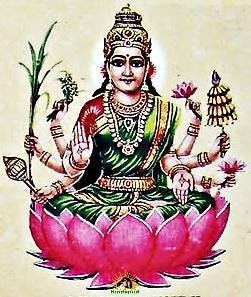
The Greek goddess Demeter. The Egyptian Isis who taught starving people to grow wheat. The Roman Ceres who gave her name to cereal itself. In Hindu traditions, among the eight forms of wealth goddesses, Dhanya lakshmi was the goddess who blessed us with abundance of grains. The examples could go on across diverse cultural memories we have preserved in every culture.
In their fascinating book, “The Dawn of Everything”, authors David Graeber and David Wengrow put it beautifully
“Every time we sit down to breakfast, we are likely to be benefiting from a dozen such prehistoric inventions. Who was the first person to figure out that you could make bread rise by the addition of those microorganisms we call yeasts? We have no idea, but we can be almost certain she was a woman..”
Are you seeing the irony here?
Women built the knowledge systems that birthed agriculture, encoded it in ritual, and passed it down across generations. And we have the audacity to call it “The International Year of Woman Farmer”.
The irony goes much deeper when you consider the very word “Farmer” and its structural male origins.
Every major word for "farmer" — across English, Latin, Sanskrit, Tamil, Telugu, Kannada, and Arabic-borrowed Deccan vocabulary — is rooted in the plough or legal land tenure.
In English, “farmer” comes from the Medieval Latin firma, meaning a fixed payment or rent. A farmer was originally a legal tenant who held land under a fixed-rent contract. Since medieval European property law defined all legal parties as male, the word “farmer” was masculine by structure.
The same is the case with the colonial administrative word — ryot, raiyat — which came from Arabic ra’iyah, meaning flock, subjects. A ryot was a male who had acquired the legal right to hold land.
Latin provides an interesting twist in this tale. Agricola - farmer - should grammatically be feminine. But since the noun referred to what Roman society had already decided was a male occupation, the language overrode its rules and assigned it masculine gender.
When we go to languages thar predate the plough and the colonial revenue system, we get in touch with fluid identities of growers.
Take the case of Swahili, where the living, colloquial term for the person who grows and sells food is mama mboga (mother of vegetables). The official Swahili word for farmer, mkulima, is gender-neutral. Mama mboga is the word people actually use.
Or closer home, take the case of Santali, spoken by the Santal people of Jharkhand, Odisha, and West Bengal. It is one of India's oldest living languages. It has no grammatical gender on nouns. No masculine or feminine for occupational words.
The word for a cultivator is chasa. Technically neutral. Santal men use call cultivators as chasa hor, where hor is the Santal word for both "man" and "human being." The people call themselves hor.
Barring older languages, the language built the male farmer into its etymology. Unless, we see the irony in using the word “farmer” and replace it with “grower”, there is no point celebrating “The Year of the Woman Farmer”.
Let’s be clear. This is not about just about history or linguistics.
This is the ground reality as well in countries like India where there are more labourers than farmers. Spend a quiet afternoon in almost any farm across India. You are most likely to find women working in the fields. Driven by male out-migration to cities, the feminization of Indian agriculture is accelerating in Indian fields. Women are de facto farm managers across large parts of rural India. Running farms they cannot legally own. Making decisions they are not institutionally recognised to make. Servicing debts taken in their husbands' names.
And yet when you look at official marketing narratives from government engines, you see something like this.
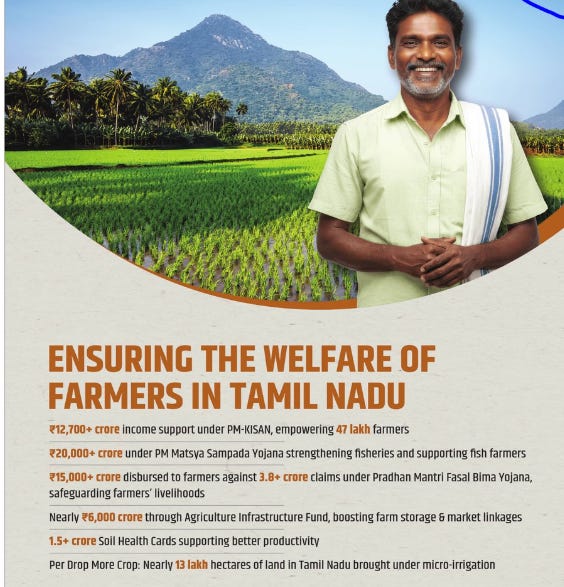
Of course, this is not to berate the Government.
As I wrote in “State of Agri-Mechanization”, this feminization is making its presence felt in the political sphere with a 227% rise in welfare spending for women in agriculture. Agripreneurs I speak to across the country are largely convinced that Village-Level Entrepreneurs are better run when helmed by women.
The institutional logic has not evolved with these ground realities. The extension worker still finds it more convenient to engage with the male farmer. The Kisan Credit Card is in the man's name. The FPO leadership roster is still male by default.
The agriculture that India needs most urgently right now is the agriculture that most resembles what women built in the first place.
Agroecology runs on capabilities the Green Revolution made redundant. It requires intimate knowledge of local seed varieties and their responses to specific microclimate It requires observing soil behaviour, pest cycles, and plant health in ways no external advisory can replicate. It requires place-based, long-duration ecological attention.
This is no idealism wrapped in feminist stripes.
Last week, I wrote about APCNF programme — Andhra Pradesh Community-managed Natural Farming.
It did not take off because bureaucrats designed a better input package. It took off because women in SHGs became the primary practitioners and knowledge-carriers of zero-budget natural farming. In 4,116 program Gram Panchayats, 9,741 village Self-Help-Group federations, 287,084 women Self-Help Programs with a membership of 30,07,072 women are in charge. Among, 10,000+ community resource persons driving this program, 60% are women.
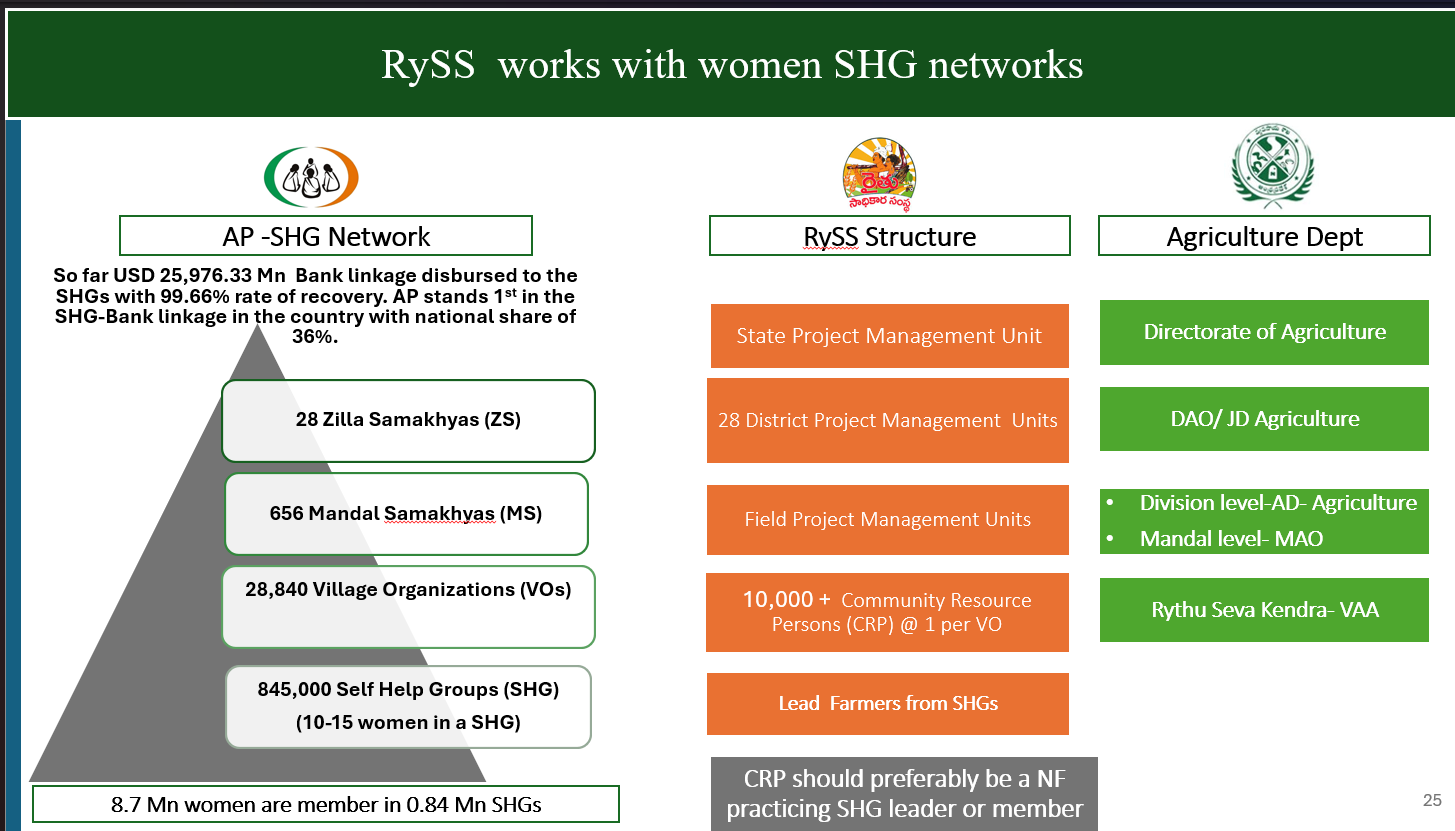
The national conversation about scaling agroecology is almost entirely happening among men in think tanks, policy committees and agritech boardrooms. The knowledge is feminine. The authority over it is not.
There is a lot to be done from land titles to women-led seed banks to designing FPO leadership structures. When the government designs the institutions to scale natural farming nationally, women should not be the target beneficiary. They should be the governing authority.
The Green Revolution spent sixty years making her invisible. Today, we are content to play DEI games with platitudes and tokenism. Take the case of policy names. MFME, Mukhyamantri Mahila Rojgar Yojana, Mukhya Mantri Udyami Yojana — women appear across schemes, while leaving existing structures intact.
The time for banal homilies is over.
Epilogue:
In our Agripreneur retreats so far, we have had less participation from women founders. Those who joined though have had some amazing feedback to share (Hear this straight from Archana Stalin and Rishita Changede) about our retreats.
I've been trying hard to bring many women founders to our retreats. I have been asked to give scholarships and other incentives for more participation. But I feel uncomfortable as it feels patronizing. In my head, a founder is a founder, irrespective of gender.
For the upcoming retreat in Bhopal, we have less than 5 percent of participation from women founders. I am eager to change this. Would you have ideas to bring more women founders to our retreats? I am all ears.
Economists Alesina, Giuliano, and Nunn (2013) tested Boserup's hypothesis empirically and found a strong and robust positive relationship between historical plough-use and unequal gender roles today. Traditional plough-use is positively correlated with attitudes reflecting gender inequality and negatively correlated with female labour force participation, female firm ownership, and female participation in politics.