
Vrikshayurveda (Indian Plant Science) Deepdive with A.V. Balasubramanian
In this first part of the deepdive, we explore the epistemological foundations of traditional Indian Knowledge Systems.

Whenever we talk about traditional Indian knowledge system, there is an elephant in the room we often shy from addressing. Why does Vrikshayurveda - a corpus of plant science older than almost any living intellectual tradition - still have to justify its existence every time it enters a room?
Why, after thirty centuries of farmers using neem, does India hold no position of leadership in neem research? Why, when a tribal community in Andhra Pradesh is using 420 species of medicinal plants with documented efficacy, does the nearest IIT estimate ten years and twenty lakhs INR (~21K USD) per plant per application to validate what farmers have already spent generations refining?
In my podcast with AV Balasubramanian (AVB), we explored many of these gnarly questions. AV Balasubramanian is one of the leading pioneers of deploying the wisdom of Vrikshayurveda in Indian Agriculture.
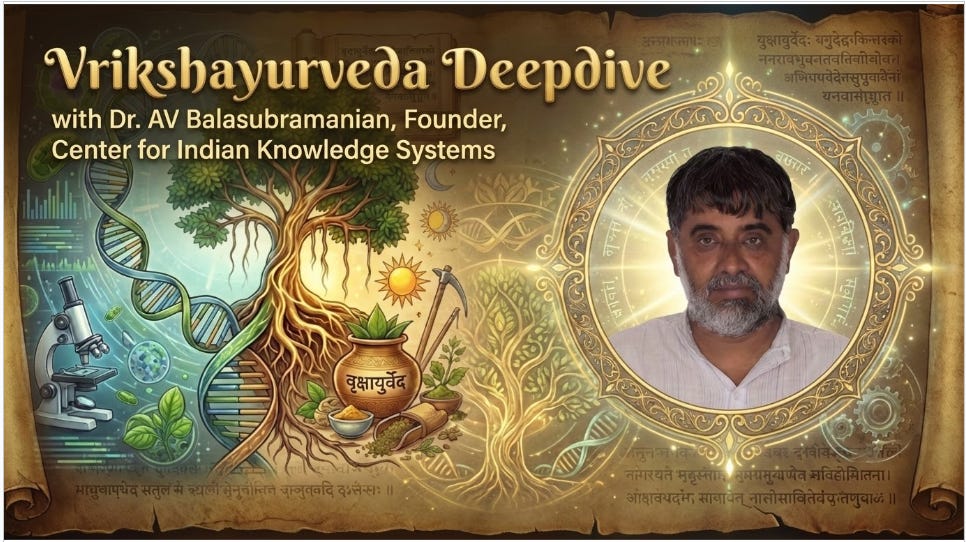
He is the co-founder of the Centre for Indian Knowledge Systems (CIKS) in Chennai, one, besides conserving 170+ traditional rice varieties, of the most serious institutional efforts to apply Vrikshayurveda -- the classical Indian science of plant health - to modern day challenges in sustainable agriculture.
His background is unusual even by the standards of people who do unusual things. A biochemistry and biophysics training at premier Indian institutions, a PhD abandoned in the US in 1982 in favour of a deep interest in exploring Science rooted in the Indian tradition, a decade as a student and teacher of Yoga at Krishnamacharya Yoga Mandiram under the direct lineage of T. Krishnamacharya and T.K.V. Desikachar, and eventually a decades-long collaboration with the Patriotic and People-Oriented Science and Technology (PPST) group, the intellectual collective that, more than any other, attempted to recover the epistemological foundations of Indian science rather than merely its recipes.
AVB could have made a career from positioning traditional knowledge as a cultural heritage to be preserved. He didn’t.
He has made a career of asking whether it works, under what conditions, for which problems, and how to scale it. His field team used a principle from Vrikshayurveda -- that bitter taste is an indicator of pesticidal potential -- to crack a fruit-and-shoot borer problem on brinjal that neem had failed to solve.
His experiments with Ayurvedic storage forms (arkas, thailas, arishtas) have demonstrated that shelf life -- the most commonly cited limitation of natural bioprotectants -- is a solvable problem, using technology the Ayurvedic drug industry has operated for over a century.
It’s unalloyed joy to hear when AVB speaks.
He speaks with scientific precision (while warning of the dangers of epistemic fascism) and carries his passion for Indian knowledge system with a scientist’s penchant for rigor. What made this conversation personal was not just the fact that he studied Yoga under the same lineage I have been studying since 2013. It was our shared love and passion for Indian Knowledge systems.
In the first part of this wide-ranging chat, AVB and I engage in philosophical throat clearing, exploring the context of Vrikshayurveda, before engaging with the the content of Vrikshayurveda.
I started off the dialogue with a fundamental question.
Traditional Indian medical and philosophical frameworks seem to rest on categories like vata, pitta, kapha that have not changed in millennia. A modern scientist looking at that would say: if your categories never change, is it really science?
In response, AVB shared a beautiful analogy he had read from Captain Srinivasa Murthy.
Imagine you make a list of every group that has tried to invade or conquer India over thirty centuries. You can list them in chronological order -- Greeks, Turks, Arabs, Portuguese, British, and so on. Or you can classify them differently: those who came by land, those who came by sea, those who came by air. The second classification not only subsumes everything that happened in the past but is capable of accommodating anything in the future.
An Ayurvedic physician examining a patient is doing exactly this. When he looks at a complex of symptoms and asks whether the primary doshic imbalance is vata, pitta, or kapha, he is using a classification scheme that exhausts the universe of discourse.
Although I hate takeaways, here is an edited transcript of the conversation for those who want to go into the greyness and nuance we explored. Always remember. The Map is not the Territory.

If you don’t want CC hassles, you are most welcome to use paypal or UPI (venkat.raman.kr@icici) and pay the annual subscription (8500 INR/95 USD) with your email in the comment. I will enable access immediately.
P.S. Supporting this work doesn’t have to come out of your pocket. If you read this as part of your professional development, you can use this email template to request reimbursement for your subscription.
Venky: You have explored an unusually wide range of subjects -- yoga, traditional metallurgy, water management, plant science -- yet your profile on the PPST website reveals a persistent interest in the epistemology of Indian knowledge systems. Before we get into the substance, I want to start personally. What was it like when you encountered this corpus of work?
AVB: I have to make this slightly biographical. Today I am being introduced as someone who made a journey into Vrikshayurveda and traditional knowledge. But I am as much a child of modernity as most others. I went to Kendriya Vidyalaya, studied biochemistry and biophysics, spent time at premier institutions, and was a PhD student in the US when I felt a craving to look at science and technology more rooted in Indian tradition. I didn’t even have the terminology “Indian knowledge systems” at that point.
I was a student in the US when I felt this craving. Having rather ingloriously abandoned a PhD in 1982, I made my journey back to Chennai. My basic training being in biophysics, I thought the nearest I could look at in terms of Indian knowledge systems was medicine or Ayurveda. But formally studying Ayurveda seemed a formidable six-to-seven-and-a-half-year course. Yoga seemed much less structured, more informal, not regularised. I first became a student and a teacher at Krishnamacharya Yoga Mandiram.
What struck me most forcefully was this patriarchal figure, Krishnamacharya himself, 90-plus years old. I always felt that when people talked about what great people India had two or three thousand years back, most of it was exaggerated. People who fought twenty thousand people, people who had brahmastra and all that. But it really blew my mind -- at the age of 93 or 94, I could see Krishnamacharya sitting in Mandaveli in Chennai, ram-rod erect. His memory was crystal clear, his recollection far better than mine.
We would start classes with him, both of us sitting ram-rod stiff. By about thirty to forty minutes we would be drooping and stooping. After one and a half hours he would still be fit as ever. Even if he resumed classes after three weeks, he would not be confused about where we stopped. He would know exactly where to start without any reference note. I said to myself: I am willing to believe that there was something very interesting in Indian knowledge with respect to health and yoga, if this is what we have by way of someone who practiced yoga at 93 or 94.
Around that time I encountered PPST -- the Patriotic and People-Oriented Science and Technology group. I had heard of them even when I was a student outside India. They were looking at traditional knowledge not as history or anthropology -- not as “the glory that was India” -- but in terms of its current relevance and potential.
What use or significance could it have today? I started taking a serious look at various aspects of traditional knowledge systems. It is an eclectic collection -- I worked on yoga, traditional Indian metallurgy, water management, and at some point I encountered Vrikshayurveda. My wife Viji and I decided to start an institution to look at traditional Indian knowledge systems from the point of view of agriculture -- helping people cultivate crops and grow them in good health based on traditional knowledge, wisdom, and practices. That was CIKS.
At first it looked like what people were doing was a collection of recipes. Where is the theory? People are using neem, people are using so many things. But slowly it struck me. Today people may say neem has efficacy because it contains Azadirachtin. But people have been using neem for thirty-plus centuries, long before this chemical composition was known. So what did they have in mind? Did they have a theory at all?
I got into Vrikshayurveda, the application of Ayurveda for traditional Indian plant science.
The biggest challenge we face when looking at traditional Indian sciences is that we are not a clean slate. We carry baggage. We have a checklist -- if you call something science or rigorous knowledge, it must have these five qualifications. And a lot of what you see around you fails that checklist immediately. You feel: this is superstition, where is the science? I think the easiest way to start is to address a few of these challenges head-on.
Venky: Let us start with them. Traditional Indian medical frameworks rest on categories like vata, pitta, kapha that seem to have not changed in millennia. A modern scientist looking at that would say: if your categories never change, how can this be science?
AVB: A few years back I witnessed a fascinating conversation between an outstanding vaidya (traditional healer) and a modern scientist -- a member of the national academy of sciences and the scientific advisory committee to the Prime Minister. We were at an airport together. The scientist started in a friendly way. In science, we have theories that are changing and evolving to solve new problems. But it looks like in Ayurveda you are living with the same categories for millennia -- vata, pitta, kapha. How do you understand this? Far from being defensive, the vaidya said confidently. Yes, it means there is a timelessness about our basic principles. They are not like fashions in clothes that you keep changing every year. The scientist was taken aback.
Looking back, I want to share how I made sense of this.
Around 1915, the Madras Presidency appointed the Usman Committee to travel across the region, interview hundreds of traditional physicians, assess efficacy and theory, and address the scientific basis Indian systems of medicine. The member secretary was a modern physician called Captain Srinivasa Murthy. He produced a small booklet, obscure and hardly known today, called The Scientific Basis of Indian Systems of Medicine. He addressed this question directly with a striking analogy.
Look at a list of all the peoples who have tried to attack India over thirty centuries. You can list them chronologically -- Greeks, Turks, Arabs, Portuguese, English. Or you can classify differently: those who came by land, those who came by sea, those who came by air. This second classification not only subsumes everything that happened in the past but is capable of accommodating anything in the future.
When an Ayurvedic physician understands whether a patient’s suffering arises from an imbalance of vata, pitta, or kapha, he is using this second kind of classification -- a scheme that exhausts the universe of discourse. So if you challenge a physician by saying “this virus was not around when Charaka Samhita was written” -- the physician says: produce the patient before me. I have a line of treatment based on doshic imbalance. The fact that this classification is timeless should not mislead us into thinking it is fossilised.
There is also a hierarchy of levels that yoga teachers talk about. One level is tattva -- the basic worldview. Another is shastra -- the science and technology derived from it. The third is prayoga -- application.
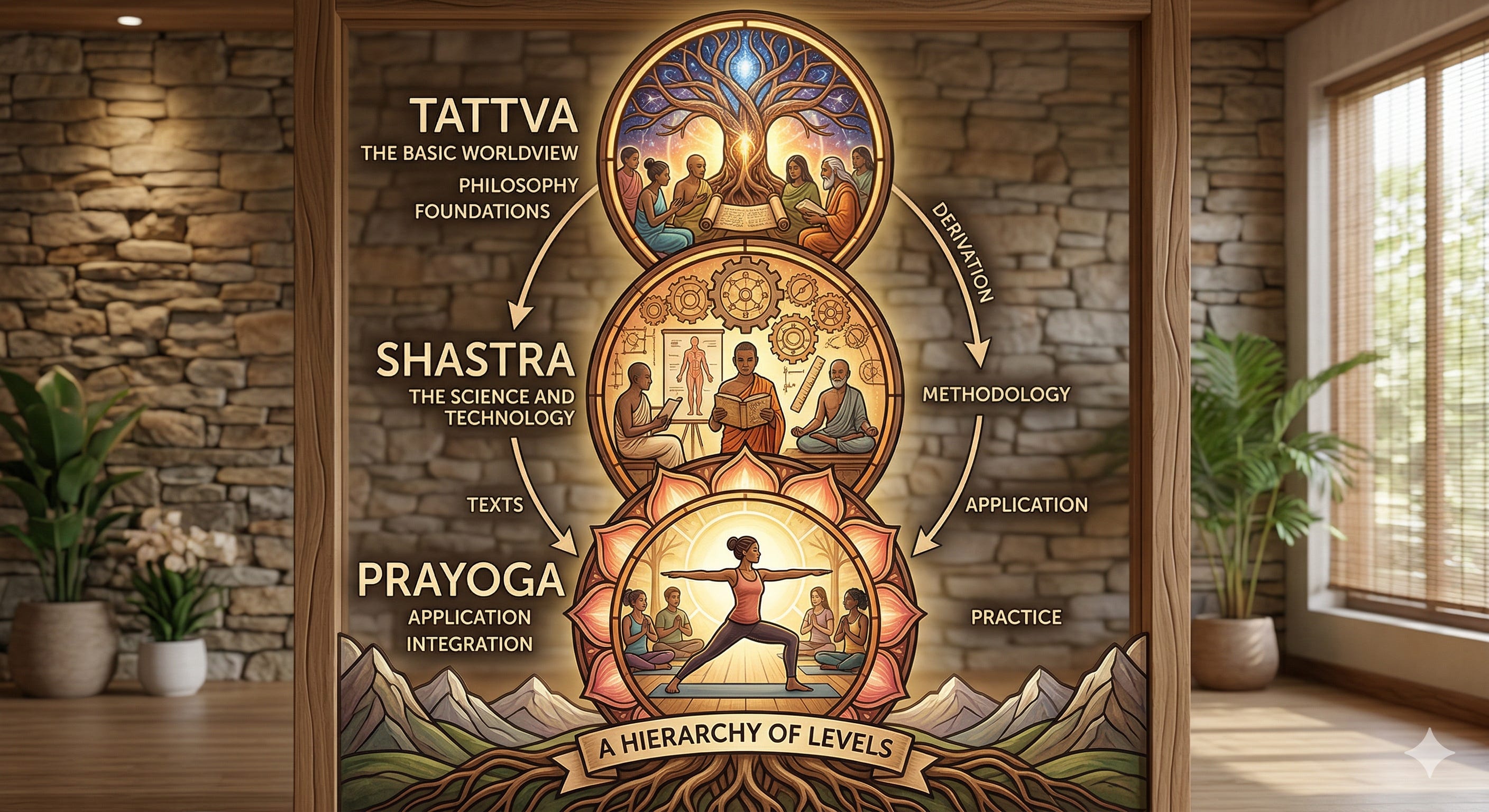
At the level of the basic siddhanta, there is timelessness.
At the level of shastra, things vary from time to time. An Ayurvedic text may prescribe sitting in padmasana for three hours -- written when yoga was practiced in a gurukula, where an eight-year-old child’s body, diet, and behaviour were entirely under the guru’s control. What you can prescribe is very different from today, when somebody walks in at forty-five, a chartered accountant with intense back pain.
At the level of prayoga, every patient and every context is different. The constant revision we valorise in modern science is one approach to rigour. The exhaustive classification that yields timeless categories is another.
Venky: I have been studying Patanjali's Yoga Sutras for some years now. It has significantly changed how I look at my work in agriculture. Given that you learned from Krishnamacharya and Desikachar, how did the practice of yoga specifically reshape the way you approached Indian knowledge systems?
AVB: Several ways. Let me try to isolate the most important ones.
The first was context-dependence. A text like Patanjali’s Yoga Sutras is not a user manual. Nobody can pick it up and start practicing yoga the next morning. It needs interpretation for the specific practitioner, the specific condition, the specific time. One of the most fascinating things I learned is how yoga is adapted to the particular person. If you ask what practice helps someone with asthma: who is this person? Age? History? Daily routine? An abstract answer is not possible.
This brought me into direct conflict with what we consider the great virtue of modern scientific approach: standardisation.
I once accompanied a legendary Ayurvedic physician from Pune on a visit to a well-known Ayurvedic research facility. A young researcher proudly told us they had completely standardised a herbal formulation for diabetes. He listened patiently and said, “I hope you have also standardised the patients coming to you for treatment.”
The second was acceptance.
When people come saying they want to give up smoking, you cannot simply tell them smoking is bad. They already know it. If they could drop it on instruction, they would not need a teacher. You have to understand why they reach for the cigarette. Usually it is stress, tension, a kind of relief. If you help them find another way to manage that, one day the cigarette drops by itself. You accept people where they are and work from there.
The third was openness.
There was a psychologist who was asked by a German colleague at a European conference: What does yoga have to say about mental retardation? He looked blank. The German said, “Yoga has texts that have talked about the nature of the mind as far back as thirty centuries. They must have said something.”
He was humble enough to say, “I don’t know, let me find out”.
When he came back to Chennai, he went to the top three yoga experts in the city. The first two said: Mental disability, No problem, send them to us, we will cure them completely. Then he came to Desikachar.
Desikachar said: people with a large number of conditions come to us and in several cases we are able to help. I have no experience in mental disability. Let us do something. You send some of these children to me. Let us see if we can help, and you tell us if yoga is working.
That partnership went on for several decades.
What Krishnamacharya himself said was clear. Some shastras are for practical application. If the practical application is curing disease and improving health, you can pick up anything in your armoury that will help in that cause. He could be sometimes the senior partner, sometimes the junior partner, and -- most importantly -- there were times when he had the humility to say: for this condition I do not think I have anything specific to offer. Look elsewhere.
To him, tradition was not a fossilized thing. It changed and adapted. Sometimes during the course of reading a text, I would ask him a question out of idle curiosity. He would refuse to entertain it. He would just say: why do you need that now? I am not going to use that practically.
Venky: My wife was treated by an Ayurvedic physician for rheumatoid arthritis. The first thing he told her was: there is no such entity as rheumatoid arthritis in the worldview of Ayurveda. There is only amavata. That collision of two taxonomies is exactly what a farmer encounters when he is talking about a crop disease. Two completely different vocabularies for what may or may not be the same phenomenon. How do we navigate that?
AVB: Stay focused on the outcome. That is the only way to avoid getting lost.
Take anemia. Modern understanding: a deficiency of iron, or a deficiency in the capacity to metabolize iron. Supplement iron, treat accordingly. In Ayurveda, iron as a biochemical entity is not defined. The closest thing they have is pandu or pandurog.
If you present a hundred anemic patients to an Ayurvedic physician, he will likely say 85 of them have pandu. The other 15 may have something else.
Conversely, present a hundred pandu patients to a modern physician, and he may say only 80% are anemic. The overlap is large. The categories are not identical. The ayurvedia physician is not just treating iron deficiency. He is understanding which doshic imbalance is at work and addressing the whole configuration.
The trap we fall into is epistemic fascism. I hesitate to use a word that rough. But the trap is real. Rather than looking at the endpoint that science and technology is supposed to achieve, we get caught asking: are you using the right terminology? Only if you use this terminology will I recognize you.
There is also a cobweb we need to clear.
In Ayurveda we say that a substance that has such-and-such a taste is likely to have such-and-such a therapeutic property. My training as a biochemist sets off alarm bells. Where is the science in this?
A friend who was a theoretical physicist wrote me a letter when I first got interested in traditional knowledge. He said: Balu, if I look at texts of Greek mathematics and science -- Aristotle, Pythagoras -- however old they are, I feel they are scientific. But the Indian texts you describe seem all mixed up. I cannot accept this as science.
It is a genuine cry of anguish. But it points to a real epistemological difference.
Aristotle made a fundamental distinction between essential and non-essential sensibilia. We get knowledge through five sense organs. Something you can know through only one sense organ -- like the colour white, which you can see but not taste or touch -- was given a different, lesser epistemic status than something you can corroborate with a second sense, like number.
Galileo took it further. He said there is more in common between the weight of an apple and the weight of the moon than between the weight of an apple and the colour of an apple. This is the root of modern science’s insistence on quantifiable, corroborable, single-sense-independent measures.
Now look at how India approached this differently.
In Nyaya and Vaisheshika philosophy, some things can be grasped by one sense organ, some by more than one, and some only by the manas (discriminatory organ). But the Indian theoreticians said that the veracity of what you perceive has to be independently verified. You do not link it to whether it was sent through one sense organ or two.
This sounds very abstract until I had a practical experience of it.
We had a problem with fruit-and-shoot borer on brinjal -- a tough pest that neem cannot control. A few weeks later when I visited the field, our team said they had cracked it. I asked how. They said: we sprayed a solution of sirayani -- andrographis paniculata. Sirayani is used in medicine, but its agricultural application was not known to us. I asked: what made you try it? They said: the Vrikshayurveda principle is that bitter taste is one indicator of pesticidal potential. So we asked ourselves -- we have something that not even neem can control. Do we have something even more bitter than neem? Yes -- andrographis. We tried it. It worked.
In the absence of this example, the theoretical claim about taste and pesticidal properties sounds like hocus pocus. With this example, you see exactly what that framework was for
Venky: This brings us directly to the question I most wanted to explore.
What is the distinction between lok parampara(folk knowledge) and shastric parampara? (Classical Knowledge). This disinction came alive through my great-grandfather’s farming text from 1908 -- chapter after chapter quoting agricultural proverbs in sutra format, and describing village-level crop scientists testing and refining those proverbs in practice. The common assumption is that shastric parampara is the authoritative stream and lok parampara is folk knowledge waiting for validation from above. Is that accurate?
AVB: Not at all. They are not antipodal. They are almost a continuum.
A classical text like Charaka Samhita or Sushruta Samhita has a fully spelt-out theoretical framework -- the seven dhatus, the tridosha -- written in classical languages and transmitted as manuscripts. In lok parampara, the carriers are a very large number of people who have no formal training. Their knowledge is picked up from the family, the neighborhood, from living closely with plants and animals across generations.
The poet A.K. Ramanujan once said, “No Indian ever read the Ramayana or Mahabharata for the first time. Looks like they always have it.”
My mother was fifth-standard pass. I would hear her say: I have this headache, it is my own fault, I drank too much coffee on an empty stomach. She did not learn pitta aggravation from a textbook. It is part of the lok parampara.
What is remarkable is that the classical texts themselves recognise and honour this. In the Brihatrayee texts -- Charaka, Sushruta, and Ashtanga Hridaya -- there are explicit passages asking: From whom should you learn about locally prevalent herbs and their uses? From gopala, from shepherds, from the tapasis in the forest. The shastra itself says that your baseline of knowledge comes from the people.
Let me give you an example that shows both directions of this relationship.
A colleague was working in a tribal block. He documented that the tribals in that area used about 420 species of medicinal plants for various purposes. He went to a nearby IIT for help in validation. They told him: per plant, per application, you should budget five to ten years and fifteen to twenty lakhs. A lifetime of work to validate what the tribals had arrived at through generations of practice.
He was then put in touch with an Ayurvedic physician who gave him a larger perspective. Lok parampara and the shastric parampara share a common underlying worldview and terminology. They are not in competition.
I witnessed this alignment directly.
In the Araku Valley, we observed tribal farmers using dried goat droppings as fertiliser for vegetable crops. We proposed a simple field experiment -- one plot without fertiliser, one with chemical fertiliser, one with goat droppings. The tribal farmers stopped us immediately. They said: goat droppings are ushnam -- hot in potency. You should test it only for the winter crop. This idea that substances have thermal properties -- ushnam, sheethalam -- I had learned from Ayurvedic texts. But the tribal farmers had not learned it from any text. They had arrived at the same understanding through observation and transmission across generations.
The diarrhea work shows the other direction.
In that tribal area, local remedies were effective in about 65% of diarrhea cases but failed in about one-third. When Ramesh Nana examined the failures, he identified that the tribal diagnoses were accurate when the primary dosha was kapha or pitta. When the primary dosha was vata, their treatment was incomplete. He offered a simple addition to the diagnostic process -- how to identify whether vata was the primary factor. The efficacy went from 65% to 95%. He was not overriding their knowledge. He was building on it within the same worldview they already held.
The Panini grammar tradition has a beautiful reflection on this.
People are speaking all over the country in all kinds of ways. Is the specialist’s role to sit in judgment and say what is correct and what is not?
Panini tradition says no.
If I need a pot, I go to a potter and commission one. But if I am moved by a new emotion and need a new word for it, I do not go to a grammarian. The new word emerges in the marketplace. The specialist’s role is at a different level -- a meta level. To illuminate structure, to help people build on what is already living, not to grant or withhold permission for it.
Venky: The biologicals industry is now one of the most heavily venture-funded areas in agriculture. Brazil saw 75% growth over recent decades, and is very well moving toward decentralized biological systems. But the central limitation is shelf life and variability. If you had a blank cheque to invest in scaling Vrikshayurveda over the next ten to twenty years, where would you put it?
AVB: The shelf life challenge is real and we faced it ourselves from the beginning. Farmers had grown comfortable with a bottle of pesticide -- fixed concentration, spray it, done. They asked us reasonably: can you not give us something more user-friendly than saying bring eight kilos of this, two kilos of that, boil, filter, leave in the sun, and then spray?
The answer we found was already inside Ayurveda itself. Take tulsi kashayam -- a decoction made fresh at home, shelf life of one day. But Ayurveda prescribes storage forms with dramatically different shelf lives. Arkas -- distillates, including what we all grew up drinking as ajwain water -- last several weeks to months. Thailas, oils, last several months. Arishtas and asavas, the fermented preparations, can last several years. These are not exotic or inaccessible technologies. The Ayurvedic drug industry has been producing them for over a century. They do not require corrosive solvents. They do not require very high temperatures. They are reasonably scale-neutral.
We tested whether converting a plant extract to an arkam retained its biological properties. In a large number of herbs -- yes, the property is retained. Something with a shelf life of one day can have a shelf life extended to several weeks or two months.
Take andrographis. A kashayam made from it has a shelf life of one day. Can you make an arkam out of it? Yes. Can you make a churam -- reducing it further to ash and doing an additional preparation? Yes, and in some sense you are applying a framework from Ayurveda that gives an entirely different level of concentration and transformation.
There is a deeper philosophical point here. When Rauwolfia serpentina was encountered by the West over a century back, they fractionated and purified it and came up with the alkaloid reserpine. Reserpine turned out to have strong side effects not seen in the whole plant formulation. When you purify something from a full plant extract down to one or two compounds, you are not only concentrating those compounds, you are getting rid of everything else. Much of what you discarded was acting synergistically. The concentrated purified product is sometimes more dangerous precisely because the rest is gone.
Some of the most interesting possibilities are in seed treatment. Ayurveda prescribes bija samskara -- fumigating seeds with the fumes of certain herbs to confer disease resistance. We have treated seeds with andrographis and oroxylum. They seem to exhibit residual disease resistance. But we have not yet fully tested whether this property survives six months of storage. That is a genuine frontier.
CIKS has moved primarily in the direction of farmer training and field science, not product development. But that product development path is genuinely open. The Ayurvedic drug industry already knows how to prepare arkas and charams at scale. Someone only has to walk that road deliberately in the direction of agricultural biologicals.
Venky: One frontier that excites me is using computer vision to identify vata-pitta-kapha imbalances in plants from images -- the way NDVI indices or colour changes are already being tracked. Are there image databases that could be categorised this way?
AVB: It is certainly possible in principle. In Ayurveda, even in the case of human patients, there are sophisticated methods -- prakriti analysis, examination of the eyes, skin, tongue, posture -- that could in theory be translated into image-based classification. The same logic applies with plants. But to do it properly you need two things. First, a baseline: what does a genuinely healthy plant of each variety look like, in terms of luster, reflectivity, colour, texture? Second, a reference library: how does each type of doshic imbalance manifest in change from that baseline?
The honest answer is we have not even scratched the surface of this. It is genuinely possible and the tools exist. But no one has yet done the careful, systematic work of mapping Vrikshayurveda’s diagnostic categories onto measurable image parameters. That mapping is the hard part. Once it is done, the computer vision layer is almost easy.
Venky: Over the last forty to fifty years, we have seen the erosion of community-based structures in Indian agriculture -- panchayat bodies with no real authority, centralisation of decision-making, the slow hollowing out of the institutions that carried this knowledge. Who is the custodian of Vrikshayurveda now? Can an organisation hold that role, or does it have to stay rooted in community?
AVB: I think there is a significant misconception that has sent effort in the wrong direction. Many people have concluded that the primary challenge is protection -- safeguarding our knowledge from being stolen by others, blocking patents.
I was a small part of the neem and turmeric patent battles twenty-five years ago. People asked: is there anything in Siddha texts that describes turmeric’s wound-healing properties? We found it, we used it to challenge the patent.
But Let’s step back and ask the harder question.
Sushruta Samhita is roughly two thousand years old and carries this knowledge. If we had been doing anything with it over those two thousand years, would we not be world leaders in wound-healing today? We are not. We seem to have done nothing with it.
An ICMR scientist once put it to me with a sharp image. Have you seen those Hindi films where there is a box full of gold and diamonds and people search for it for years, and when they finally get close, a snake appears and hisses at them and drives them away? Our attitude to traditional knowledge is like that snake. We guard it fiercely. But we are doing nothing with it.
The neem story is instructive in the other direction. In the 1960s, Western scientists visiting Delhi saw some remarkable neem trees -- including some in the India International Centre campus. Within a couple of decades, the West had complete technological leadership in neem research and application. The first two World Neem Conferences were not organised by India. We claim twenty-five centuries of neem use. But we haven’t taken forward
Custodianship is important. But practice is even more important. A living farmer practice is worth more than any sloka in any text. Nobody learns to make wine by reading biochemistry and microbiology. Nobody learns to make rasam from a recipe alone. There are subtleties in practice that can only be transmitted through practice.
The best example I have is an old farmer we encountered when we first started working with herbal bioprotectants. People in the village mentioned him, slightly dismissively -- oh, there’s an old man who still does that sort of thing. We went to him. What he was doing was this: he had a large pot with about a third of its volume filled with cow urine. He would gather eight to ten plants, crush them, add them to the urine with a bit of water, seal the pot with cloth, and bury it. Every week or two he would unearth it briefly and stir it. After the fermentation was complete, he had a product -- extraordinary smell -- which, when filtered and sprayed, functioned as a broad-spectrum biopesticide. When we asked him which plants he chose, he said: these are not rigid rules. You can use plants that are bitter in taste. You can use plants that cattle refuse to graze. You can use plants whose stems produce a milky latex when broken, like arka or calotropis. Work within those principles and make your selection. That is a parampara. Translating that into field practice is something I could not have derived from any text in a lifetime of work.
Venky: I recently met a 75-year-old plantation owner in Kerala who told me that his fields respond differently when he walks through them -- that the plants are more vigorous when he is present and attentive. In the Indian tradition, the human being is part of the system. Has CIKS done any work on the role of the farmer’s presence -- his attentiveness, his relationship with the land -- and how that affects outcomes in the farm?
AVB: I have not studied it rigorously, and I want to be honest about that. But I am also unwilling to dismiss it.
What I can say is that the mental element is unambiguously strong in the treatment of human beings and plants. In yoga and Ayurvedic treatment, how you approach a patient, how you guide them, what path you lead them down matters enormously. A direct answer is not always the right intervention.
There is a teaching story in the vaidya tradition.
A man comes complaining of baldness, has spent enormous sums trying every remedy. The vaidya says, "I can help you”. It will cost fifty thousand rupees, and it will take forty-one days. The man agrees. After forty-one days, the vaidya hands him a bottle of oil and says: apply this every day. One condition: while applying the oil, you must never think about monkeys. The man laughs and says: I never think about monkeys, this is no condition at all. Two weeks later he returns looking like a wreck. He says: I cannot apply the oil without my mind filling up with nothing but monkeys. The vaidya says: at your age, some things are natural. There is no cure for that. Why did you not tell me this directly? He said: if I had told you at the outset, you would have walked out and gone to the next practitioner who would promise a cure for one lakh, or the one after that for two lakhs. Now you have walked this path. Now you believe me.
This is exactly what you are pointing at. Sometimes the person most involved in a system -- whether patient or farmer -- arrives at understanding through a path they had to walk themselves, not through information transferred from outside.
What an attentive farmer does concretely is also worth noting: he observes in fine detail. He notices what is uneven. He pays attention to small changes in specific corners of the field. That attentiveness in itself is an intervention. Whether it also operates on some other level -- whether plants respond to something beyond the physical presence, the observation, the care -- that is something genuinely worth exploring. I have heard too many credible people describe it to dismiss it. But I have not done the work to speak to it with confidence.
Venky: When I search for Vrikshayurveda today, almost everything I find is still trying to justify its existence. After so many hundreds of years of exploration in this land, we still have to prove that it exists. What thought would you leave people with?
AVB: Learning about tradition is not a finished product. It continues.
When Krishnamacharya was more than 97 years old, there was a conference about teaching yoga to children with special needs. People came from various parts of India. In the middle of the gathering, he was asking curious, detailed questions of all the people who came -- what was working, what was not. Somebody remarked that he was still so curious at this age. He said, very naturally: even now I consider myself a student. What is the problem?
As Dr. Radhakrishnan once said, “It takes centuries of living to make a little history, and it takes centuries of history to make a little tradition.” It is not out of nowhere. But then it needs somebody with the patience and seriousness to figure out what from those traditions is relevant for today, in this context -- and what is not.
If Krishnamacharya could say that at 97, there is still a great deal for all of us to learn and do.
So, what do you think?
How happy are you with today’s edition? I would love to get your candid feedback. Your feedback will be anonymous. Two questions. 1 Minute. Thanks.🙏
💗 If you like “Krishi.System”, please click on Like at the bottom and share it with your friend