
Will Indian Agriculture No Longer Be a State Subject?
Pay attention to the future tense. Agriculture Is Still A State Subject. However, looking at the 2025-26 policy reforms, I am starting to harbor doubts.

At the heart of each and every 2025-2026 policy reform that strives to transform rural India and Indian Agriculture lies a provocative question: Will Indian Agriculture No Longer Be A State Subject ?
I am not exaggerating one bit.
Peel the skin of each of 2025/2026 policy reforms - VB-G RAM G Act, Seeds Bill, Pesticides Management Bill 2025, National Cooperation Policy and National Policy on Agricultural Marketing. If you pay attention to the forest instead of the trees, you might perhaps listen to the quiet, beating heart of this provocative question.
Of course, constitutionally speaking, Agriculture is a State subject (Entry 14, List II in Seventh Schedule).
But here is the thing.
The bitter experience of the 2023 Farm Law Repeal taught the current Union Govt an important lesson. Legislative force generates resistance that reinforces status quo. And so, if the Union Government is hungry for reforms, especially with Modi quietly recognizing that he is perhaps in his last term, what should they do? How can the Union government legislate without stepping on States’ constitutional toes?
Beneath the slew of policy reforms, I see a sophisticated policy gameplay.
Niti Aayog builds the "software" (Model Acts, Policy Frameworks, and Digital Platforms) for States. And thanks to centralization of taxes, populist spending packages and historical burdens, the States’ fiscal predicament forces them to "install" them, leaving them with less freedom of choice to take decisions on important State subjects (such as seeds)
What fiscal conditions are we talking about? Take the case of States like Punjab, Kerala and Himachal Pradesh that have high debt-to-GSDP ratio. Each of these states cannot afford to say no to Central funds. States like West Bengal and Telangana that tried to exercise "Freedom of Choice" and faced immediate fiscal blockade. In contrast, states like Andhra Pradesh and Uttar Pradesh aligned quickly to maximize fiscal intake. Instead of forcing laws on States, NITI Aayog drafts Model Acts and policy frameworks. These serve as blueprints that States can voluntarily adopt, adapt (as it happened during the case of Farm Laws in states like Rajasthan), or even ignore (as it happened in the case of West Bengal when the state refused to receive funds from PM-Kisan for a brief period)
To encourage States to install this "software" and implement reforms, NITI Aayog creates indices and ranking systems that measure States' performance on various parameters.
Composite Water Management Index | Aspirational District Blocks Program | AMFFRI (Agricultural Marketing and Farmer Friendly Reforms Index). There are plenty of such indices Niti Aayog has been playing with for quite some time.
This naming and shaming (and conversely naming and faming) approach through indices creates peer pressure among Chief Ministers and their bureaucracy to improve their state's ranking.
Now let’s examine each of the policy reform in detail to observe this gameplay.
Take the case of VB-G RAM G Act:
The Viksit Bharat – Guarantee for Rozgar and Ajeevika Mission (Gramin) Act, passed in December 2025, subtly shifts power from the State Capital to the Gram Panchayat, bypassing the middleman of state bureaucracy. By mandating that plans must be integrated with PM Gati Shakti, the Centre forces local Panchayats to adopt central digital standards (Geo-tagging/real-time dashboards) to get funds. States that don't digitize effectively choke their own funding pipelines.
Or take the case of Seeds Bill:
The Seeds Bill creates central registration requirements, central seed committees, and notably proposes to recognize 'any organization established in territory outside India, for conducting trials to assess the Value for Cultivation and Use', bypassing state-level agricultural institutions entirely.
The Centre doesn't need to get into legislative conflict with States to remove trade barriers. By digitizing the seed itself, the Centre creates a "One Nation, One Seed" market. A bag of seeds approved in Telangana can be verified in Punjab instantly. It renders state-level protectionism obsolete through technology.
Or Take the case of Pesticides Management Bill 2025:
Section 2 explicitly brings the regulation of the pesticide industry under the Union Government, citing public interest. This centralization aims to ensure uniform standards while state governments have not been provided with regulatory powers to act on prohibition of pesticides.
It includes a "deemed registration" clause. If not decided in 18 months, it's deemed granted. This prevents State bureaucrats from sitting on files to extract rents. If the State is inefficient, the Centre's law automatically clears the product, forcing States to be efficient to stay relevant.
Or take the more pertinent case of National Cooperation Policy:
The Centre cannot directly legislate on State Cooperatives as it is a State Subject. The creation of the Ministry of Cooperation itself was the first centralizing move as cooperatives are constitutionally a state subject. The policy establishes three multi-state cooperative societies for exports, seed production, and branding & marketing of organic products, thereby bypassing state cooperative structures.
The 2025 Policy opens up lucrative Central sectors to State entities such as Primary Agricultural Credit Societies (PACS).
PACS are now licensed to run retail fuel outlets (a Central subject). PACS can run generic medicine stores. PACS effectively become the digital nodes for central schemes. But here is the catch. To access these lucrative business licenses, the PACS must adopt the Model Bye-laws drafted by the Centre.
The Centre isn't forcing the Bye-laws. It is simply saying, "If you want your local cooperative to own a petrol pump (high revenue), they must adopt the new Bye-laws." This is "Cooperative Federalism" weaponized—using financial carrots to standardize governance across diverse states.
The Policy sets a target of increasing cooperative contribution to GDP by 3X by 2034. This creates a measurable metric. States are now ranked not just on “Ease of Doing Business” but on “Cooperative Vibrancy”—effectively shaming states that let their sugar or dairy cooperatives collapse due to corruption.
The cooperative sector in India has long been plagued by "Ghost Societies"—paper-only entities used for laundering funds or vote-banking. The 2025 Policy uses data transparency to trigger competition. PACS computerization funnels all cooperatives onto central digital platforms, creating a "traceability spine" the Centre controls.
Finally, Let’s take the case of National Policy on Agricultural Marketing.
The Policy explicitly proposes the creation of a "Market-Stack" or "Unified National Market Portal (UNMP)”. Just as “India Stack” (Aadhar/UPI) became the OS for finance, “Market-Stack” is the proposed OS for Agriculture. It mandates a "Federated Model" where State-level registries (Prices, Licenses, Mandi Automation) must be integrated with the Central Portal via API (Application Programming Interface).
“States /UTs those have notified such policy are required to tweak their policy framework to be by and large in consonance with the National Policy Framework to achieve the goal of making available “Best Possible Market and Price” to the farmers for their produce .” - Chapter 3: Mission of National Policy Framework
Pay attention to the language here.
It doesn't say "States should decide"; it says they must "tweak" their laws to match the Central Master Code. The Policy proposes a new governance layer in Chapter 7: An "Empowered Agricultural Marketing Reform Committee" modeled explicitly on the GST Council. The goal here is to push States to adopt a "Single Unified Trading License" valid across the country.
By modeling it on the GST Council, the Centre is signaling a move toward a "One Nation, One Market, One Tax" structure for Agriculture. Just as States lost their financial sovereignty under GST, this committee aims to erode their marketing sovereignty by standardizing fees and licenses.
Is Agriculture still a State subject? On paper, yes. But in practice, the “autonomy” of a State is shrinking, to explore the metaphor of the software further, to merely customizing the user interface, while the backend logic is increasingly controlled by the Centre.
The Centre acts as the architect, designing the blueprints and holding the purse strings. The States are becoming the contractors—free to build, but only if they follow the Union Architect’s plan.
Perhaps, as we discover, much to our chagrin, how cooperative federalism becomes coercive federalism through technology, it might help if we reflect on true meaning of cooperative federalism.
The shibboleth “Agriculture is a State Subject” is perhaps the oldest truism of Indian agriculture. Enshrined in the Constitution, it was designed to empower local governments.
But here is the thing. Enshrined autonomy can never be the same as living, dynamic autonomy.
In a country like India with 86% smallholders, there has always been a healthy tension between the Center pursuing the national agenda-involving all states, political parties and other stakeholders - and each state fulfilling its constitutional obligations on agriculture.
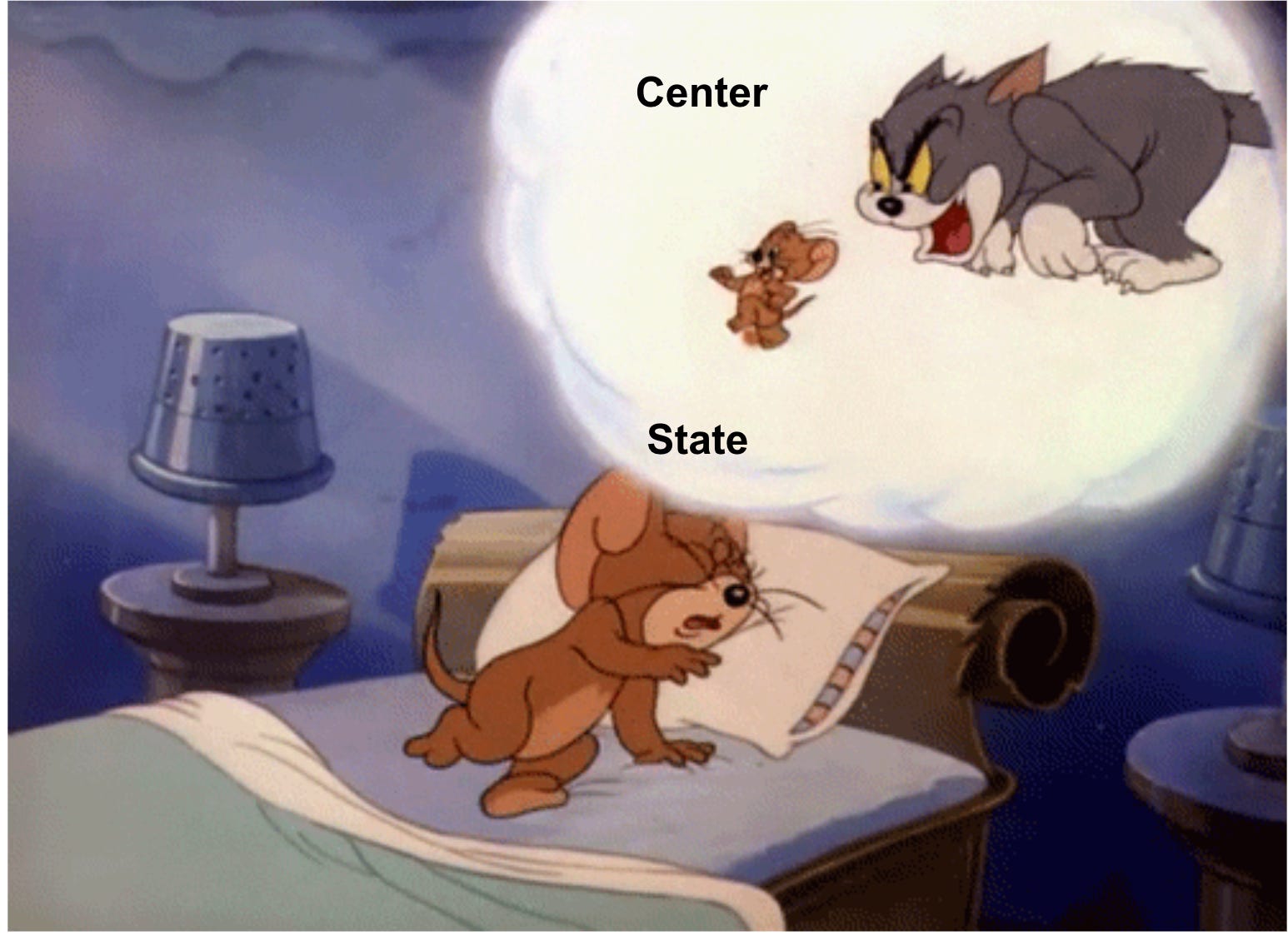
For outsiders, here is Ajay giving a good taste of the complexity we are dealing with.
“The Union Minister will soon realise that central government policy is restricted by the fact that agriculture and land are in the domain of the states; animal husbandry and fisheries where real growth is visible are separate ministries; the budgetary allocations are controlled by the Ministry of Finance; and an outdated inflation policy is dictated by the RBI.” - Ajay Vir Jakhar (Source)
Cooperative Federalism is today an utopian ideal.
As this fascinating EPW paper explores in greater detail, today, we face a strange predicament where richer states (Punjab, Haryana, Telangana, Gujarat, Karnataka, Maharashtra, and Tamil Nadu) are much bigger beneficiaries of subsidies compared to the poorer states.
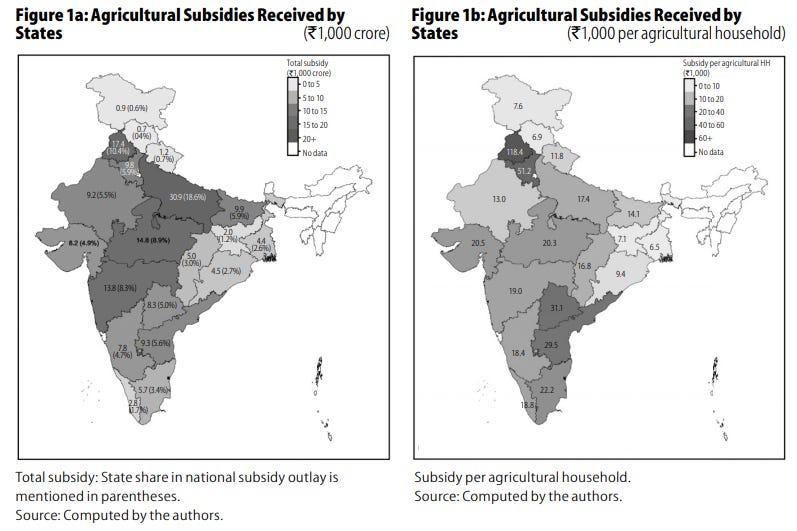
True cooperative federalism is a matter of skin in the game with each state financing their own farmer support initiatives.
True cooperative federalism is a matter of the Union Govt providing robust public infrastructure (research and development, insurance and post-harvest infrastructure), before it rushes to provide digital public infrastructure.
True cooperative federalism is a matter of States having the freedom and responsibility to ‘discharge their constitutional obligations on agriculture’.
True cooperative federalism is a matter of States exercising responsibility and boundaries through their agricultural policies. One State’s policy cannot take a toll on the natural resources of another State.
Perhaps, a lot of water has crossed under the bridge to rediscover Cooperative federalism in the current political context. We can reimagine policy reforms better if we respect the principles of Cooperative federalism, instead of weaponizing it.
When true policy reforms for Viksit Bharat 2047 demand rhythm and balance in Centre-state and inter-state coordination, can we get our hands together and think more strategically for the future?
The Samudra Manthan teaches us that the nectar of immortality was not obtained by one side overpowering the other, but by a grueling, synchronized effort involving both.
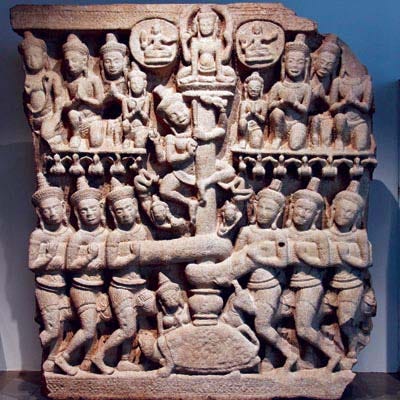
NITI Aayog’s current policy gameplay may achieve the technical efficiency required to churn the Amrit of a $30 trillion economy, but it risks hollowing out the federal spirit that holds India together. To truly reform Indian agriculture, the Centre must loosen the digital noose and allow States to pull their weight. Only when the tension on the rope is equal, and the rhythm is shared, as the puranas tell us, will the ocean yield its treasures.
If you don’t want CC hassles, you are most welcome to use paypal or UPI (venkat.raman.kr@icici) and pay the annual subscription (8500 INR/95 USD) with your email in the comment. I will enable access immediately.
P.S. Supporting this work doesn’t have to come out of your pocket. If you read this as part of your professional development, you can use this email template to request reimbursement for your subscription.
So, what do you think?
How happy are you with today’s edition? I would love to get your candid feedback. Your feedback will be anonymous. Two questions. 1 Minute. Thanks.🙏
💗 If you like “Krishi.System”, please click on Like at the bottom and share it with your friend.