
Sunday Reflections (Hosachiguru, Policy Reforms, Cooperative Federalism, Agritech Expectations for Union Budget)

Dear Friends,
Greetings from Hyderabad, India. Welcome to Sunday Reflections where I reflect on what I’ve written and ask myself, In doing what I am doing, what am I really doing?
Subscriber-Only Post Trailers
DPI for Indian Agriculture: Paper Review
A new white paper argues that better architecture will drive adoption of digital public infrastructure in India. How do we address the DPI adoption challenge in the Indian context when the constraint is institutional and not technical?
This paper—produced by Co-Develop, Gates Foundation, The World Bank , Vital Wave, and OpenAgriNet—advocates for a layered “building blocks” approach to digital agriculture: foundational DPI (identity, payments, data exchange) complemented by sector-specific blocks (farmer registries, crop registries, data standards, AI assets).
Their promise is seductive. Who doesn’t want to reduce fragmentation, enable interoperability, unlock innovation?
The paper places heavy reliance on Registries (Farmer, Plot, Crop) as the Sector-Specific Building Blocks. It cites AgriStack and the Digital Crop Survey as successes where foundational DPI (Aadhaar) links to land records to create a "Farmer ID."
The paper exhibits classic technology determinism: build the infrastructure, and good things follow. But consider the sequence in India.
Aadhaar existed since 2009. UPI scaled from 2016. PM-KISAN (direct transfers) was launched around 2019. AgriStack was announced during 2021. As of December 2024, only 3.7 million farmer IDs were created while the goal was to reach 60 million by end-2025.
Why the slow uptake despite “mature” foundational DPI? Because the problem was never primarily technical. The paper acknowledges this obliquely, but then proceeds as if better architecture will solve political problems.
More in a recent subscriber-only post at Krishi.System.
Will Indian Agriculture No Longer No Be a State Subject?
When true policy reforms for Viksit Bharat 2047 demand rhythm and balance in Centre-state and inter-state coordination, can we get our hands together and think more strategically for the future?
The Samudra Manthan teaches us that the nectar of immortality was not obtained by one side overpowering the other, but by a grueling, synchronized effort involving both.
NITI Aayog’s current policy gameplay may achieve the technical efficiency required to churn the Amrit of a $30 trillion economy, but it risks hollowing out the federal spirit that holds India together.
To truly reform Indian agriculture, the Centre must loosen the digital noose and allow States to pull their weight. Only when the tension on the rope is equal, and the rhythm is shared, as the puranas tell us, will the ocean yield its treasures.
How did Hosachiguru thrive while Growpital capitulated?
How did Hosachiguru thrive while Growpital capitulated? On the surface, there are plenty of similarities between asset-light Growpital and asset-heavy Hosachiguru.
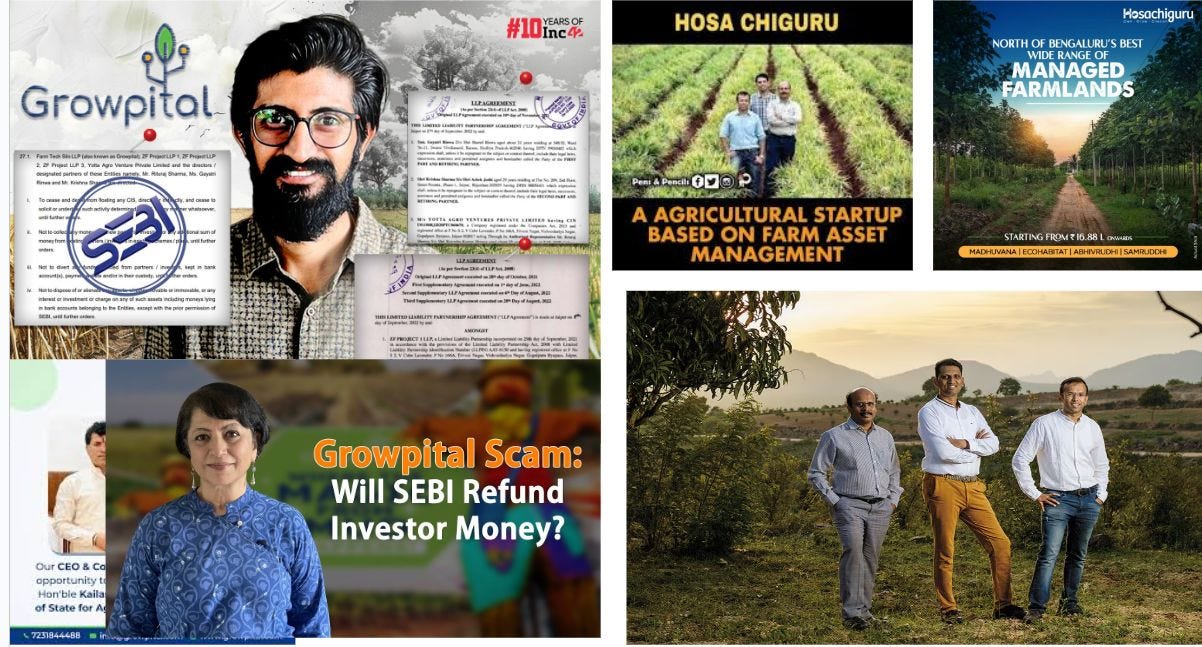
Both promise the same dream: “Be a farmer without the sweat”.
And yet while Growpital is stuck in regulatory gridlock, Hosachiguru has grown significantly. What did Growpital do which Hosachiguru didn’t and vice-versa? How did Hosachiguru evolve its business model and deal with the same risks which Growpital encountered differently? How is Hosachiguru different from Organo Eco Habitats?
Now is a great time to sell the urban dream of becoming a farmer without a sweat. Believe it or not. You can also now own a cow without managing it.
I’ve been tracking agri-investment tech players for quite sometime. Keeping aside my fundamental discomfort of severing land’s agrarian roots by making it a real-estate product, it’s fascinating to see how this space is spreading its tentacles from managed farming to real estate to agri-tourism, crafting a niche in building elite community/weekend life real-estate projects for India 1 market.
When farm land gets priced beyond a point, it becomes a real-estate product. When farmers are exiting agriculture, should we be, atleast, happy that through expensive real-estate deals, urbanites could get to rediscover their connection with land and soil?
Although I’ve been tracking Hosachiguru for a while, I realized I hadn’t written about them, especially while watching their influencer collaboration video advertorial with gen.E.
Although you could argue that comparing Growpital with Hosachiguru is the case of apples and oranges, it is fascinating to contrast their divergent journeys.
More in a recent subscriber-only edition of Krishi.System.
My Agritech Expectations for Union Budget 2026
Let’s be honest.
Budget expectations hardly move the needle for farmers. Except for thought leadership theater, where wish lists become subtle acknowledgement of what was lobbied for in Krishi Bhavan chambers, budget wish lists keep piling without creating a dent in the livelihoods of farmers.
Smallholder Farming continues to be unviable for smallholding farmers. Governments ensure that this charade continues for the sake of political brownie points through subsidies to compensate the unacknowledged taxes farmers pay by being at the receiving end of a misguided policy that favour consumer inflation over farmer incomes. Of course, governments are fully aware of the leakages that ensues and talk of having no choice, but to subsidize a broken farming system. You could argue that if not for government support, farmers would have long discontinued farming.
Conversely, by not pulling out the plug, you could argue that we’ve managed to create sustainable poverty that churns out disenchantment year after year, even while soil health becomes alarming enough that it is eventually pulling the plug out from farming.
Farmers are better off if they refuse any form of support from governments. Whenever I meet individual farmers, I tell them to build direct relationship with consumers. Let consumers discover that their health is in farmers’ hands. Let farmers discover that their economic needs are better met by them being farmers.
That said, where can governments really help? Perhaps, collectively speaking in supporting farmers transition towards regenerative farming practices. When you contrast how much governments support conventional farming systems with regenerative farming systems, you discover the yawning chasm in terms of what governments can do to ensure that the next generation continues to do farming.
With that prologue in place, my top expectations from this year’s Budget are the following:
1) Currently, a massive chunk of ICAR/State Ag University budgets goes toward salaries and pensions, leaving little for actual research. Allocate 1% of agricultural GDP (approximately ₹30,000 crore) to agricultural R&D, with a clear mandate that at least 40% goes toward frontier technologies including AI-driven crop advisory systems that reduce input costs, genomics for crop improvement, and bio-input development. Alternatively, a matching-grant framework where government funds match private investment in high-priority areas like climate-resilient seeds or precision farm tools could also be explored.
2) A dedicated ₹2,000 crore fund for operationalizing forest and tribal livelihood corridors that link traditional knowledge holders (forest communities) with formal AYUSH and nutraceutical value chains, backed by streamlined single-window clearances.
3) BRCs currently struggle because they are treated as government extensions rather than viable business units. Transform BRCs into ‘Bio-Economy Hubs’ run by FPOs/Rural Entrepreneurs with a standardized, fast-track quality certification process (Bureau of Indian Standards aligned). Allow them to plug directly into the fertilizer subsidy ecosystem so that bio-inputs get the same price-support visibility as chemical fertilizers.
4) Legalize and formalize land leasing through a model law that states can adopt, building on NITI Aayog’s 2016 recommendations. Provide fiscal incentives for FPO-based collective farming models that can achieve operational scale without changing ownership.
5) Convert 25% of the urea subsidy (approximately ₹30,000 crore) into a “Soil Health Improvement Grant” that states can access only if they demonstrate measurable improvements in balanced fertilizer use ratios. Mandate digital Soil Health Cards integrated with Point-of-Sale fertilizer systems, or alternatively create Soil-Health Wallets, so that recommendations can translate into actual purchase behavior.
6) Create a specialized credit guarantee fund for FPOs that want to buy assets (drones, grading machines, cold storage infra, pack house) rather than just inputs (seeds/fertilizers)
What do you think? Does it make sense? What would you add?
Patna Agripreneurs Meetup
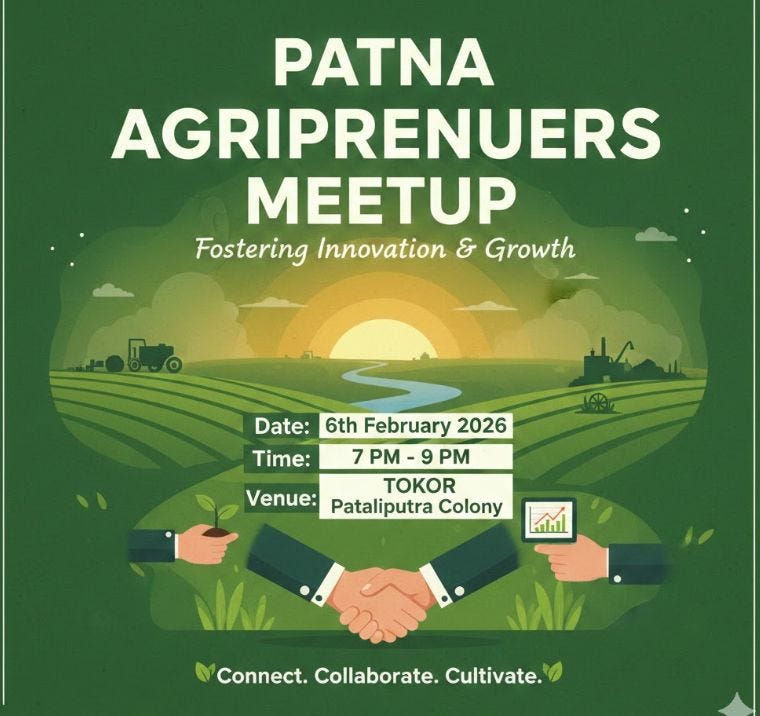
Excited to host my first Agripreneurs Meetup in Patna. Do help me spread the word. Why do I host Agripreneurs Meetup?
I deeply care about Indian Agriculture and I've discovered that meetups are a great way to build mycorrhizal networks that bind the agripreneurs towards deeper collaboration, impact and success.
When Agripreneurs come together in KrishidotSystem ecosystem, a lot of possibilities emerge: Fellow Agripreneurs discover collaborations, partnerships. Joint Ventures are born. And more importantly friendships are born.
Date: 6th February 2026 | Time: 7 PM - 9 PM IST | Venue: TOKOR, Pataliputra Colony | RSVP
P.S. While the event is free and will always remain free, you are most welcome to support me in organizing agripreneur meetups across the country.
Musings on Republic Day
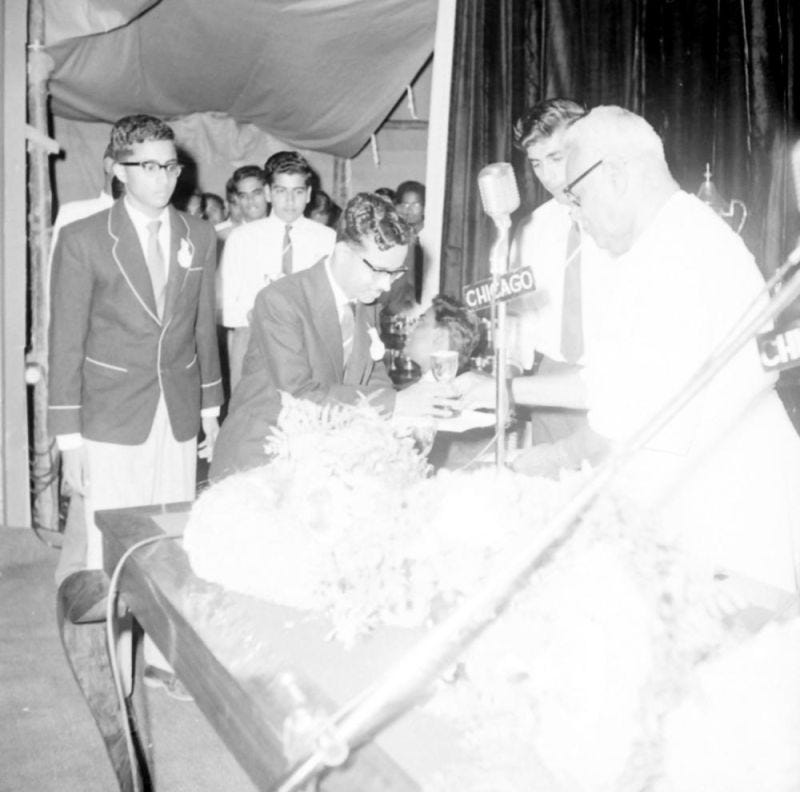
Whenever I think of Republic Day, I am reminded of my dear mentor T.S. Ananthu who transformed how I looked at the very idea of "Republic".
I found this picture from the 1962 archives of IIT Madras when T.S.Ananthu received a prize from Dr. P. Subbarayan (Minister for Transport and Communication). History might not remember Dr. P. Subbarayan. But I have a strong feeling. History , especially the kind where change makers recollect history to drive the engine of progress, will definitely remember T.S. Ananthu.
Ananthu did his B. Tech. (Electrical Engineering) from the Indian Institute of Technology Madras in 1965. After completing a Master’s Degree from Stanford University, he worked for the Xerox Corporation for a while before returning to India in 1969.
In Delhi, he worked for IBM for some time before setting up a software company. Ananthu had always been interested in social causes and this drew him to the J.P.Movement. In 1976, he joined the Gandhi Peace Foundation, where he worked for 14 years before moving to Navadarshanam.
Navadarshanam was the place of my dreams. It was the first place where I met living Gandhians in oozing flesh and blood. It was the first place where I saw that large dreams can be quietly manifested. I had gone there when I was 25. I was a confused soul searching for spiritual in the mundane and mundane in the spiritual.
Even though I was doing MBA, I wasn't content with its curriculum. I decided that my second year dissertation would focus on quantum mechanics and its parallels with modern management.
There was just one problem. I had no training in physics. And so when Ananthu TS announced a 10 day course in quantum mechanics, I rushed there and signed up.
I don't know if the ritual is still alive. For few years, Navadarshanam celebrated its annual day on 26th January. And on each republic day, T.S. Ananthu asked us fundamental questions of being a part of a republic. The conversations I had with him stir deeply within me.
What does republic mean ? A republic is a form of government where the state is considered a "public matter" (res publica), sovereignty rests with the people, and the head of state is an elected official rather than a monarch.
Who decides the "public matter" ? What does sovereignty mean? Do we the people have sovereignty ? Who decides the air we breathe? Who decides the quality of the soil our food grows in? Who decides the quality of water we drink and swim in?
When you ponder on these questions, you discover that Republic day is a gentle reminder that we are still a nation that is work in progress. We have work cut out in front of us. Until our children take over the nation building, we have to strengthen the foundations of res publica.
So, what do you think?
How happy are you with today’s edition? I would love to get your candid feedback. Your feedback will be anonymous. Two questions. 1 Minute. Thanks.🙏
💗 If you like “Krishi.System”, please click on Like at the bottom and share it with your friend.