
Sunday Reflections (Bamboo Unlocks, AI Myths, Rain Shadows, Lock-In)

Dear Friends,
Greetings from Hyderabad, India. Welcome to Sunday Reflections where I reflect on what I’ve written and ask myself, In doing what I am doing, what am I really doing?
If you don’t want CC hassles, you are most welcome to use paypal or UPI (venkat.raman.kr@icici) and pay the annual subscription (8500 INR/95 USD) with your email in the comment. I will enable access immediately.
P.S. Supporting this work doesn’t have to come out of your pocket. If you read this as part of your professional development, you can use this email template to request reimbursement for your subscription.

Subscriber-only Post Trailers
Is “Two Brothers Organic” Facing a Hamletian “Organic” Identity Crisis?
Why does a company with ECOCERT, USDA Organic, and NPOP certifications still feel compelled to prove they're glyphosate-free? Doesn’t it point to something broken in how consumers perceive the organic label itself?
Satyajit recently announced that Two Brothers Organic Farms® became, in his words, “India’s first brand to secure the independent Glyphosate Residue-Free Certification for ghee, atta and jaggery.”
With eroding trust on organic labels in India, Two Brothers Organic Farms (TBOF) has adopted a hybrid strategy that mixes standard "process certification" (Ecocert) with aggressive "product verification" (Detox Project).
At one level, it makes sense.
In India, many “organic” dairy farms fail because while they may not inject cows with hormones, they cannot control the fodder the cows eat. Farmers often buy dry fodder (straw/hay) from neighbors who use Glyphosate (Roundup) as a desiccant or weedkiller. Glyphosate sprayed on fodder crops enters the cow’s digestive system and can concentrate in the milk and fat (ghee).
At another level, it doesn’t make sense.
More in a subscriber-only edition of Krishi.System.
Post-Facto: Sandeep Bhargava, Founder-Director, OneCert International, made a fascinating comment:
“[Are they] able to stop air contamination or water contamination. Many operations claim pesticides free etc. They have grown crops without using pesticides. Their is still chance of contamination or traces due to past use of land. Lab test also report up to a level like 0.01 ppm. They do not report pesticides free. Therefore claiming pesticide or glyphosate free is mis leading, they may use claim no glysophate used on farm. That’s by NOP allow sale of material as organic if traces are less than 5 percentage of EPA limit.”
Rain-Shadow Side of India-EU deal
What if India had allowed New Zealand and European cheese, SMP, and butter in at reduced tariffs?
India produces 239 million metric tonnes of milk annually—a quarter of global output, more than any nation. This comes from 80 million farming households, typically keeping 1-5 animals. Half of all cattle rearers own only 1-2 animals; these small herds contribute 29% of total production and 22% of milk sold.
But here’s what makes Indian dairy structurally different: 38% of rearers don’t cite milk sales as their primary motivation for keeping cattle. In Jharkhand, that figure is 71%. They keep cattle for household nutrition. For dung—cited by 74% as a key benefit. For draft power. For insurance against crop failure. For socio-cultural reasons no spreadsheet captures.
The EU maintains dairy subsidies of €8-12 billion annually through the Common Agricultural Policy. EU farms operate at industrial scale, supported by infrastructure and direct payments Indian smallholders cannot match.
In years 1-3, subsidized European products would flood urban markets at prices below cooperative costs. Private processors—Nestlé, Britannia, Mother Dairy—would face pressure to switch to cheaper imported ingredients.
In years 3-7, cooperative procurement economics would begin collapsing. If processors can buy imported powder cheaper than fresh milk, why maintain village collection networks? The daily milk collection that provides daily cash to farming households becomes economically unviable.
In years 7-15, the 190,000+ dairy cooperative societies would face an existential choice: consolidate dramatically or dissolve. The small rearers—those 49% who keep only 1-2 animals—would have nowhere to sell. They would exit.
More in a recent subscriber-only edition of Krishi.System
Post-Facto: Ashish made a fascinating point:
“There is hardly any discussion holding consumers responsible for this state, when they are the most important stakeholder for agrifood Systems. But what if this aspect turns around with the Indian Consumer becoming loyal to Indian produced goods/produce? This will also mean Apples, Almonds and Walnuts produced here - with whatever quality/seasonal limiations they exist - are preferred by the consumers? Then no matter what goods flow into India if no one buys them, then they meet their end of life here at the expense of the American economy!”
Muhammad Riaz from World Bank made me think deeply about the gender dimension, something I hadn’t considered deeply: “In Rural India and Pakistan, animal husbandry is the responsibility of women of the family. Taking care of animals and her own children, besides family chores, is a huge burden on her shoulders. It will be good if these animals can be taken out of these households.”
World Bank and PoCRA Lock-In
Climate Resilience is a funny word. It appears everywhere and has now been abused enough to mean nothing.
Take the case of 2017 World Bank funded PoCRA project in the state of Maharashtra. In paper, it was supposed to provide climate resilience to farmers. In reality, what happened was the complete opposite of resilience.
There is a term in systems thinking for what PoCRA was creating: lock-in. Once farmers plant orchards, they cannot adapt to drought by reducing their water use. The trees must be watered or they die. The investment must be protected or it is lost. Flexibility—the very essence of adaptive capacity—is surrendered.
In a region where rainfall varies wildly from year to year, this is the opposite of resilience. A resilient farmer in Marathwada should be able to intensify in good years and pull back in bad ones. Plant more wheat when the rains are strong; plant less when they’re weak. This is how dryland farmers have survived for centuries.
PoCRA was dismantling this flexibility. By subsidizing orchards, it was encouraging farmers to make twenty-year bets on water availability in a landscape where next year’s rainfall is unknowable.
More in a recent subscriber-only edition of Krishi.System.
Post-Facto: Sheriff Babu introduced me to Hydraulic Memory Audit:
Before financing a 20-year asset, we must audit the Soil's Hydraulic Memory (using historical SAR data, not just rainfall). If the sub-surface soil shows a history of holding moisture during dry spells -> Plant the Orchard. If the soil physics shows rapid dry-down -> Keep the flexibility. Resilience is aligning the Crop's Inertia with the Soil's Inertia.
Here is a live Hydraulic Memory Audit from our Maharashtra cluster (Asset ID: B2, Banana, Clay).
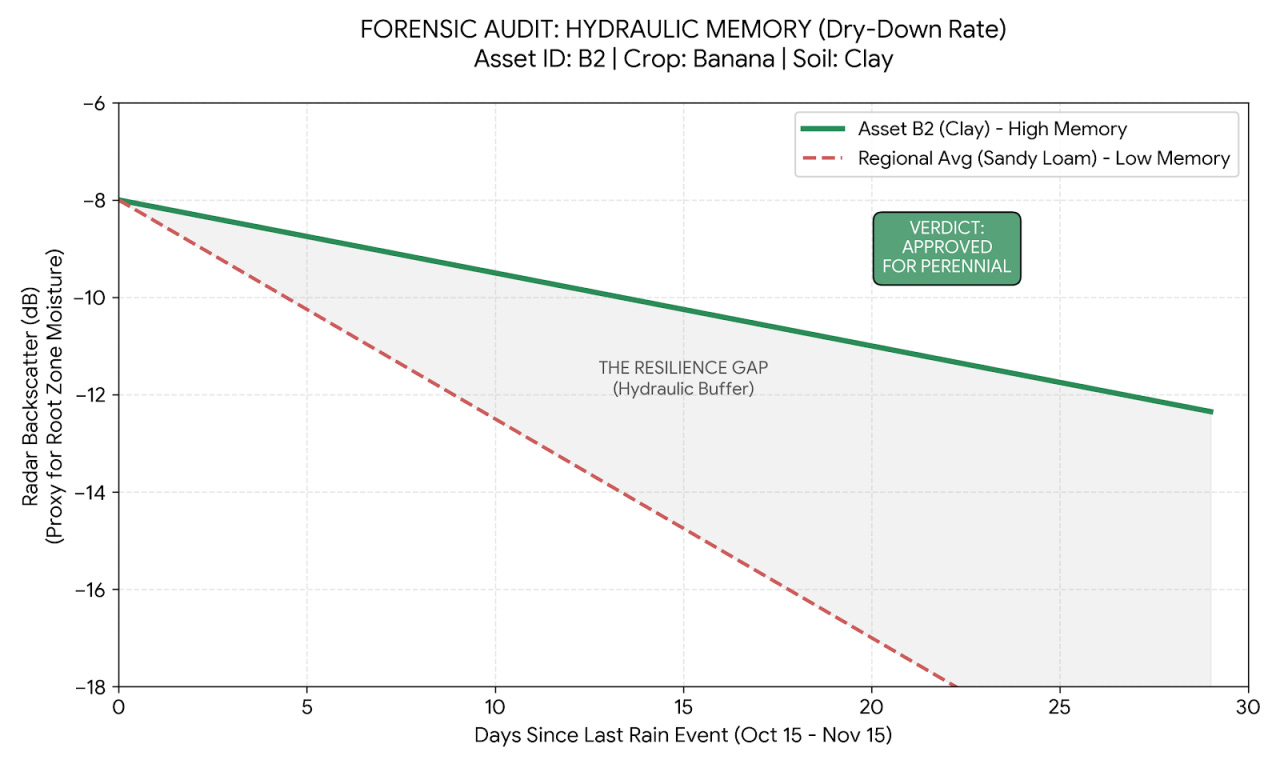
We tracked the Radar Dry-Down Curve (Dielectric Decay) following the Oct '24 post-monsoon rains. THE FORENSIC DATA: 📉 Regional Baseline: Lost moisture signal in 7 Days (Steep Slope = Low Memory). 📈 Asset B2 (Clay): Retained root-zone moisture for 22 Days (Flat Slope = High Memory). THE VERDICT: [APPROVED] Because the Soil's Inertia (22-day buffer) matches the Crop's thirst, we validated the "Lock-in" for this 12-month Banana asset.
If this curve had tracked the regional baseline (7 days), we would have rejected the Orchard and forced the farmer to stick to adaptive seasonal Maize. Financing a long-term asset without auditing the soil's 'RAM' isn't lending. It's gambling.
Are Small farmers the Future of AI? Surely You Must Be Joking Mr. Nilekani
Ofcourse, it doesn't make sense to critique reels. But is it just me who is finding this AI Kool-Aid: "Small farmers is the future of AI" total BS?
With all due respects to the gentlemen Nandan Nilekani and Jeff Rowe, and I have great regard for Nandan for driving the DPI revolution in India, I find this totally disingenuous.
On one end there is no money in small holding farmer. And on the other end, we are vastly under-estimating how AI is such a deflationary force. I agree with Michael Burry when he recently said that AI is "deflationary for productivity spend. And that productivity gained is likely to be shared by all competitors."
With already existing slim margins, this will further commoditize the playing field. Much like lab-grown meat has made farm-grown, free-range meat premium, I see AI accelerating the focus on fundamental value creation in agriculture - focusing on growing food that is nutrient dense through deep investments in regenerative agriculture.
As I've said before, we have enough of digital infrastructure. Real physical infrastructure and the ability to take risk is the real bottleneck in Indian Agriculture.
AI definitely has a lot of potential. If it can help farmers select cheapest inputs for starters, I'll be happy. But right now most AI efforts are at agri input value chain disintermediation. Because agri-input sector is where the money is, all efforts are being built to new age platforms that can help agri-input manufacturers squeeze out more margins from the channel and supply chain.
In the recent budget, Nirmala Seetharaman proposed Bharat Vistaar - "a multilingual AI tool that shall integrate the AgriStack portals and the ICAR package on agricultural practices with AI systems." . As someone who has worked on DPI ecosystem, the real challenge is not technical. It is institutional.
We don't have yet institutions that can come together and build a DPI ecosystem layer with the right amount of skin in the game for farmers. As such, advisory platforms have been commoditized. There is no value in building yet another advisory tool.
And private organisations are not keen on driving this. Why would they commoditize their margins? It's high time we have a more honest conversation on what are the real challenges in agriculture and what we ought to focus on.
Can Bamboo Unlock Wealth for Indian Farmers?
Despite all the enthusiastic chatter around National Bamboo Mission, why do farmers still get penalized for growing bamboo? Can we take a look at Maharashtra’s Bamboo Policy? Why is bamboo stuck in a 90-year old colonial hangover? What are the three unlocks that can make National bamboo policy work?
Dr. P.N. Rao has been growing bamboo in Sangareddy district for close to eight years. He has two varieties on his farm — Balcooa (Beema) and Tulda. Few weeks ago, he began harvesting the Beema variety and dispatched one lorry of poles to Markapuram in Prakasham district, Andhra Pradesh. He did everything by the book: eWay Bill, GST copy, farmer details establishing that the bamboo was grown on private agricultural land.
The Forest Range Officer at Vijay Puri South, Nagarjuna Sagar, stopped the vehicle
Bamboo, the officer said, is a forest species. Permission is required. Dr. Rao spent the morning trying to convince him otherwise, citing the 2017 amendment to the Indian Forest Act that reclassified bamboo grown on non-forest land as agricultural produce — no longer a tree, no longer requiring transit permits.
His lorry sat stuck at a forest check post, eight years after Parliament declared bamboo free to move. Despite all talk and chatter around National Bamboo Mission, why do farmers like Dr. Rao still get penalized for growing bamboo?
Meanwhile, earlier in December, Maharashtra did something remarkable.
Under its new Bamboo Industry Policy, all thermal power plants in the state must now blend five to seven percent bamboo biomass with coal.
Here is why this is an important ruling. When a farmer grows bamboo, only about half the plant — the straight middle section — fetches a premium from furniture or agarbatti makers. The crooked bottom, thin top, knots, and leaves are waste, burned or left to rot. A farmer invests a hundred percent of effort and gets paid for fifty percent of the plant. This has been the silent killer of bamboo farming’s economic viability.
Maharashtra’s mandate changes this.
Thermal power plants do not care if bamboo is crooked or knotty. They need combustible biomass. With 25,000-plus megawatts of thermal capacity, the mandate creates millions of tonnes of annual demand — specifically for the ugly stuff nobody else wants. The farmer now sells prime cuts to furniture factories and pelletizes the scrap for power plants. A hundred percent of the crop is monetized.
The state has backed this with ₹1,534 crore for the first five years and ₹11,797 crore over two decades, building industrial clusters, FPOs, and MSME support across bamboo-rich districts like Gadchiroli and Chandrapur.
What good is demand-side activation when the supply-side regulatory foundation remains broken?
Under the Indian Forest Act of 1927, bamboo was classified as a tree for ninety years — requiring felling permits, transit permits, and royalty even on private land. For a plant that is botanically a grass and must be harvested annually to stay productive, this was absurd.
The Centre tried to fix it.
Between 2013 and 2017, the Ministry of Environment issued ten separate advisories urging states to relax bamboo regulations. Then came the 2017 Parliamentary amendment removing bamboo from the definition of “tree.” Then the Environment Minister personally wrote to every Chief Minister asking them to amend their state laws. A meeting of all Principal Chief Conservators of Forests followed, with a deadline of January 2018.
Eight years later, a forest range officer in Telangana still stops a lorry because, in the rules he operates under, bamboo remains a forest species. The Centre deregulated. Many states never fully followed through — their Forest Acts unamended, their check posts unreformed, their operating procedures unchanged.
For a national bamboo policy to work, three things must happen simultaneously.
First, complete the regulatory reform. Publish a state-by-state compliance scorecard — who has amended their acts, removed transit permits, exempted royalty. Name and shame. Make the Pan India Transit Permit legally enforceable, not advisory. Integrate bamboo into e-NAM as a regular agricultural commodity.
Second, take Maharashtra’s demand logic national. A three percent biomass blending mandate across India’s 205 gigawatts of coal capacity would transform the crop’s economics everywhere, not just in one state. Add government procurement mandates for bamboo in public construction and packaging.
Third, build sustainability guardrails before it is too late.
The carbon neutrality claim for bamboo biomass holds only with local processing and short transport chains. Mandate life-cycle assessments. Large-scale bamboo demand will incentivize monoculture plantations, carrying real risks of biodiversity loss, pest vulnerability, and the biological time bomb of gregarious flowering, where an entire species flowers and dies simultaneously across vast areas.
Require species diversification. Promote bamboo within agroforestry systems, not as standalone monoculture. Direct expansion toward degraded lands. And ensure the infrastructure being built around coal plants is fungible enough to survive when those plants eventually shut down. After all, we still have to phase out coal.
Maharashtra has shown what is possible when a government thinks in creating demand cycles. The challenge for the rest of India is twofold: Build the demand and fix the foundation.
Reflections from Prakritika Event
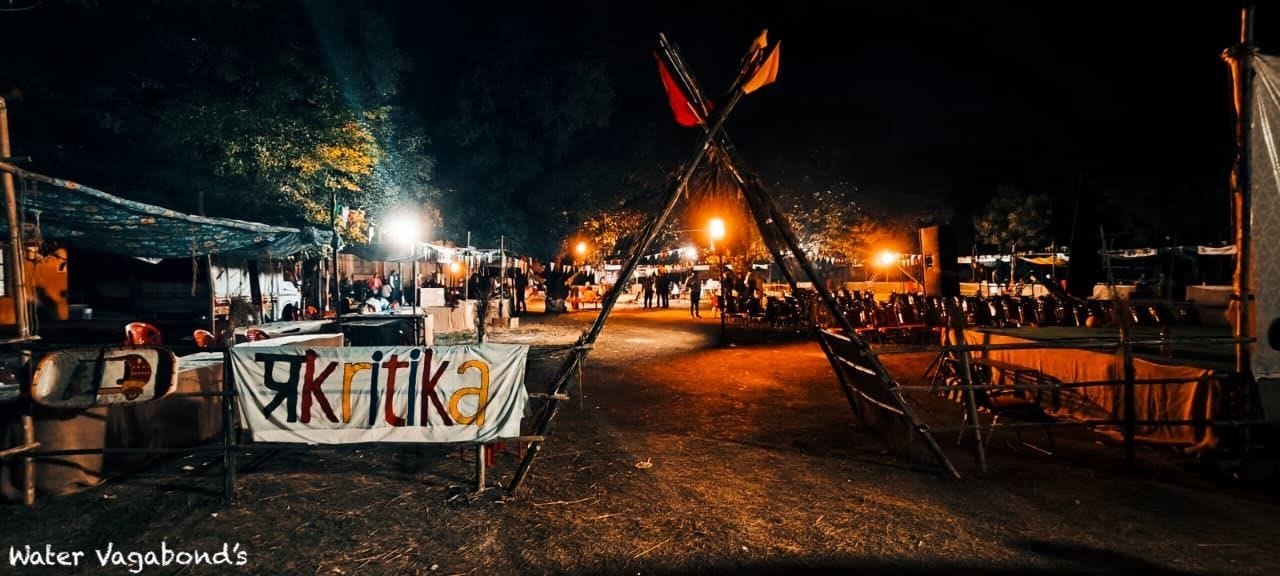
When I asked Ishteyaque Ahmad what spurred him and the Regenerative Bihar team to organize Prakritika event, Ishteyaque ji said something profound: We want to make farmers learn to engage as equals with the market in their own terms. And what an event it turned out to be.
Over the past few months, I have been attending only farmer-led agritech events and happily missing the rest.
And if you've attended them, you would know. Farmer events have a different air about them. The air is placid, there are lots of amazing food around and the conversations are far more democratic and happen in a circle.
I often tell this to event organizers: If you are serious about sustainability, you have to design events where people sit in a circle. You cant talk about sustainability in a podium where some wise person will pontificate and the rest will listen. Sustainability emerges when folks come together and reflect on the predicament everyone has willy-nilly contributed towards.
I had gone to Prakritika to build relationships so that one day Patna Agripreneurs Retreat could happen there. One of the highlights of the event was listening to Subhadra Tai speak beautifully about the eco-feminism view that underpins the true regenerative vision of agriculture and hear Rahul Yaduka and Eklavya Prasad share the structural challenges that underpin recurring Bihar floods.
This was my first trip to Bihar and it deeply affected me. I heard a lot of anguish about how Biharis feel when their very identity becomes a curse word, when they migrate to different states.
From the 1857 revolt to the final push in 1942, Bihar frequently served as the laboratory of Indian resistance, testing methods of struggle like Satyagraha that would later be applied nationally. Bihar is the birthplace of the Gandhian era in Indian politics. While the Congress fought for political freedom, Bihar became the epicenter of the economic freedom struggle for farmers.
How did we end up with this affairs where Bihar became the eye sore of our nation?
While Tamil Nadu, Kerala, and Andhra Pradesh are entering demographic decline with aging populations and falling fertility rates, Bihar sits on India's youngest population base.
The road to Viksit Bharat runs through Bihar.
I hope to organize my first agripreneurs retreat in Bihar soon and do my bit for this beautiful state and the lovely people I met in this state. Let's see!
So, what do you think?
How happy are you with today’s edition? I would love to get your candid feedback. Your feedback will be anonymous. Two questions. 1 Minute. Thanks.🙏
💗 If you like “Krishi.System”, please click on Like at the bottom and share it with your friend.
Thank you for this awesome set of takes on a wide range of topics.
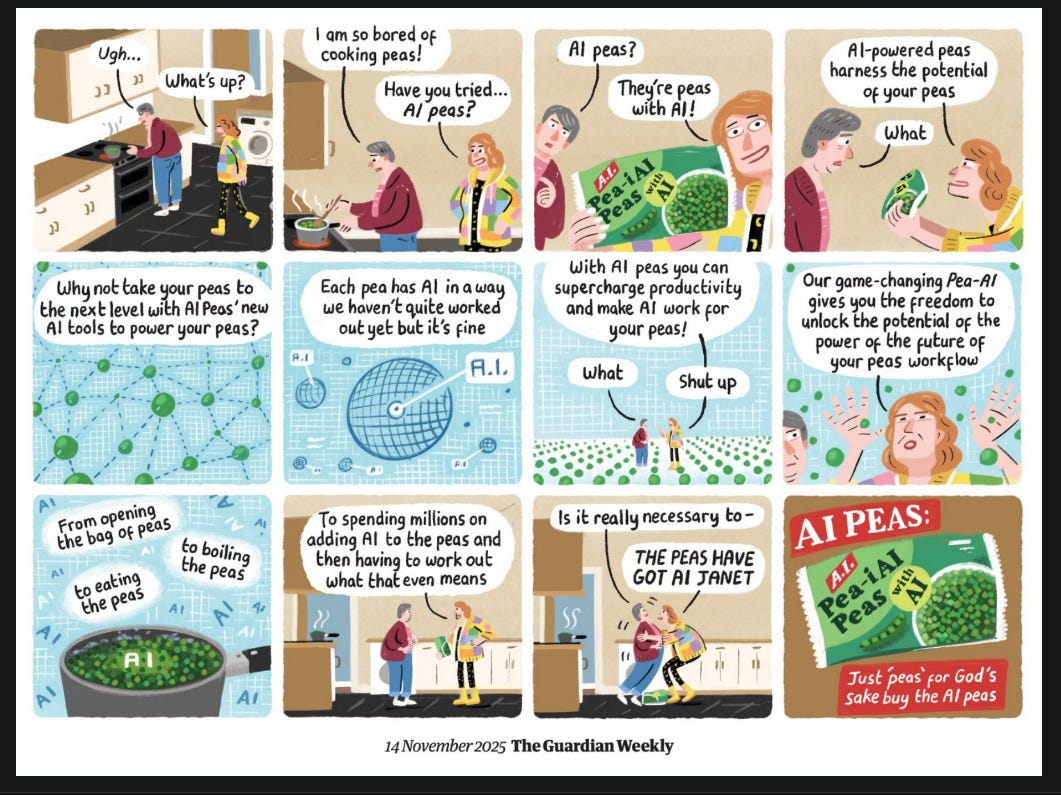
I found the one on AI especially relevant the comic and the longer explainer. I’ve also been frustrated by the number of posts about “GenAI will fix smallholder agriculture”. It’s not a tech problem! But I guess it is a way to play the VC grift game.
I also liked the takes on dairy and bamboo. Most industrial policy seems to suffer from narrow thinking but agriculture seems to have the worst of it. Policy choices are too often made without considering the context and then when the policy fails to produce the expected results, it’s blamed on a lack of awareness or education.
Please keep writing and pushing for a more honest approach.
In case interesting this is my LinkedIn post complaining about AI in Agri. I’ve added a link to your post in the comments. https://www.linkedin.com/posts/connorclarklindh_llms-wont-fix-smallholder-agriculture-but-activity-7426499767926673408-zk35
as usual, beautifully woven !