
A Case for Private Mandi
A sponsored deep-dive collab with Bloomly

Krishi.System is read by 46206 readers across Substack and LinkedIn who are curious to discover Systems Thinking in food and agriculture systems with a global community of changemakers in an age of runaway Climate Change.
If you don’t want CC hassles, you are most welcome to use paypal or UPI (venkat.raman.kr@icici) and pay the annual subscription (8500 INR/95 USD) with your email in the comment. I will enable access immediately.
P.S. Supporting this work doesn’t have to come out of your pocket. If you read this as part of your professional development, you can use this email template to request reimbursement for your subscription.

Dear Friends,
Today marks a special day in the annals of Krishi.System. I am doing a sponsored deep-dive with Bloomly that is boldly building a case for Private Mandi with skin in the game on the ground.
This is my third sponsored-deepdive after Bioprime and OCP Nutricrops with an entrepreneur pursuing a bold path when most investors have written off this messy side of the agritech ecosystem with their incumbent investments.
I decided to do this with Bloomly as their thesis aligns with the first principles that are needed to reform the mandi ecosystem while acknowledging its strengths. It also helped that, as I explain in my article below, their thesis puts the right skin in the game to tackle this wicked problem.
Since I deeply value the trust you repose in me as a reader and subscriber, it is my duty to explain how I approached this process without compromising my ethics as an agritech analyst. You can learn more here about how I select the companies to work with and the responses to the sponsored deep-dive ethics checklist. If you have any questions on my approach and would like to offer feedback, you are most welcome to email me (venkyr@hey.com) or share here anonymously.
Shall we begin?

Editor’s Note: This longform piece should take 14-15 minutes to read. Here is the geography I cover: Why Mandi is the most efficient post-harvest machine? - > What are its limitations? What is a Private Mandi and what is not? What is the thesis of Bloomly? What are its strengths? What are its limitations?
A Case for Private Mandi
Before we make the case for private mandi, the case for mandi must be made.
Despite all its misgivings and the truck load of perceptions it carries, we often fail to realize how efficient the Mandi system is, operating at just enough viable margins to keep the system chugging along.
Consider what the system delivers every single morning before most of the country wakes up.
Azadpur in Delhi receives around 14,000 tonnes of fruit and vegetables a day. Pineapples from Nagaland. Pomegranates from Maharashtra. Sixty percent of Kashmir's apples. Approximately 2,200+ commission agents clear roughly 20,000 + transactions a day.1
Koyambedu in Chennai turns over nearly 1,500 truckloads of produce daily and absorbs a hundred thousand visitors, with most trading done before sunrise. No cold chain2, no software, no subsidy. The whole apparatus is self-funding, settles daily, and holds almost no inventory overnight.
Two decades of organized retail, one decade of venture-funded agritech, hundreds of millions of dollars deployed haven’t managed to move even a third of fresh produce out of this chain. Per tonne moved, per rupee of capital employed, per dispute generated, the Mandi is the most efficient post-harvest machine India has ever run.
Given how India’s political economy works, I am now convinced that it is churlish to think that Mandi can be replaced warts and all. If we are enterprising enough to reimagine Mandi, it must be done through a new architecture that grows much like weeds on an old building, slowly taking the best of it and removing the worst out of it.
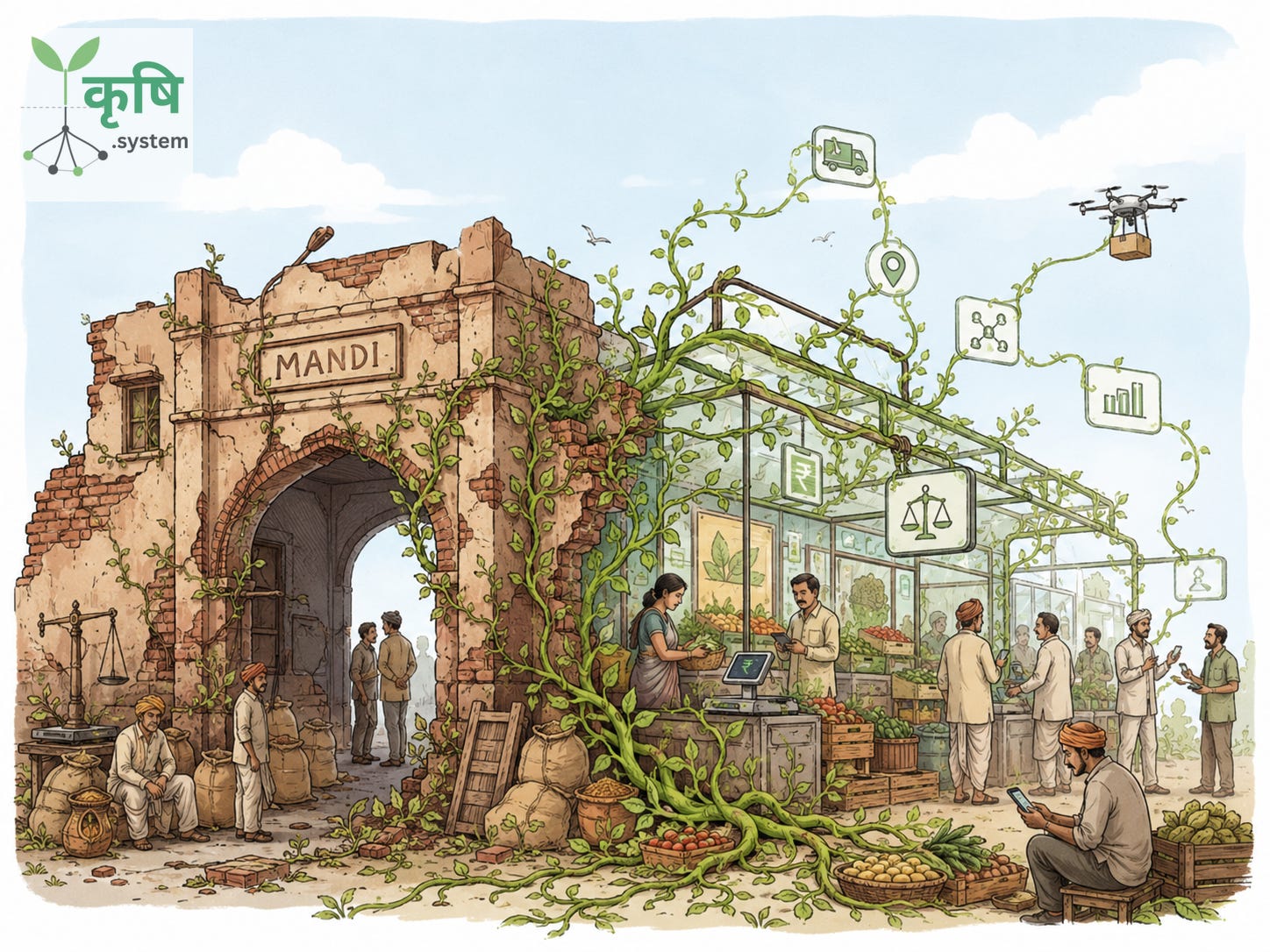
Because, let’s be honest. Mandi provides a bundle of services no other rural institution provides together. For outsiders not clued into the Mandi’s belly, here is a quick primer.
At the end of the day, what does Mandi really do in its ideal design intent?
Pay attention to the fine print. We are talking about the ideal case. Jump to the footnotes if you want to know the nuances.
It aggregates scattered harvests into tradeable lots. It discovers3 price through an open auction where rival buyers bid on the same heap. It assures quality floor by physical inspection4. It settles5 the same day with deductions fixed by statute6 and a paper trail attached to a licensed name. It clears everything7 — any quantity, any quality, some price — as the farmer values a certain sale over anything else. Some price beats no sale for a perishable every time.
How does this system perpetuate its legitimacy? It broadcasts feeding arrivals and prices into the public record that farmers fifty kilometres away use to decide what to sow.
Let’s build a proper vocabulary to be more nuanced while talking about Mandis. There are two types of mandis. Those which are seller-led at production regions. And those which are buyer-led at consumption regions. As my friend VS Vivek defines it, in both these regions, traders are selling to other businesses whose job is to resell to either different region or different consumer.
Every Mandi’s rules are written by its buyers.
V.S. Vivek’s example from his Subjimandi venture days is illustrative here.
Solapur and Nashik both trade onion round the year, barely 250 kilometres apart, yet Solapur trades in bags and Nashik sells loose on tractor wagons. Solapur's buyers are traders reselling to Bangalore, Hyderabad and Chennai, while Nashik serves buyers from every region including exporters. Same crop, same state, different buyer mix, different market.
The same is the case with sweet lime. They are sold in production mandis as loose direct loads of 10-24 ton vehicles. Consumption Mandis pack them in 25-30kg bags as per buyer convenience.
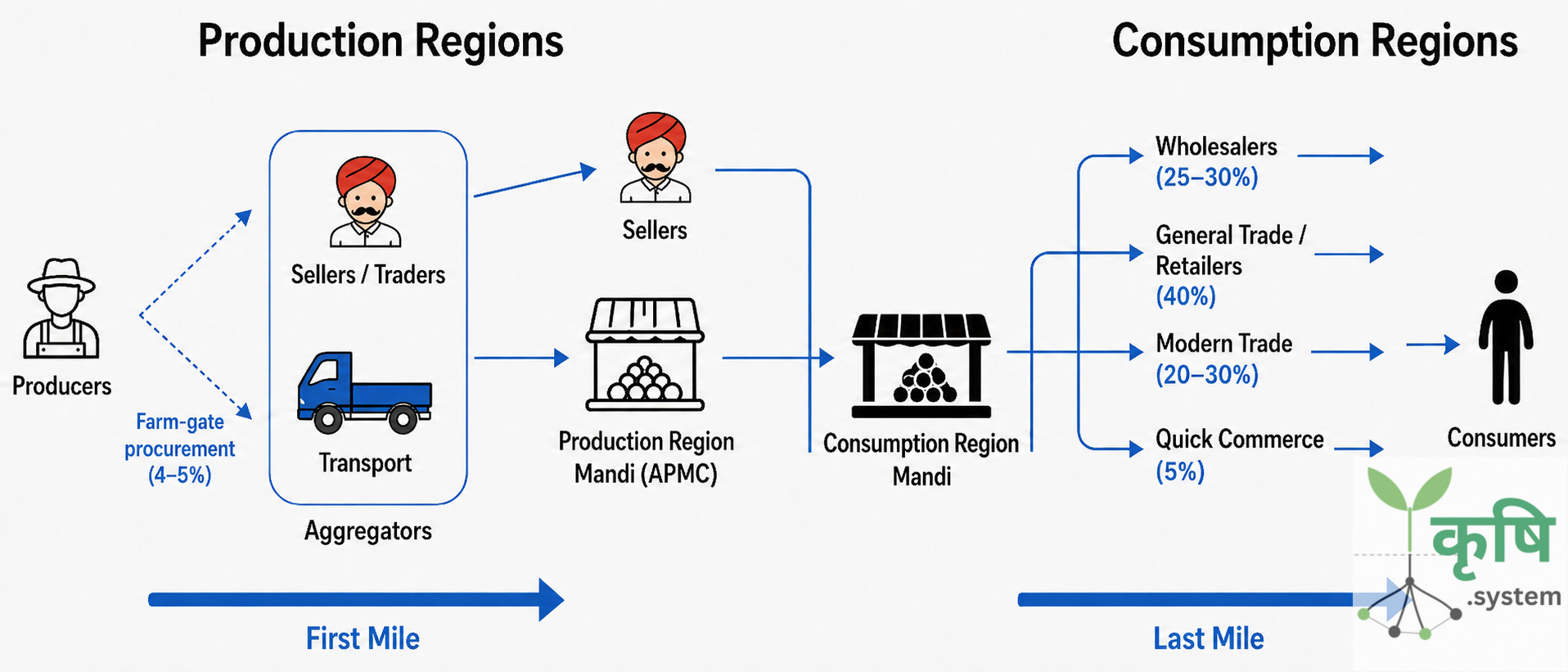
India has roughly 2,477 principal regulated markets and about 4,843 sub-yards. No official census splits them into production and consumption side mandi. An APMC is an APMC. But if you pay attention to the geography, the classification becomes obvious.
The overwhelming majority of the seven thousand sit in producing regions, because that is where the Acts of the 1960s and 1970s built them: one yard per tehsil, to regulate the first sale of the local crop. The consumption mandis are a thin crust on top, a few dozen big-city terminal markets, perhaps a hundred or so yards nationally that primarily distribute the produce. Practically every metro has between one and four of these big-city terminal markets.
Between production and consumption ends, the produce runs a relay. Intermediary must exist at every regional boundary to move between these mandis, insider enough to know the customs of both yards, buying enough volume to make the truck economically viable.
Ownership changes hands at every hop by design. Farmer to trader in the local mandi, trader to buyer in the consumption mandi. This happens as we are dealing with an ungraded trade where price cannot travel without the produce.
Quality and grade parameters are never standardized across the journey of the value chain for a reason. Every vendor gets to define quality and grade in their way. It is their currency of trading.
The mandi’s quality assurance rests on inspection of physically present goods. This hands the person who grades the power to price. The arhatiyas has been quietly converting that power into the ten percent commission paid, prevalent in the fruit trade, irrespective of the outcome with ten percent wastage deduction added as a cherry on the cake along with 1 percent loading and unloading charges.
Here is the spanner in the wheels.
The Mandi is facilitating the sale without ownership in an environment that benefits from price uncertainty and opaque price discovery. And if that weren’t enough, the absence of a guaranteed closing price—with or without an auction—adds to the uncertainty. Working capital bottlenecks are mitigated by traders through delays in farmer /aggregator payments.
This, unfortunately, is what makes Mandi transactions a zero-sum game for the farmer.
The farmer is fighting a battle of diminishing returns every time he steps into the Mandi.8 This is evident in anecdotal data that is emerging across several Mandis. There has been significant dip in farmer footfall across Mandis with farmers preferring private traders over Mandis. The earliest evidence points out to 2012-13 and this trend has accelerated further.
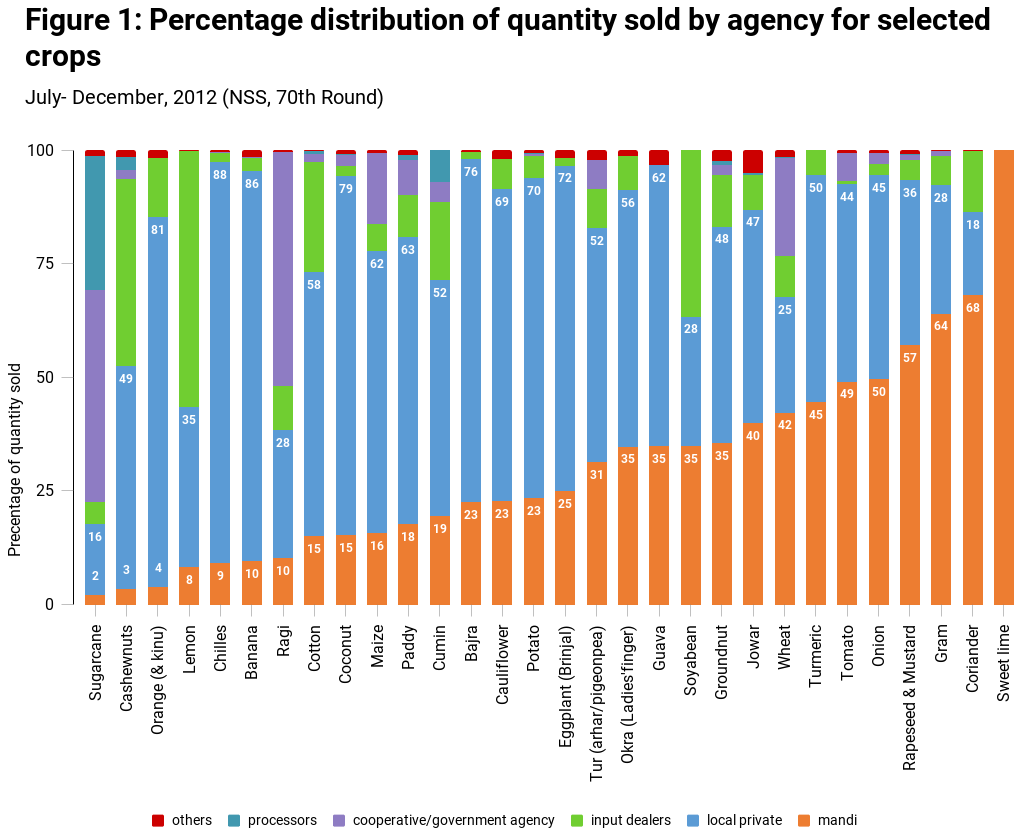
“Nationally representative data of agricultural households suggests that only 25% of all transactions in India during 2012-13 passed through these mandis, whereas 55.9% were sold to private traders.” (Source)
“In the same period of 2018, only 8 per cent of paddy was sold in APMCs. Take the example of pulses: only 22 per cent of arhar landed in APMCs in 2018, compared to 66 per cent in 2012.”
“…The share of wheat marketed by farmers in APMCs dropped from 44 per cent in 2013 to 13 per cent in 2019. That for mustard declined from 63 per cent to 13 per cent.” (Source)
“…For paddy and wheat, only 29% and 44% of the harvest is sold in a mandi, while 49% and 36% goes to local private traders or input dealers" (Source)
For fruit, the equivalent arrivals data doesn't exist. Most states delisted fruits and vegetables from APMC regulation years ago.
Instead of replacing Mandi as the site of transactions, why not bring more skin in the game with the facilitator-aggregator taking the risk by owning the produce and providing price certainty, besides providing grading slip to the seller?
This also ensures that the traditional 10% commission and the 1% handling charges are removed from arhatiyas’ (commission agent) pocket and go to the farmers’.
That’s Bloomly’s Private Mandi thesis in a nutshell.
Bloomly is a bootstrapped fruit business with a small team in Bengaluru that is building a Private mandi model in consumption side regions.
The word “Private Mandi” comes here after a lot of thought-wrangling. If you look around, you would see plenty of “Private Mandis” out there. Last week, I covered one in Himachal for apples by Ninjacart.
For some, Private Mandi is replicating the design principles of the public mandi, including the auction system in a private market context. For some, Private Mandi is setting up destination markets where the facilitator aggregates from aggregators(who in turn buy from farmers without true ownership) and acts as a guarantee for collection.
Ownership is the key differentiator here as it provides skin in the game.
For Bloomly, the definition of Private Mandis boils down to owning the materials and providing spot payment at the Private Mandi premises.
Here is how the model works on the ground.
The farmer or aggregator enters Bloomly’s private mandi with credentials. Weight is taken and the moisture loss is adjusted openly. The produce is graded into A, B and C grades. GRN is created instantly and spot payment is done through RTGS/UPI mechanisms.
This thesis is predicated on the key contrarian insight that the web of incentives in the Mandi system make the B-grade and C-grade (what is commonly called Misfits) irrelevant, often cleared at throwaway dirt prices, reducing the incomes earned by farmers.
Several fresh produce players don’t care enough about C-grade produce deeply enough to have avenues to liquidate them. Neither the Modern-trade nor the Mandi have the right incentives to liquidate the C-grade produce.
Here is a rough thumb rule breakup of the journey the produce takes from the farmgate to the Mandi. The modus operandi among the mandi players is simple. Mix B-Grade with A grade so that price and margins get adjusted.
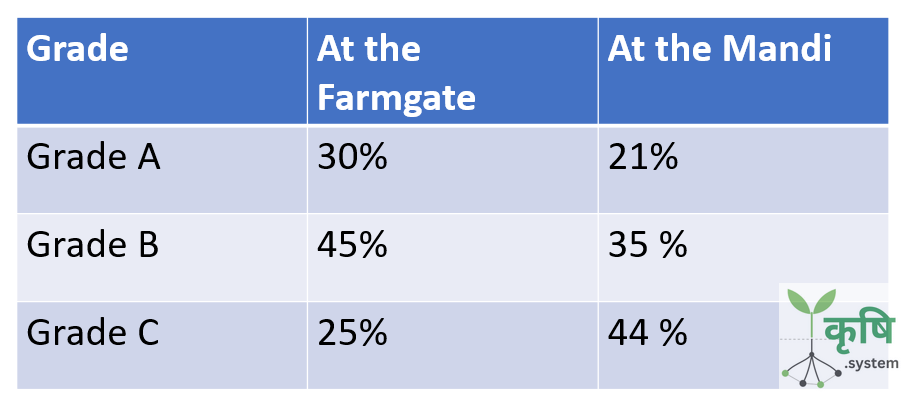
In contrast, here is how the hierarchy of the grades plays out with Bloomly.
A-grade finds its way to the modern trade and quick commerce. A-grade and B-grade finds its way to the general trade- which occupies the highest pie of trade- where the demand is real and price-sensitive buyers value it properly. C-grade produce becomes cut-fruit, smoothies, juices, pulp where cosmetic appearance is irrelevant and the produce is finally paid for what it actually is.
How does Bloomly procure different commodities ? Here is a snapshot of their hybrid-sourcing fruit universe in action circa 2026.
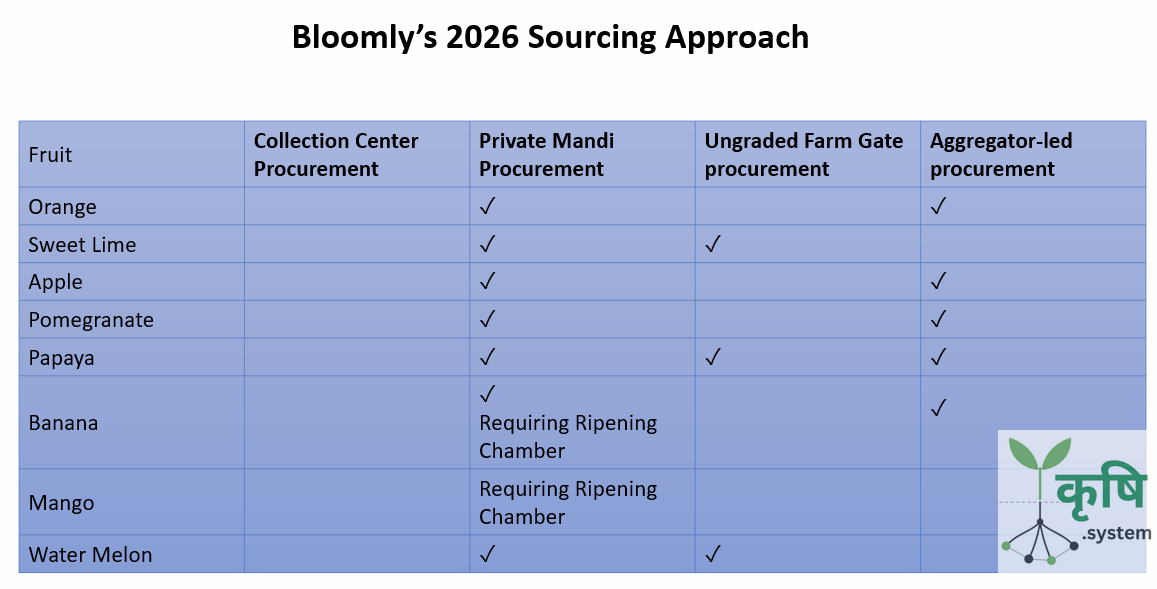
Hybrid sourcing is key here as each article has its idiosyncratic supply and demand cycle and this diversity is equally reflected in the avenues that are available to liquidate the produce. This ensures that the market design is no longer unhealthily dependent on the premium grades alone.
If you pay attention to their hybrid-sourcing fruit universe, you would notice that Collection Center procurement is blank. Why is this the case?
Collection center procurement is rife with leakage/ corruption issues with employees often doing illegal side-business with the buyer and manipulating the employer with fake transactions. The leakage issues plaguing collection centers have prompted larger collection center players to pivot aggressively toward local vendors, suppliers, and Mandis.
The advantage of this model is that the entire lot clears at fair value instead of one-third of it carrying the economics of the whole. Wastage falls because B-grade moves fast enough to stay consumable. And blended basket margin lifts not by squeezing anyone in the chain, but by capturing value the chain was quietly throwing away.
So what are the limitations of this model?
Today, there are far more traders willing to play the old game, pass the relay of ownership by coupling price-discovery with the sale of produce than traders like Bloomly who are willing to own the produce and the risk and decouple price-discovery with the sales of the produce.
In an ideal world, we would be a lot better if we can do farm-gate sourcing with machine-generated grade slips. But the risks of corruption, leakage and consistency will always remain.
When the vehicle’s trip is priced at per trip rather than per kilo, there is a stronger case for aggregators to do this far more profitably than farmers.9 This is the reason why seventy to eighty-five percent of consumption-side arrivals come through aggregators and the rest via farmers. Ten years down the line, the farmer pie is bound to increase and arrive at an optimal mix. There are two trajectories at play here: One, Farmers gain share as DCs multiply and the near-radius grows. Two, Declared benchmark prices force aggregators to bid up the farm gate.
At the end of the day, the fundamental question remains: Is the farmer's trip to the private mandi actually cheaper than the trader's pickup at his gate? Or if the farmer is better off, if he takes the transit risk on his own and sell at the price he sees fit?
Going with my typology of four axes of food systems viz., Sarkaar (State), Bazaar (Markets), Samaaj (Society) and Sanchar (Media, Data and Narratives), farmer-led sale would make sense in a samaj-led universe. Aggregator-led sale would make more sense in a bazar-led universe.
The biggest limitation of this model is what I call Informationalization paradox.
An efficient model that works on the ground is not what is often favored by the investors. Here is the paradox in action: The more you informationalize the transaction, the more personnel you hire, and your cost curve starts climbing.
Refuse to informationalize and there is no tangible difference between you and the trader.
A private mandi privatizes price discovery and the state has noticed the category. Karnataka's March 2025 APMC amendment pulls warehouses and dark stores under APMC licensing and cess. Would the fate of private mandi also suffer from the same policy cholesterol that public mandi is beset with? I don’t know.
One thing is for sure. Private Mandis are already here and unevenly distributed. If they tweak their business model to align with fundamental Mandi reform principles that provide better margins and transparency with price-certainty for farmers, the possibilities are immense.
For starters, Private Mandis can start building closed-loop regulatory infrastructure in the near futures. They could publish pan-India wide grading standards, deduction and price basis on every transaction slip happening across the country, open the transaction log to ombudsman audits and share the price feed through consortium structures via API feeds.
The Future of Private Mandi can be bright as long as long as the farmer can read on one slip -the grade, deduction and reason- everything that the Mandi never showed.
So, what do you think?
How happy are you with today’s edition? I would love to get your candid feedback. Your feedback will be anonymous. Two questions. 1 Minute. Thanks.🙏
💗 If you like “Krishi.System”, please click on Like at the bottom and share it with your friend
In a Mandi context, more transactions happen outside the system than inside. Hence, take these numbers with a pinch of non-iodized salt.
Well, some do. In few mandis, you will find small cold rooms and ripening chambers.
Field studies, on-ground experience and plenty of farm-law literature have documented nominal or collusive auctions.
To be really honest, what really happens is visual assessment of the heap, mostly ungraded. Assessment is not assurance; the buyer bears the judgment, the farmer bears the deduction.
The Model APLM Act 2017 requires that the price of notified produce transacted in any market yard be paid the same day or the next day to the seller. The controversial 2020 FPTC Act for trade-area transactions required payment on the same day or within a maximum of three working days, with a receipt mentioning the due amount given to the farmer the same day. What happens on the ground is messier.
Under the APMC system, arhatiyas (commission agents) sell the produce, receive the payment plus commission, and then forward farmers the earnings after deductions. Settling on the same day would depend on arhatiya's cash position and the farmer's debt position with him. Even Government procurement routinely breaks this promise. Haryana promised payment within 72 hours, but commission agents alleged the government itself delayed payments by 15 to 20 days under the new online system. Taraori farmers from Karnal district, Haryana waited five months for roughly ₹32 crore of paddy payments stuck in departmental reconciliation.
“Deductions fixed by statute" is only half true. The notified deductions are indeed fixed. The arhatiyas’ commission is government-fixed at 2.5 per cent and in Punjab fee-plus-commission totals 8.5 per cent versus 6.5 per cent in Haryana. The unlegislated deductions (karda, dharmada, moisture cuts, palledari passed to the farmer) are unavoidable reality underpinning every mandi grievance. Fruit, delisted from APMC regulation in most states, sits outside these caps Hence the fruit trade's 10% commission persists.
This is the important function, especially if you look at it from historical context. The APMC was introduced specifically to limit distress sales — forced sales under financial pressure.
Today, digital revolution has significantly upended a lot of these structural limitations. Instagram Influencers at Mandis broadcast prices on every day basis. There is a Ph.D thesis waiting to be written on how Social Media has transformed price discovery in Mandi ecosystems.
A consignment from the Anantapur to Bangalore sourcing belts to the DC costs ₹21,000 to 22,500 all-in — ₹17,500 to 19,000 for the vehicle, ₹2,000 of grass to cushion the fruit, ₹500 of bata for the crew, ₹150 at the weighbridge. When you do the math, it becomes obvious that the Private Mandi system currently works better for aggregators than farmers.